 Rigworthy
The Best Ergonomic Footrests for Long Workdays in 2026
By Rigworthy Editorial Team · Updated September 11, 2026
Rigworthy is reader-supported: we may earn a commission if you buy through our links, at no cost to you. How we make money
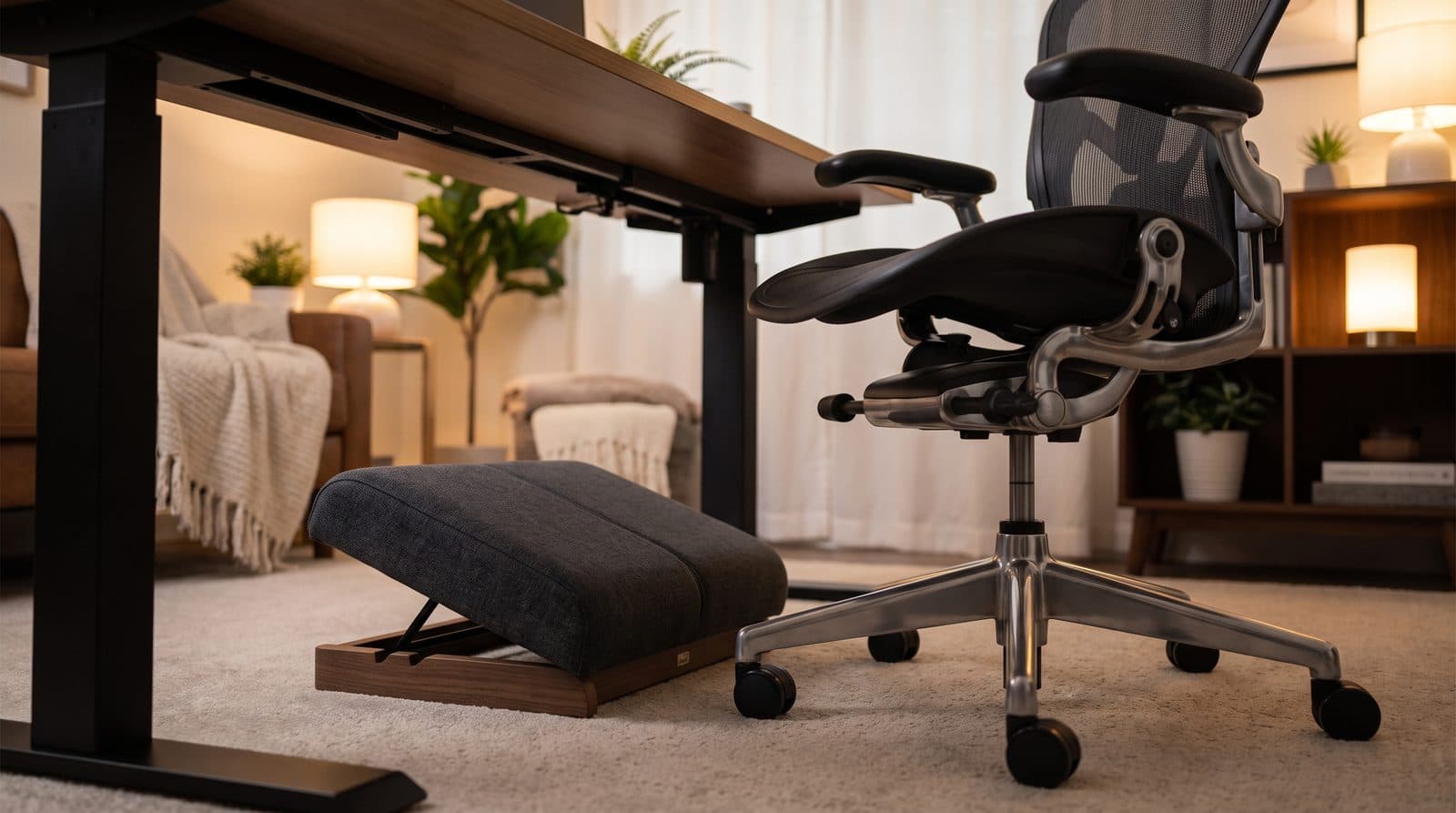
Footrests are the unglamorous corner of desk ergonomics, and one of the most immediately effective. If your chair is set correctly for your desk height, there's a good chance your feet no longer sit flat on the floor — pressure moves to the underside of your thighs, circulation suffers, and you start perching on the chair's front edge by mid-afternoon.
A footrest closes that gap. The good ones add two things: a platform height that fits your actual desk-and-chair geometry, and some freedom of movement, because static feet get restless over an eight-hour day.
The first of those is where this category quietly disappoints, so the specs below lead on it. "Adjustable" is on almost every box here and means something different on each one — three real positions on one, a single Velcro lifter on another, two settings inside three and three-quarter inches on a third, and nothing at all on two of them — including the most expensive product in the guide. Measure your gap first; then read the heights, not the awards. Here are the five worth considering.
Our top picks at a glance
- 1
- 2
- 3
- 4
- 5
How we chose
- Published platform height, and whether it adjusts at all — most don't
- Platform size large enough to move your feet around
- Movement — tilt or rocking that encourages circulation
- Surface grip for socks, shoes, and bare feet alike
- Durability of foam, hinges, and height mechanisms over daily use
Our picks come from spec research, long-term owner feedback, and category expertise — not sponsorships. Read the full methodology.
Compared side by side
| Product | Award | Type | Height range | Typical price |
|---|---|---|---|---|
| HUANUO Adjustable Footrest | Best Overall | Adjustable platform | 4.3 / 5.5 / 6.7 in | ~$35 |
| Humanscale FM500 Foot Machine | Best Premium | Rocking, plywood/aluminium | Fixed 4.5 in | $100–$150 |
| ErgoFoam Adjustable Footrest | Best Foam | Foam block | 4 / ~6 in | ~$45 |
| Fellowes Standard Footrest | Budget Pick | Fixed-step platform | 3.75 in, 2 positions | ~$25 |
| StrongTek Wooden Rocking Footrest | Best Active | Wooden rocker | ~3.9 in at rest | ~$40 |
1. Best Overall
HUANUO Adjustable Footrest
Typically around $35
- Measured gaps over 5 in
- Shoe-wearing offices
- Unknown or changing gaps
HUANUO's platform footrest is the practical engineer's option, and it is the only product here that covers the full range of gaps this guide tells you to measure: three locking height positions at 4.3, 5.5 and 6.7 inches (11, 14 and 17 cm), with a free tilt that follows your ankle angle. Those are steps rather than a continuous range — you pick the nearest one rather than dialling in an exact figure — but the top step reaches higher than anything else here at any price.
The textured surface works equally well with shoes — a real consideration in shared offices — and at 18 by 13 inches the platform is the largest in this guide, wide enough to shift positions through the day. It's plastic and looks it, but the mechanism is sturdy where it counts and the price makes it an easy experiment.
What we like
- Three real height positions — 4.3, 5.5 and 6.7 in
- Largest platform here at 18 × 13 in
- Free-tilting platform follows natural ankle angles
Worth knowing
- Plastic construction is functional rather than premium
- Tilt has no lock for those who want a fixed angle
- Type
- Hard platform, adjustable frame
- Height
- Three positions — 4.3, 5.5, 6.7 in (11/14/17 cm)
- Platform
- 18 × 13 in, textured
- Tilt
- Free-pivoting, −30° to +30°
2. Best Premium
Humanscale FM500 Foot Machine
Typically $100–$150
- Active sitting
- Buy-once buyers
- Gaps close to 4.5 in
The FM500 is the footrest designed by people who think about sitting for a living. Its elliptical base puts the point of rotation directly below your ankle rather than under the middle of the board, so it pivots with the joint instead of tipping the whole platform — the detail that separates it from the flat rockers it competes with. Molded plywood platform, die-cast aluminium legs, a steel foot stop and rubber pads on the rockers; it is light at about 2.6 lbs and backed by a lifetime warranty.
Buy it with one number in mind: it is 4.5 inches high and it does not adjust. That is squarely in the 3-to-5-inch band most people need, so for most readers the fixed height is a non-issue — but if you measured your gap and got six inches, this is the wrong product no matter how good it is, and no amount of money fixes that. Check your own measurement before the price tag persuades you.
What we like
- Ankle-aligned pivot — the rocking geometry is genuinely better here
- Lifetime warranty, and materials that justify it
- Rubber-tread rockers stay put on hard floors and mats
Worth knowing
- Fixed 4.5 in height with no adjustment at all
- Several times the price of the platforms that do adjust
- Type
- Rocking platform, molded plywood and die-cast aluminium
- Height
- 4.5 in, fixed (not adjustable)
- Platform
- 16.75 × 12.25 in
- Warranty
- Lifetime
3. Best Foam
ErgoFoam Adjustable Footrest
Typically around $45
- Soft support
- Sock-feet comfort
- Simple setups
ErgoFoam's pick is the best-executed version of the soft footrest: a firm high-density foam block wrapped in a velvety washable cover (a breathable mesh version is also sold), with a detachable lifter that Velcros on to add height. The base block is 4 inches; the lifter takes it to about 6. Flip it over and the curved side becomes a gentle rocker.
Foam footrests live or die by density — too soft and your feet sink to the floor by lunch. This one holds its shape under daily use, and the machine-washable cover addresses the honest reality of where feet spend the day. It's the comfort-first pick for sock-footed home offices.
What we like
- High-density foam that doesn't pancake over time
- Velcro lifter adds 2 in, plus a flip-over rocking mode
- Removable, machine-washable cover
Worth knowing
- No fine height adjustment — two fixed levels
- Soft surface is less ideal with hard-soled shoes
- Type
- High-density foam, velvet or mesh cover
- Height
- Two levels — 4 in base, ~6 in with the lifter attached
- Platform
- 17.3 × 11.5 in
- Care
- Removable washable cover
4. Budget Pick
Fellowes Standard Footrest
Typically around $25
- First footrest
- Office standard-issue reliability
- Simple needs
The Fellowes Standard (model 48121) is the footrest that's been under office desks for decades: a textured platform, moulded from 95% post-consumer recycled content, with a free-floating tilt and two height positions, built to survive being kicked around under a desk indefinitely.
Be clear about what 'adjustable' means here, because it is the least of any product in this guide: two height settings on a platform that stands 3.75 inches tall. If your measured gap is four inches or under, that is all you need and this is the cheapest way to get it. If your gap is five or six inches, the Fellowes cannot reach it and no setting will change that.
What we like
- Proven office staple at the lowest price here
- Free-floating platform lets you stretch your legs
- Effectively indestructible in normal use
Worth knowing
- Only two height positions, and 3.75 in of height to work with
- Cannot reach the 5–6.5 in gaps a fixed 29-inch desk creates
- Type
- Textured platform, free-floating tilt
- Height
- 3.75 in, two positions
- Platform
- 17.63 × 13.13 in
- Tilt
- Two tilt positions
5. Best Active
StrongTek Wooden Rocking Footrest
Typically around $40
- Restless sitters
- Standing desk pairing
- Natural materials
StrongTek's curved wooden rocker takes the opposite philosophy from padded footrests: instead of cushioning static feet, it keeps them gently in motion. The hard Lauan plywood platform rocks through a comfortable arc, which reads as fidgeting until you notice your legs no longer fall asleep. It is rated to 350 lbs, so it doubles as a balance board at a standing desk — where shifting weight across the rocker relieves standing fatigue too.
Check which one you are ordering. StrongTek sells a classic fixed rocker, roughly 18 by 11 inches and 3.9 inches high at rest, and a newer three-position adjustable version rated to 440 lbs. The listings look alike and the model names barely differ, so read the height and the capacity on the exact item rather than the brand.
What we like
- Rocking motion genuinely helps circulation and restlessness
- 350 lb rating means it works as a standing-desk balance board
- Solid wood construction looks good left in view
Worth knowing
- The classic version has no height adjustment
- Hard surface — sock comfort depends on the wood's finish being enough
- Type
- Curved plywood rocker
- Height
- ~3.9 in at rest, rising to ~6.5 in at the top of the rock
- Platform
- ~18 × 11 in, anti-slip grips
- Load
- 350 lbs (440 lbs on the adjustable version)
The verdict
The HUANUO adjustable is the right first buy for most people — genuine height adjustment across 4.3, 5.5 and 6.7 inches at a price that makes the experiment easy. If you work in socks and want plush support, the ErgoFoam is the comfort pick at 4 inches, or 6 with its lifter attached.
The Humanscale FM500 is the endgame choice for build, warranty and rocking geometry — its pivot sits under your ankle rather than under the middle of the board, which is a real engineering difference. Buy it only if your gap is close to 4.5 inches, because that is its height and it does not adjust. Fellowes covers the strict-budget case at 3.75 inches, and the StrongTek rocker is the one to pair with a standing desk or restless legs.
One thing to do before you order, and it's the reason we'd send you to how to adjust an office chair first: set your seat height from your elbows and the desktop, then measure the actual gap from the floor to your soles. That gap is the platform height you need, and it is the spec this category is worst at — of the five products here, one adjusts across a useful range, one adjusts by a single 2-inch step, one offers two settings inside 3.75 inches, and two do not adjust at all. Most people land at three to five inches, which is well covered. But on a fixed 29-inch desk a shorter sitter can face closer to six and a half, and at that point only the HUANUO at its top setting reaches — the premium pick in this guide falls two inches short of it. The StrongTek's arc peaks near 6.5 inches, but that is the top of a rock rather than a height you can rest at, so read it as motion, not as reach. If your number comes out that large, a standing desk that drops low solves it at the source rather than working around it.
Frequently asked questions
Run a simple check: sit with your chair adjusted so your forearms are level with the desk while typing. If your heels lift off the floor or you feel pressure under your thighs at the front of the seat, your feet need support. This is especially common for shorter users at fixed-height desks, which are typically built around taller averages.
High enough that your knees sit at roughly a right angle with feet flat and thighs parallel to the floor — for most people that's somewhere between 3 and 7 inches, which is why adjustable models are the safe first buy. If you already know your gap (measure from heel to floor in your correct sitting position), a fixed-height model that matches works fine. Worth knowing before you shop: this category adjusts far less than its marketing suggests. Across the five picks here the published heights are 4.3/5.5/6.7 in (HUANUO), 4 in or about 6 with a lifter (ErgoFoam), 3.75 in across two settings (Fellowes), a fixed 4.5 in (Humanscale FM500) and a fixed ~3.9 in at rest (StrongTek, which peaks near 6.5 in mid-rock but cannot hold you there). Only one of them reaches the top of the range and stays put, so measure first and shop to the number rather than to the award.
They solve different problems. Flat and foam platforms maximize static comfort; rocking designs trade some of that for movement, which helps circulation and restlessness over long sessions. If your issue is numbness or fidgeting, movement helps. If your issue is simple height and pressure, a stable platform is the more direct fix.
Yes, in two ways. While seated, it works like it would at any desk. While standing, a rocker or angled board gives you somewhere to shift weight and stretch calves — many standing-desk users prop one foot up alternately, which noticeably extends comfortable standing time. The StrongTek-style wooden rockers suit this dual role best.
Keep building your setup
Desks
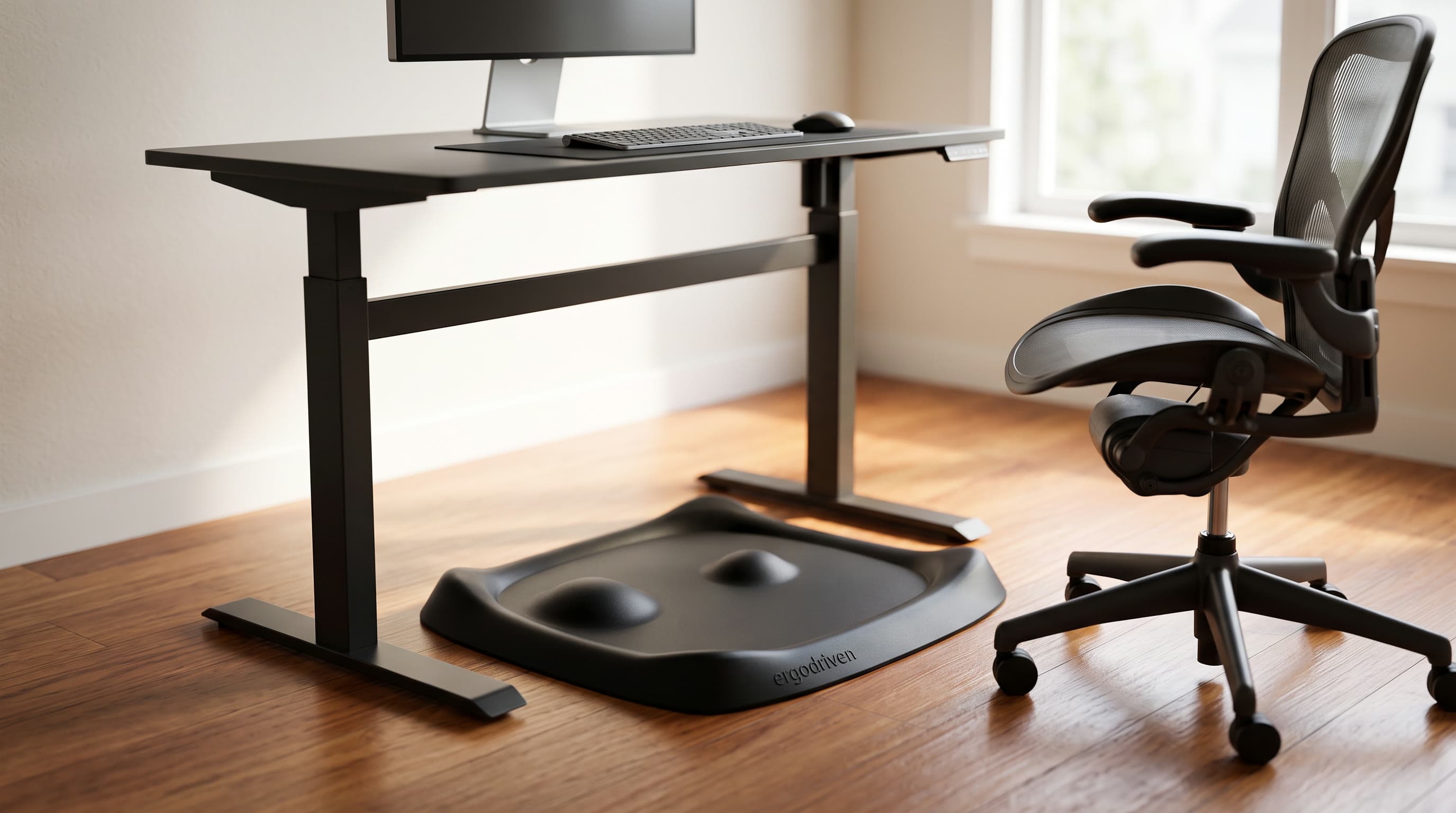
The Best Anti-Fatigue Mats for Standing Desks in 2026
A standing desk without a mat just moves the ache from your back to your feet. Six anti-fatigue mats — active terrain, thick memory foam, and made-in-USA polyurethane — sorted by how you actually stand.
Updated July 30, 2026
Ergonomics
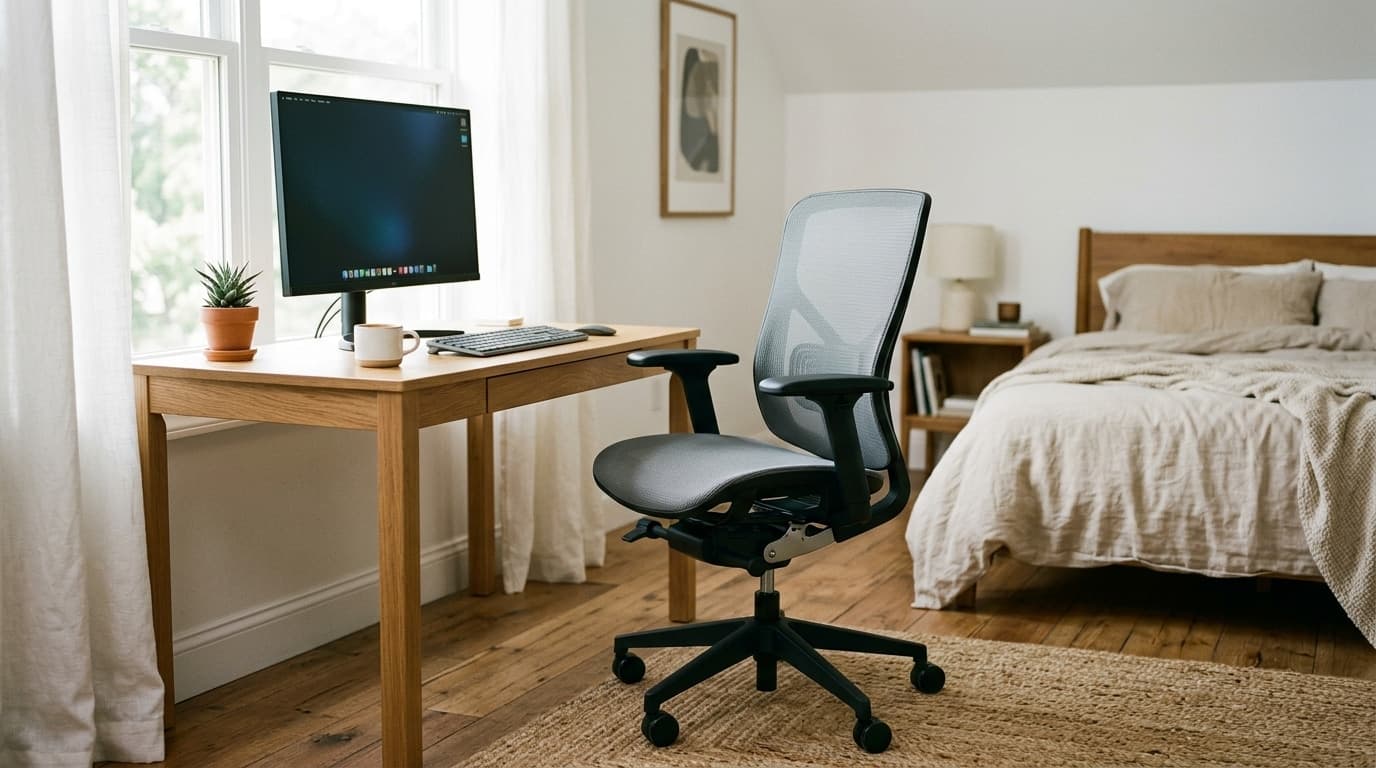
How to Adjust an Office Chair: The Order That Actually Works
A standard 29-inch desk is built to the elbow height of the tallest man in twenty. Cornell's ergonomics notes say a seat should adjust nine inches; the chairs we recommend adjust three to five. Here is the order to set a chair in, and the arithmetic that decides whether yours can even reach.
Updated September 15, 2026
Ergonomics
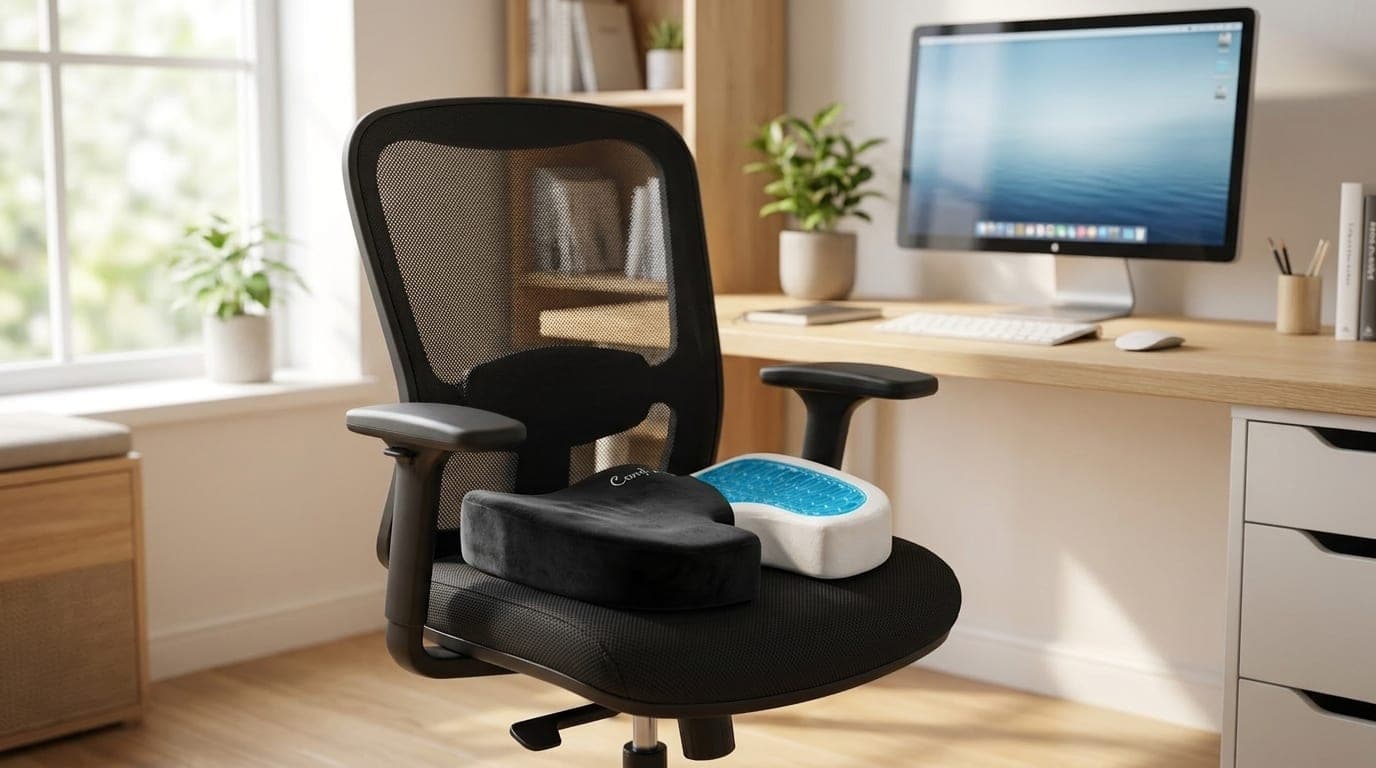
The Best Seat Cushions for Office Chairs in 2026
The cheapest fix for a hard seat that leaves your tailbone aching by 3pm. Six seat cushions compared by cutout shape, height, firmness, and how hot they run.
Updated July 29, 2026
Get the next guide in your inbox
One short email when we publish or meaningfully update a buying guide. No spam, no daily deals firehose.