 Rigworthy
The Best Cable Management Boxes & Raceways in 2026
By Rigworthy Editorial Team · Updated August 3, 2026
Rigworthy is reader-supported: we may earn a commission if you buy through our links, at no cost to you. How we make money
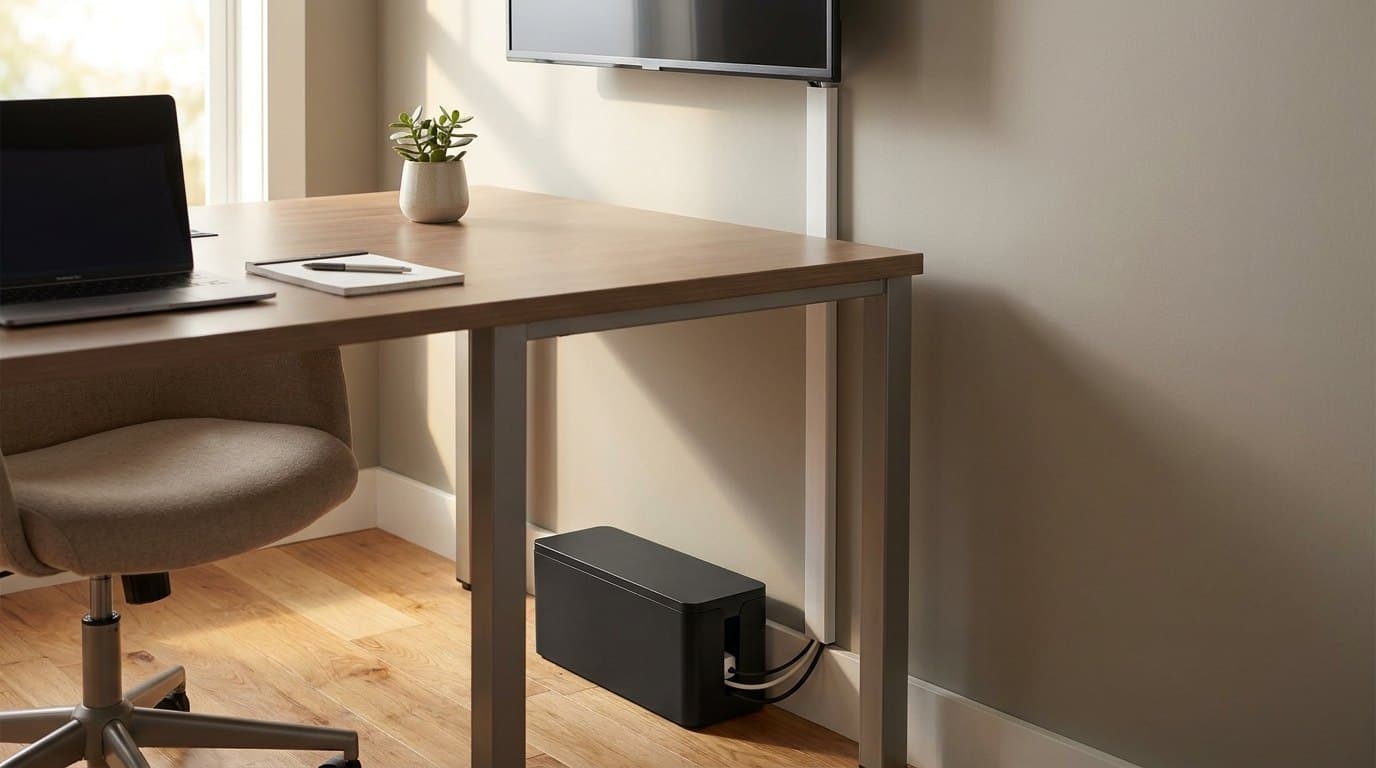
An under-desk cable tray fixes the power strip bolted beneath your desktop — but it does nothing for the cords that have to leave the desk. The strip that lives on the floor because you rent and won't drill. The cable climbing a wall to a mounted monitor. The loose fistful dropping behind the desk to the outlet, and the lead that has to cross open floor to reach it. Those are four different problems, and no single product solves all of them.
This guide sorts the tools that do, matched to the mess each one is for: boxes that swallow a floor-sitting power strip, an on-wall raceway that carries cords up a wall and paints to match, a sleeve that bundles the visible drop into one clean line, and a floor cover that makes a cross-room cable safe to walk over. We've been honest about where each stops — a box won't move a cable, a sleeve won't truly hide one, and adhesive raceways don't come off cleanly — so you buy only the pieces your setup actually needs. Prices and dimensions reflect what manufacturers list as of mid-2026; where a figure varies by size or kit, we've said so rather than inventing one.
Our top picks at a glance
- 1
- 2
- 3
- 4
- 5
- 6
How we chose
- Capacity — a box must swallow a full surge protector plus its bricks, not just a slim strip
- Concealment method matched to the problem — floor strip, wall run, cord drop, or across-floor cable
- Mounting without regret — no-drill adhesive and drop-in options that suit rentals and glass
- Safety — flame-retardant boxes, low-profile floor covers that won't trip you or snag a chair
- Finish that disappears — paintable raceways and neutral boxes that read as part of the room
Our picks come from spec research, long-term owner feedback, and category expertise — not sponsorships. Read the full methodology.
Compared side by side
| Product | Award | Type | Conceals | Typical price |
|---|---|---|---|---|
| D-Line Cable Tidy Box (Large) | Best Overall | Box | Floor power strip | ~$25 |
| Baskiss Cable Management Box (Wood Lid) | Best for Looks | Box | Desktop power strip | $25–30 |
| Bluelounge CableBox | Premium Pick | Box | Visible power strip | $30–35 |
| D-Line Cable Raceway Kit (Paintable) | Best Wall Raceway | Raceway | Wall cord runs | $25–30 |
| JOTO Cable Management Sleeve | Best Cord Sleeve | Sleeve | The cable drop | ~$9 |
| Yecaye Floor Cord Cover | Best for Floor Runs | Floor cover | Cross-floor cables | $12–15 |
1. Best Overall
D-Line Cable Tidy Box (Large)
Typically around $25
- Hiding a floor power strip
- Under-desk and behind-console use
- Homes with kids or pets
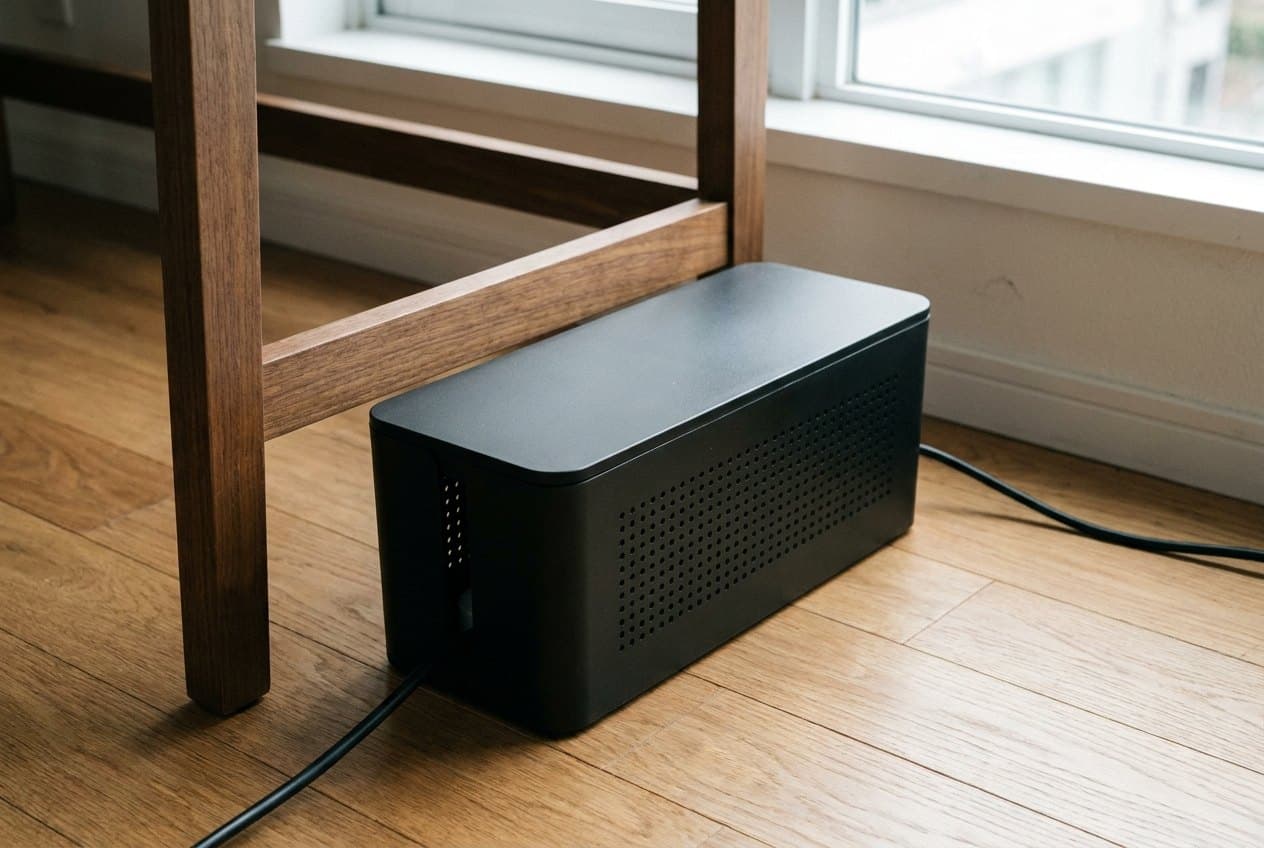
If your power strip has to live on the floor — no under-desk tray, no drilling — the D-Line Tidy Box is the one to reach for first. It's a ventilated, flame-retardant plastic box roughly 12.75 × 5 × 4.5 inches that takes a full-size surge protector up to about 10.5 inches long: drop the strip in with everything still plugged, feed the incoming lead through one end and your device cables out the other, and the whole knot vanishes under a clean lid. Slots at each end and a vented body keep heat from building, and the closed shell keeps curious kids and chewing pets away from live outlets.
It's function over fashion. The finish is honest matte plastic rather than a design statement, so on an exposed shelf it reads as 'cable box' more than the wood-lidded Baskiss or the sculpted Bluelounge below. And like every box here, it hides a strip — it won't route a cord up a wall (that's the raceway's job) or across a floor (the cover's). But for the single most common problem in this category — a messy power strip you want gone — it's the most capacity and safety per dollar, and the one we'd hand to most people.
What we like
- Deep enough for a full surge protector with bricks attached
- Ventilated, flame-retardant shell that's safe around kids and pets
- Drop-in use — no need to unplug anything first
Worth knowing
- Plain plastic look if it sits somewhere visible
- Hides a strip only — not for wall or floor cord runs
- Type
- Cable box
- Dimensions
- ~12.75 × 5 × 4.5 in
- Fits
- Power strips up to ~10.5 in
- Material
- Flame-retardant ABS
- Mounting
- Free-standing (rubber feet)
2. Best for Looks
Baskiss Cable Management Box (Wood Lid)
Typically $25–30
- Desks where the box is visible
- A box that doubles as a small shelf
- Warm and wood-toned setups

The Baskiss solves the one thing plain plastic boxes can't: what to do when the box has to sit somewhere you'll see it. It pairs a high-density ABS body (12 × 5 × 4.5 inches, fitting strips up to about 11.4 inches) with a solid wood lid that softens the whole thing into something that reads as a desk object rather than hardware. Double end outlets pass the main cables through, three smaller ports handle USB and phone leads, and the flat wooden top is stable enough to park a phone, a smart speaker, or a charging watch on — so the box earns a little surface back instead of just taking floor space.
The wood is a laminate-topped lid, not a solid-oak heirloom, so treat it as a good-looking cover rather than furniture, and keep it out of direct spills. Capacity is essentially the same as the D-Line, so you're paying a small premium purely for the look — worth it on an open shelf or a desktop, skippable if the box is going to live hidden under the desk anyway. Where appearance matters, it's the tidiest middle ground between function and style in the group.
What we like
- Wood lid blends into a desk far better than plain plastic
- Flat top doubles as a small shelf for a phone or speaker
- Extra USB-size ports for charging cables
Worth knowing
- Slight premium over the D-Line for the same capacity
- Laminate wood lid wants care around spills
- Type
- Cable box
- Dimensions
- 12 × 5 × 4.5 in
- Fits
- Power strips up to ~11.4 in
- Material
- ABS body, wood lid
- Mounting
- Free-standing
3. Premium Pick
Bluelounge CableBox
Typically $30–35
- Design-led setups
- Color-matching a room
- Drop-in simplicity
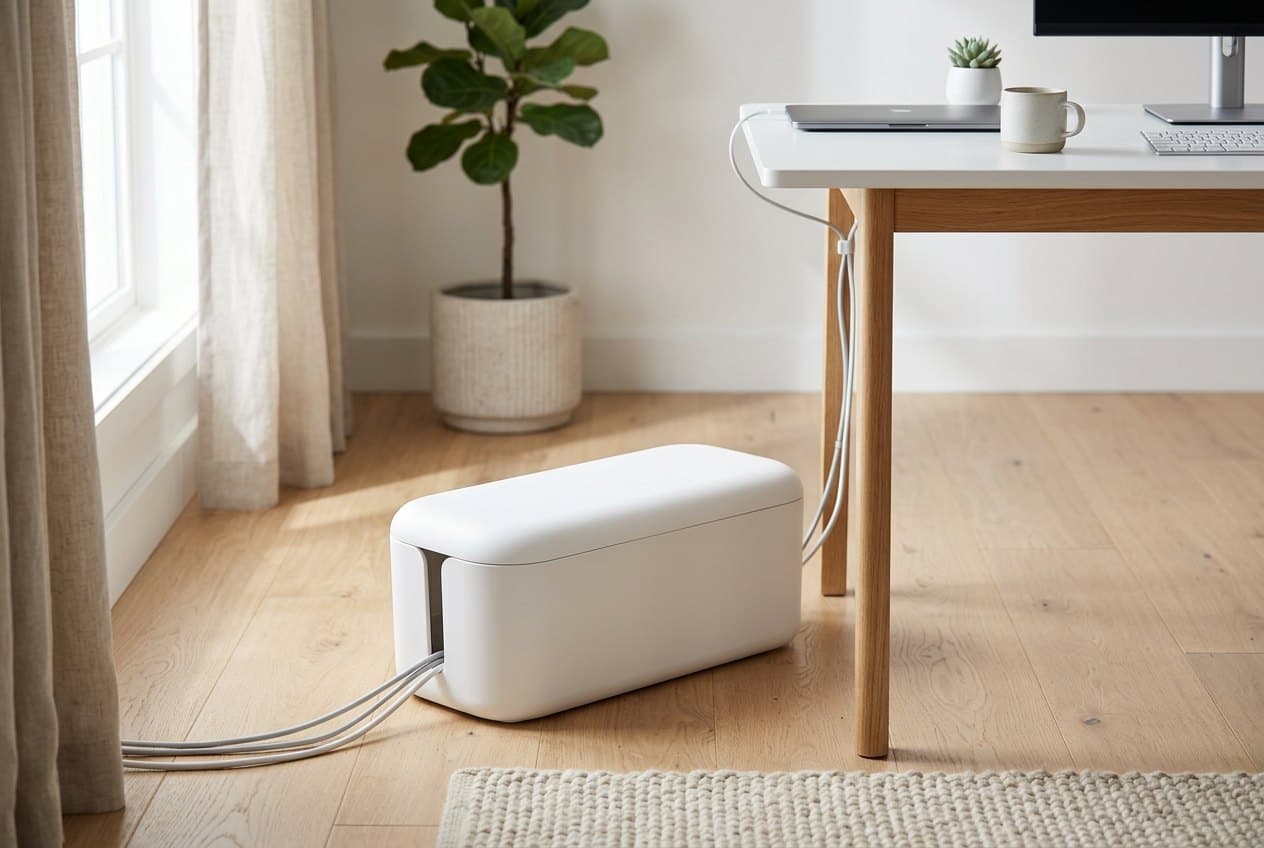
The CableBox is the design-house take on the concept, and it's the one to buy if the box will be seen and you care that it looks considered. The lid is a soft curved shell in a choice of colors — black, white, and muted tones like moonlight blue and light sage — over a 6 × 15.6-inch footprint, with wide slots front and back so you drop a fully-plugged strip in and close it in one motion. Like the others it's high-density, flame-retardant plastic with grippy rubber feet, so nothing slides. There's also a smaller Mini version (about 4.6 × 9.3 inches) for a single wall-wart cluster or a slim strip.
You're paying for form here, not extra function — capacity and safety are broadly in line with the cheaper boxes, and the price is the highest of the three. If the box lives hidden under a desk, the D-Line saves you money for the same result. But on show in a living room or a design-forward office, the CableBox is the one that looks like it was chosen rather than tolerated, and the color options let it disappear against a wall or lean into the decor.
What we like
- Sculpted lid and color choices that suit a visible spot
- Effortless drop-in, close-and-done design
- Mini size available for smaller cable clusters
Worth knowing
- Priciest box for capacity that matches cheaper ones
- Curved lid can't hold items flat like the Baskiss top
- Type
- Cable box
- Dimensions
- ~6 × 15.6 in (Mini ~4.6 × 9.3 in)
- Fits
- Full power strip, plugged in
- Material
- Flame-retardant plastic
- Finishes
- Black, white, blue, sage
4. Best Wall Raceway
D-Line Cable Raceway Kit (Paintable)
Typically $25–30
- Cords running up a wall
- Wall-mounted monitors and TVs
- A paint-to-match finish

When the cord problem isn't a floor strip but a cable that has to travel — up a wall to a mounted monitor, along a skirting board, or from a desk to a distant outlet — a box can't help; you need a raceway. D-Line's self-adhesive channel is the category standard: a low-profile half-round cover (the common kit runs about 1.18 inches wide by 0.59 inches high) that sticks to the wall, snaps open to lay cables inside, and closes flush. The multi-length kits ship with the fiddly bits that make a run look finished — internal and external bends, flat tees, connectors, and end caps — so a cord can turn a corner cleanly instead of stopping dead.
The headline feature is that it's paintable: key the surface with fine sandpaper, apply two coats, and the channel takes wall color and effectively disappears. That's the difference between 'hidden cables' and 'a white stripe on the wall.' The trade-offs are honest — the adhesive is committed once it's down and can lift paint on removal, and the half-round profile suits a few cables rather than a thick bundle. For a wall-mounted screen or a cord that has to climb, though, nothing here does the job as cleanly.
What we like
- Paintable — takes wall color and genuinely disappears
- Kits include bends and connectors for clean corners
- Snap-open channel makes adding a cable later easy
Worth knowing
- Adhesive is permanent-ish and can mark paint on removal
- Half-round profile suits a few cables, not a fat bundle
- Type
- On-wall raceway
- Profile
- ~1.18 in W × 0.59 in H, half-round
- Kit length
- ~13 ft with accessories
- Finish
- Paintable, self-adhesive
- Best for
- Wall / TV cord runs
5. Best Cord Sleeve
JOTO Cable Management Sleeve
Typically around $9
- Bundling the visible cable drop
- Behind-desk and TV cord groups
- The cheapest quick win
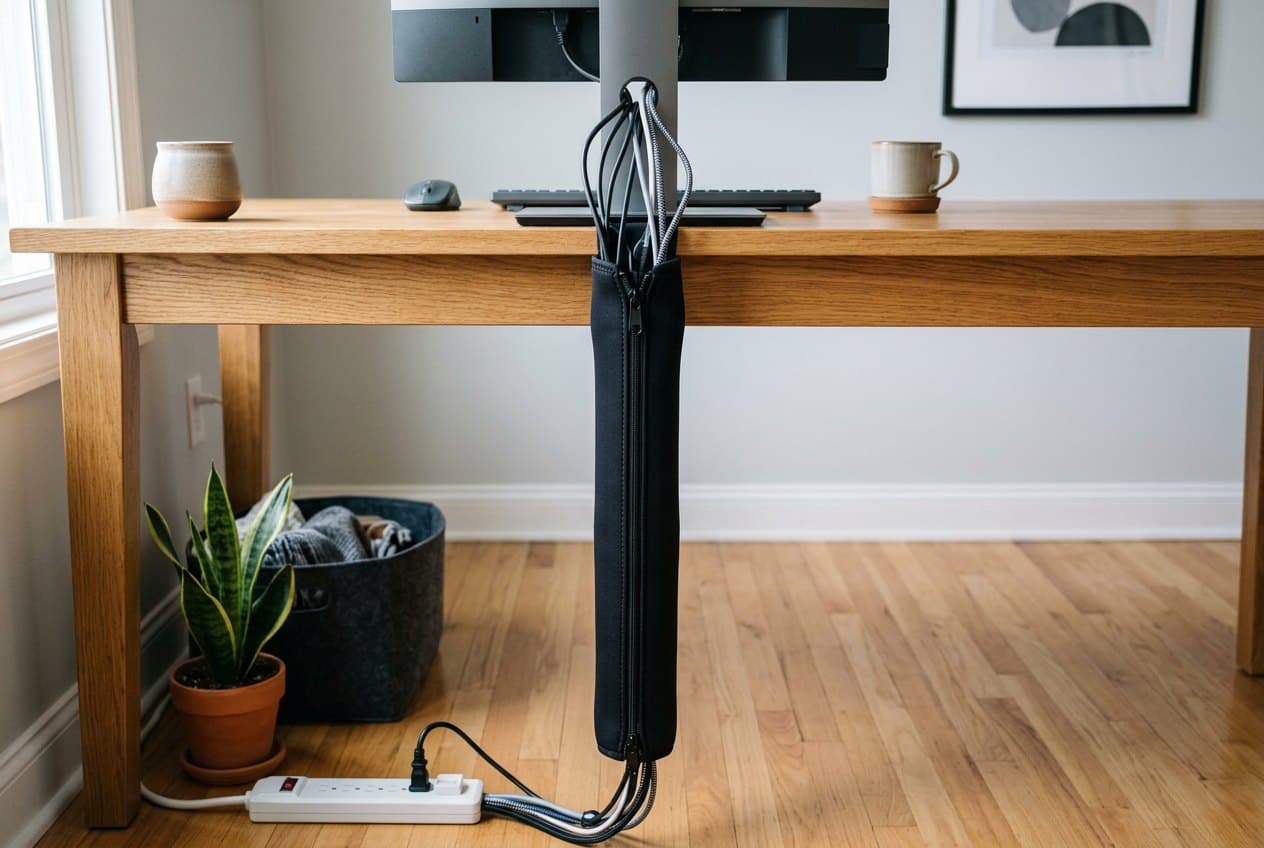
Some of the worst-looking cabling isn't a strip or a wall run — it's the loose fistful of cords dropping from the back of the desk to the floor. The JOTO sleeve is the $9 fix: a stretchy neoprene wrap that gathers up to eight or ten cables into a single clean tube, closing with a lengthwise zipper (or a hook-and-loop version) so you can add or remove a cable anytime. The wrapped bundle is about 1.2–1.5 inches across, and the cuttable rolls let you size a run exactly; you can even snip a small gap to peel one cable off partway along.
It organizes rather than hides — a neat black tube is far tidier than a tangle, but it's still a visible tube, so pair it with a box or a raceway if you want cables truly gone. It also doesn't add protection underfoot; anything crossing a floor still wants a proper cord cover. For turning the messy drop behind a desk into one deliberate line, though, it's the highest tidiness-per-dollar item in the whole category, and the first thing to add to any cable cleanup.
What we like
- Bundles 8–10 cables into one clean line for about $9
- Zip or hook-and-loop closure — add a cable anytime
- Cuttable to length; snip a gap to branch a cable off
Worth knowing
- Tidies rather than truly hides — the tube is still visible
- No underfoot protection for floor crossings
- Type
- Cord sleeve
- Capacity
- ~8–10 cables
- Wrapped diameter
- ~1.2–1.5 in
- Material
- Neoprene, zipper / hook-and-loop
- Length
- Cuttable rolls (to ~10.8 ft)
6. Best for Floor Runs
Yecaye Floor Cord Cover
Typically $12–15
- Cables crossing a walkway
- Rolling-chair and foot traffic areas
- Trip-hazard safety
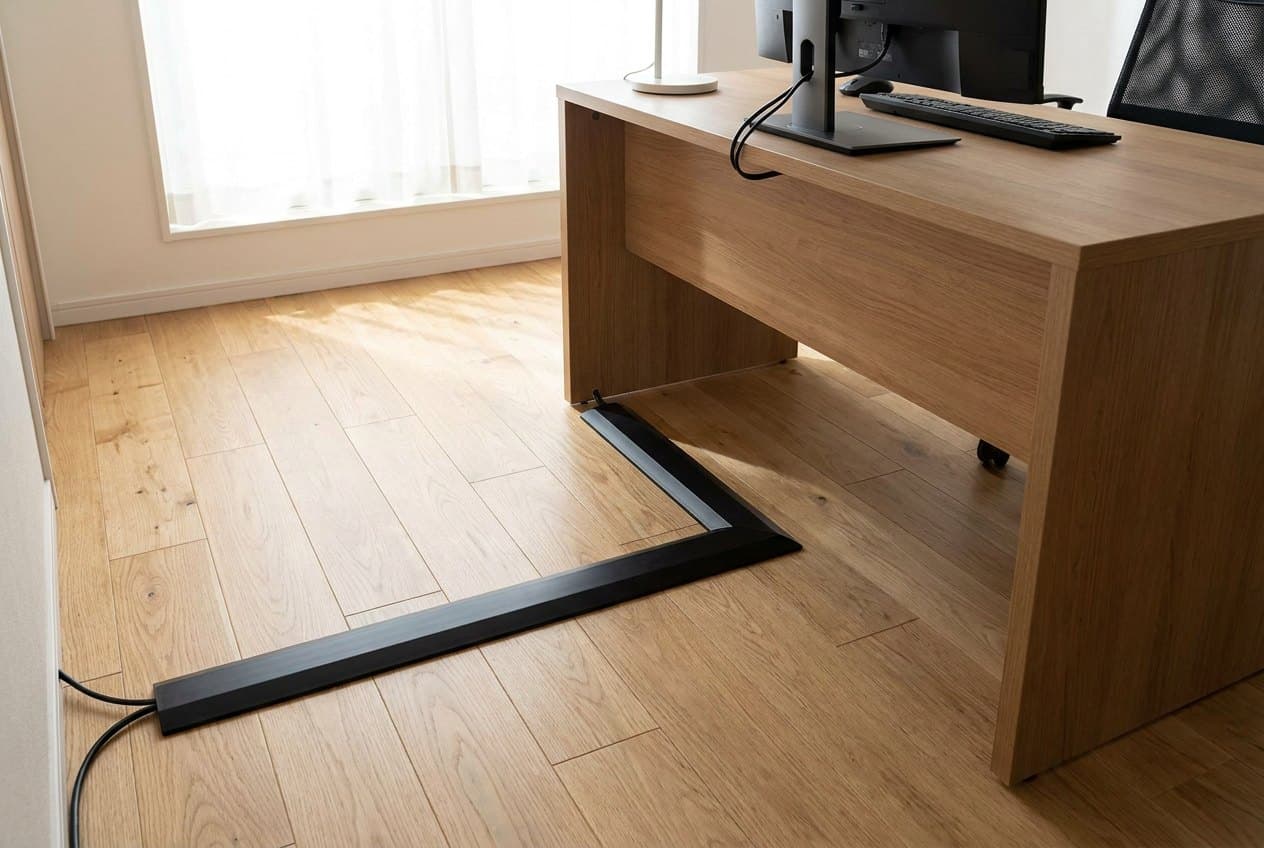
The last cable problem is the one that's actually dangerous: a cord that has to cross open floor to reach a far outlet or a second desk. A sleeve won't protect it and a box won't move it, so this is a job for a floor cord cover — a low-profile PVC channel that lies flat over the cable, with gently sloped edges a chair can roll over and a foot can't catch. Yecaye's cover is durable industrial-grade PVC that shrugs off being stepped on, and the enclosed cavity (roughly 0.55 inches wide by 0.27 high) keeps a power lead or two protected and out of sight underfoot.
It's cuttable with a knife or scissors, so you trim it to the exact run and cap the walkway rather than laying a cord anyone can snag. Black is the default and reads as trim against most floors; it's a functional safety piece more than a decorative one, so a bright rug is still a rug with a channel on it. But for the specific and genuinely hazardous case of a cable across a path — especially in a shared room or with kids around — it's the safe, tidy way to handle it, and it's the piece that makes a cable run compliant with basic common sense.
What we like
- Low, sloped profile a chair rolls over and a foot won't catch
- Tough PVC that survives being stepped on
- Cuttable to the exact length of the run
Worth knowing
- A functional safety piece, not a decorative one
- Narrow cavity suits one or two cables, not a bundle
- Type
- Floor cord cover
- Cavity
- ~0.55 in W × 0.27 in H
- Material
- Industrial-grade PVC
- Install
- Lay-flat, cuttable to length
- Best for
- Cross-floor cable runs
The verdict
For the most common problem — a messy power strip you want gone — the D-Line Cable Tidy Box is the buy: the most capacity and safety per dollar, drop-in easy, and safe around kids and pets. If the box will be seen, spend a little more on the wood-lidded Baskiss or the design-led Bluelounge CableBox so it reads as part of the room.
Then match the rest to your specific mess. Cords climbing a wall to a mounted screen? The paintable D-Line Raceway kit disappears into wall color. The tangle dropping behind the desk? A $9 JOTO sleeve is the best few minutes you'll spend. A cable crossing the floor? The low-profile Yecaye floor cover makes it safe to walk over. Most desks are sorted with a sleeve and a box for under $40 — and if you can mount to the desk itself, pair any of this with an under-desk tray for the cleanest result of all.
Frequently asked questions
They solve different versions of the same problem. An under-desk cable tray mounts to the underside of your desktop and holds the power strip up out of sight — the cleanest look, but it needs a desk you can screw or stick a tray to, and everything travels with a standing desk. A cable box sits on the floor or a shelf and hides a strip that has to stay at ground level — the right call for rentals where you'd rather not mount anything, for a strip behind a TV console, or when the desk underside is already full. Many setups use both: a tray under the desk and a box for the floor strip that powers the rest of the room. If you can mount a tray, start there; if you can't, the box is the no-commitment answer.
That's a raceway job, not a box. A box hides a strip in one place; a paintable on-wall raceway like the D-Line kit sticks to the wall and carries the cords vertically inside a low channel, then takes wall paint so it disappears. Run the channel from behind the screen down to the desk or an outlet, use the included bends to turn corners cleanly, and paint it to match before you commit. For the cleanest result, combine it with a cord sleeve for the section that drops behind the desk and a box for the strip at the bottom — each piece handles the stretch it's best at.
A reputable box is designed for exactly this and is made of flame-retardant plastic with ventilation slots, so a normal desk power strip and its adapters run fine inside one. The real safety wins are keeping kids and pets away from live outlets and stopping dust building up on exposed plugs. The sensible limits: don't coil a heavy, heat-producing load (a big laptop charger under sustained full load, say) tightly inside a sealed box with no airflow, and don't overload the strip itself. For typical monitor, dock, and charger duty, a ventilated box from a known brand is a safe, tidy home for the tangle.
Adhesive raceways hold well on clean, smooth, painted walls, but the bond is meant to be permanent-ish — removing it later can lift paint, so treat wall raceways as a considered install rather than something you'll reposition often. Floor cord covers are lower-risk: most, including the Yecaye, simply lay flat over the cable and rely on their own weight and profile, so they lift away cleanly. If you rent and want zero marks, favor a free-standing box and a lay-flat floor cover over anything adhesive, and test a small section of raceway tape in an inconspicuous spot first.
Start with a $9 sleeve. Gathering the loose cords dropping behind your desk into one JOTO sleeve is the single biggest visual improvement per dollar — it turns a tangle into one deliberate line in a few minutes with no tools. From there, add a box to hide the power strip those cables lead to, and only reach for a raceway or floor cover if you actually have a wall run or a floor crossing to deal with. You don't need every piece; you need the one that matches your specific mess. Most desks are fixed with a sleeve plus a box for well under $40.
Boxes and floor covers are for cables that stay put, so they pair better with the parts of your setup that don't move — the strip and cords running to the wall and the rest of the room. For everything that has to travel with the desktop as it rises, an under-desk cable tray that mounts to the desk itself is the right tool, with a single power lead dropping to the floor with enough slack for full height. A common clean setup: a tray under the moving desktop, one sleeved cord dropping to a floor box, and the box feeding the wall. Test the full height before you fix anything down.
Keep building your setup
Cables
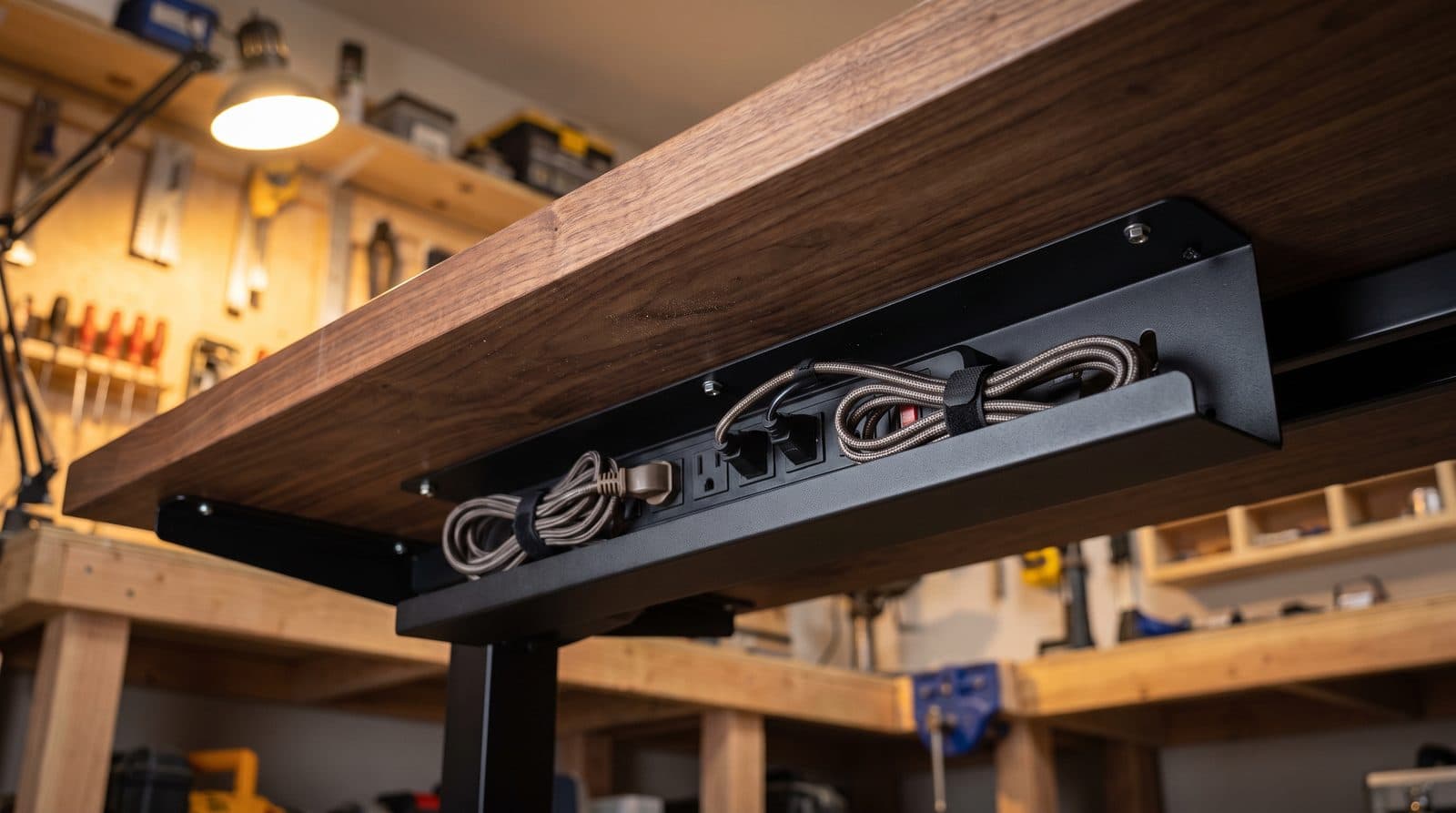
The Best Under-Desk Cable Trays in 2026
The fastest way to a clean 'floating desk' look: five cable trays and channels compared by capacity, mounting method, and standing-desk fit.
Updated September 11, 2026

Cables
The Best Power Strips & Surge Protectors for a Desk Setup in 2026
The strip your cable tray hides and your box conceals — chosen properly. Six desk power strips and surge protectors compared on real surge ratings, USB-C wattage, outlets, and mounting.
Updated August 3, 2026
Cables
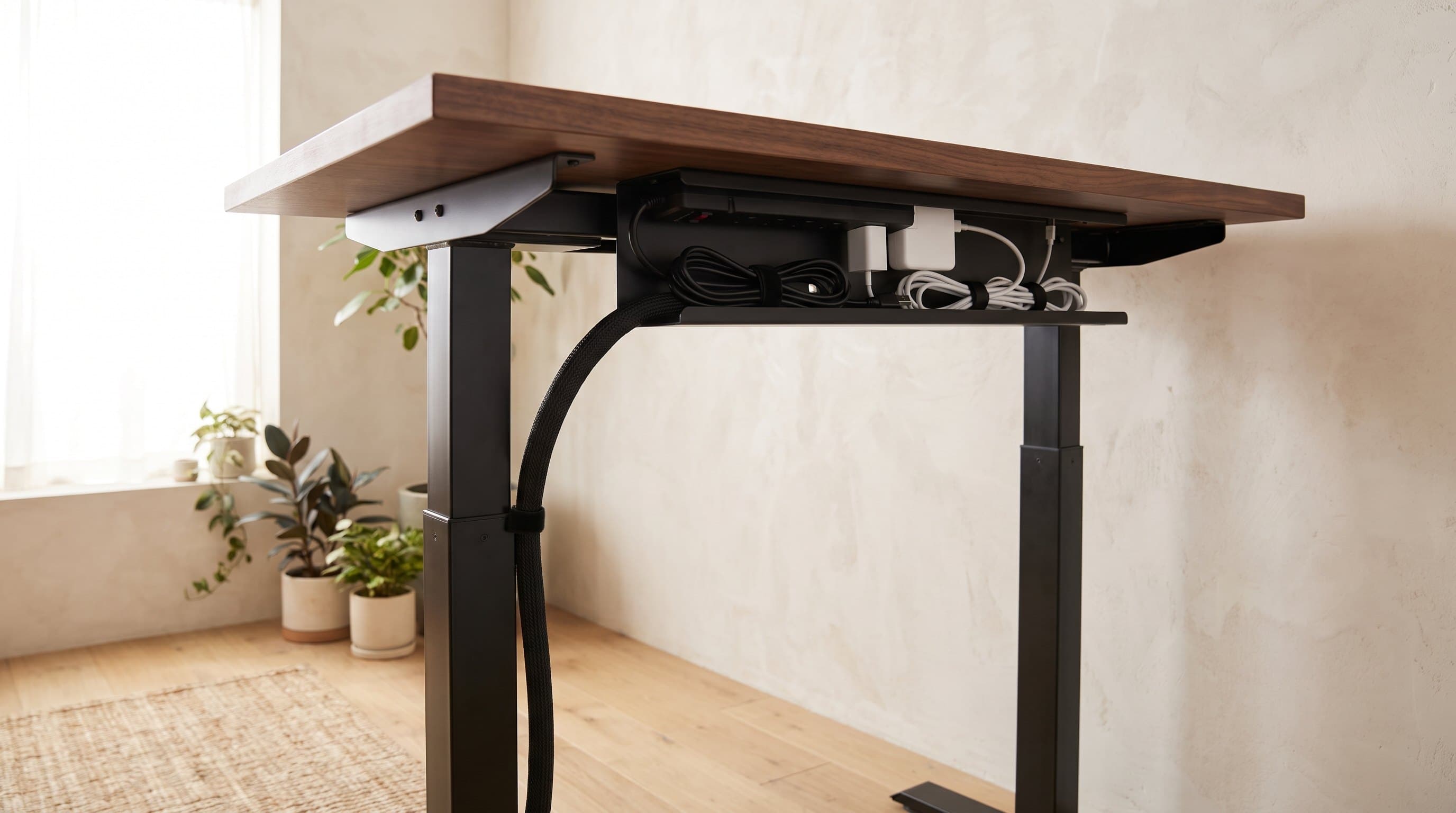
How to Hide Desk Cables: The Order to Do It In
Most cable management guides hand you a shopping list. The list is the last step, not the first — what decides your setup is which cables travel with the desk, what plugs into what, and how much slack the frame's travel demands. Here is the whole job in order, including the one arrangement to avoid.
Updated September 14, 2026
Get the next guide in your inbox
One short email when we publish or meaningfully update a buying guide. No spam, no daily deals firehose.