 Rigworthy
The Best Headphone DACs and Amps for Your Desk in 2026
By Rigworthy Editorial Team · Updated July 28, 2026
Rigworthy is reader-supported: we may earn a commission if you buy through our links, at no cost to you. How we make money
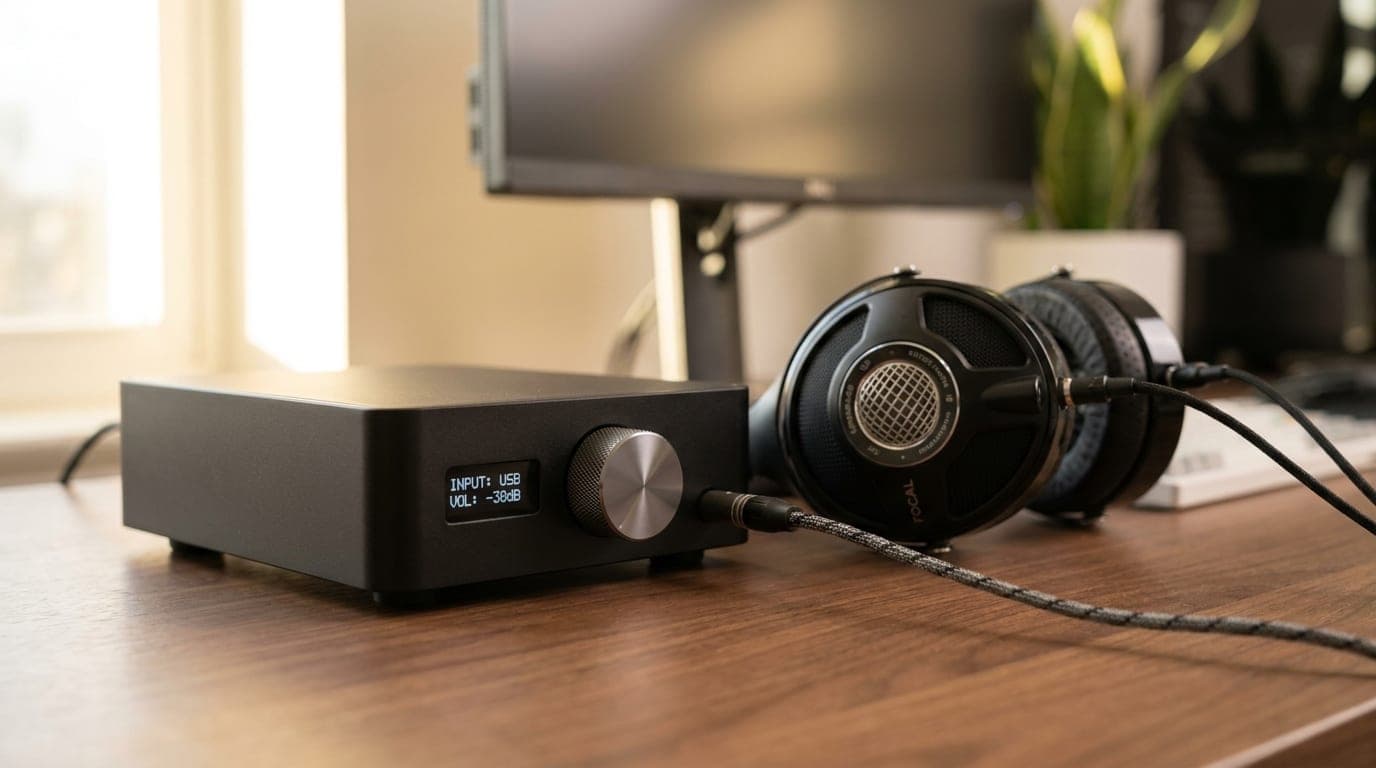
Your headphones are almost certainly better than whatever is driving them. A modern gaming headset or a pair of open-back studio cans can resolve far more detail than the audio circuitry crammed onto a motherboard or squeezed into a laptop's chassis — and the gap shows up as background hiss, thin dynamics, and a volume slider that runs out of road before the music gets loud enough. A dedicated desktop DAC/amp is the fix: a clean digital-to-analog conversion followed by an amplifier stage with the power to actually control your headphones.
The category has quietly become one of the best-value upgrades in the whole desk-setup world. What cost $400 in clean, powerful amplification a few years ago now sits around $130, and the field is deep enough that the right pick depends less on budget than on what you own and how you use it. This guide sorts five desktop DAC/amps from $129 to $499 by exactly that — power into real headphone loads, the connectivity a desk actually needs, and honest fit for the buyer, from a first upgrade to a gaming command center to an endgame hub that also runs your speakers.
Our top picks at a glance
- 1
- 2
- 3
- 4
- 5
How we chose
- Power into real loads — clean output at both 32Ω and 300Ω, because a DAC/amp is only useful if it drives your headphones
- Connectivity that fits a desk — USB for the PC plus optical/coaxial for a console or second source, and useful outputs for speakers
- Measured performance where it exists — low distortion, high SNR, and low output impedance for neutral, hiss-free sound
- Clear value inside the $99–$500 band — each pick has to earn its price with features, power, or a genuine step up
- Fit for the buyer — a real use case behind every award, from budget starter to gaming to endgame hub
Our picks come from spec research, long-term owner feedback, and category expertise — not sponsorships. Read the full methodology.
Compared side by side
| Product | Award | DAC chip | Power @ 32Ω | Balanced out | Typical price |
|---|---|---|---|---|---|
| FiiO K11 | Best Budget | Cirrus CS43198 | ~1,400 mW (bal) | 4.4mm | ~$129 |
| FiiO K7 | Best Overall | 2× AKM AK4493S | ~2,000 mW (bal) | 4.4mm | ~$199 |
| Creative Sound Blaster GC7 | Best for Gaming | AKM AK4377 | Not published | No | ~$150 |
| Topping E30 II + L30 II Stack | Best Modular Stack | 2× AKM AK4493S | ~2,700 mW (SE) | No | ~$300 |
| FiiO K9 | Premium Pick | 2× ESS ES9068AS | ~2,000 mW (bal) | XLR-4 + 4.4mm | ~$499 |
1. Best Budget
FiiO K11
Typically around $129
- First desk DAC/amp on a tight budget
- Owners of 4.4mm balanced headphones
- Planar and mid-impedance cans that need real power
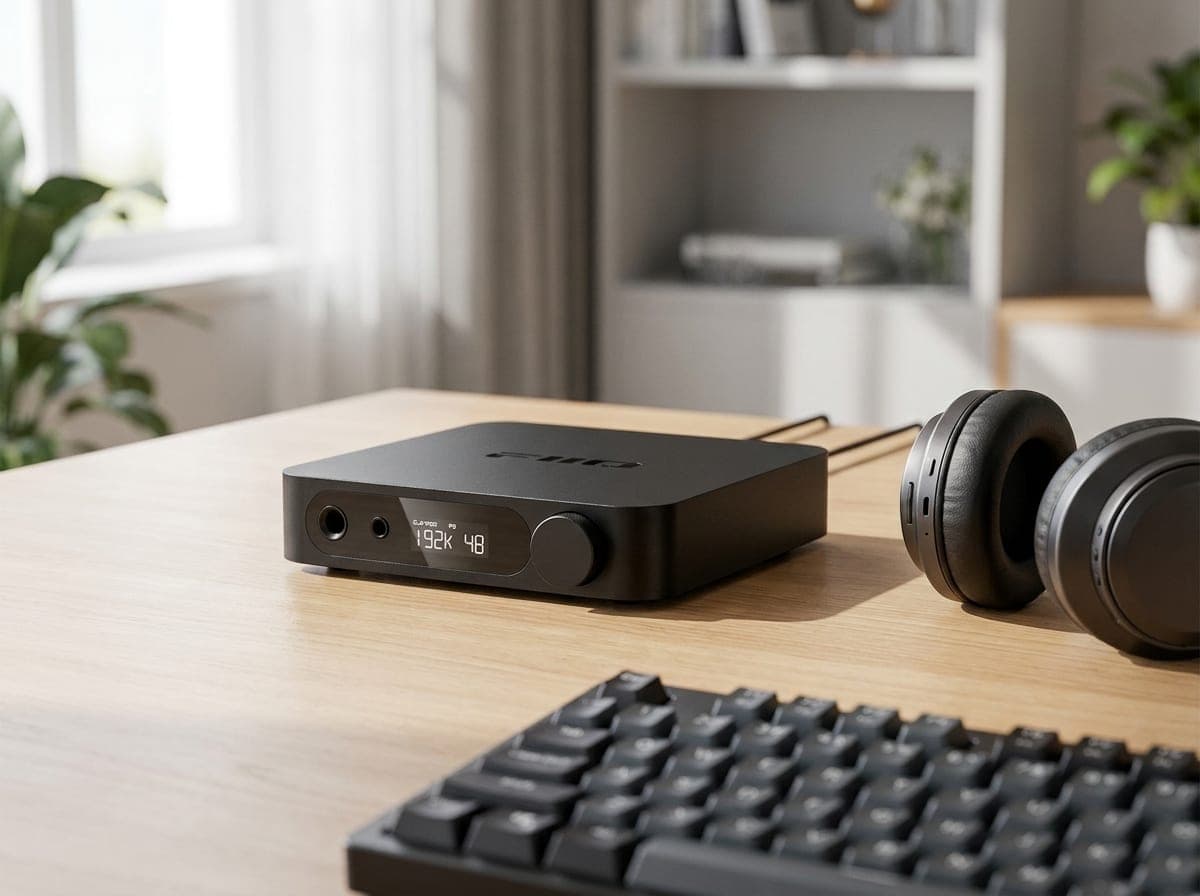
The K11 is the value benchmark of the current desktop market, and it earns that title on one number: up to 1,400 mW per channel into 32Ω from its 4.4mm balanced output. That is more usable power than DAC/amps costing twice as much offered a couple of years ago, and it is enough to drive most planar-magnetic and mid-impedance headphones to clean, dynamic volume with headroom to spare. For a first serious desk upgrade — replacing hissy motherboard audio or a laptop jack that never gets loud enough — nothing at this price does it more decisively.
Beyond the power, the K11 is a genuinely complete little box. A Cirrus Logic CS43198 DAC handles PCM up to 32-bit/384kHz and native DSD256; inputs cover USB-C, optical, and coaxial; and outputs include the 4.4mm balanced port, a 6.35mm single-ended jack, and an RCA line-out to feed powered speakers. A crisp front display shows sample rate, gain, and volume so you always know what the unit is doing. The honest caveats: there is no Bluetooth, and the single-ended output (around 520 mW into 32Ω) is far weaker than the balanced port — if your headphones use a standard 6.35mm plug, you are leaving most of the K11's power on the table. Re-terminate to 4.4mm, or buy the K7 instead.
What we like
- Roughly 1,400 mW into 32Ω balanced — drives most planars for the money
- Balanced 4.4mm, single-ended 6.35mm, and RCA line-out in one sub-$130 box
- Clear front display for sample rate, gain, and volume
- Slim, tidy footprint that disappears on a desk
Worth knowing
- No Bluetooth, unlike some similarly priced rivals
- Single-ended output is much weaker than the balanced port
- Single-DAC design is a small step below dual-chip units on paper
- DAC
- Cirrus Logic CS43198
- Power (balanced)
- ~1,400 mW @ 32Ω; ~250 mW @ 300Ω
- Inputs
- USB-C, optical, coaxial
- Outputs
- 4.4mm balanced, 6.35mm SE, RCA line-out
- Max resolution
- 32-bit/384kHz PCM, DSD256
2. Best Overall
FiiO K7
Typically around $199
- The default pick for a serious desk setup
- Demanding headphones including planars and 300Ω cans
- Buyers who want THX amplification without the premium price
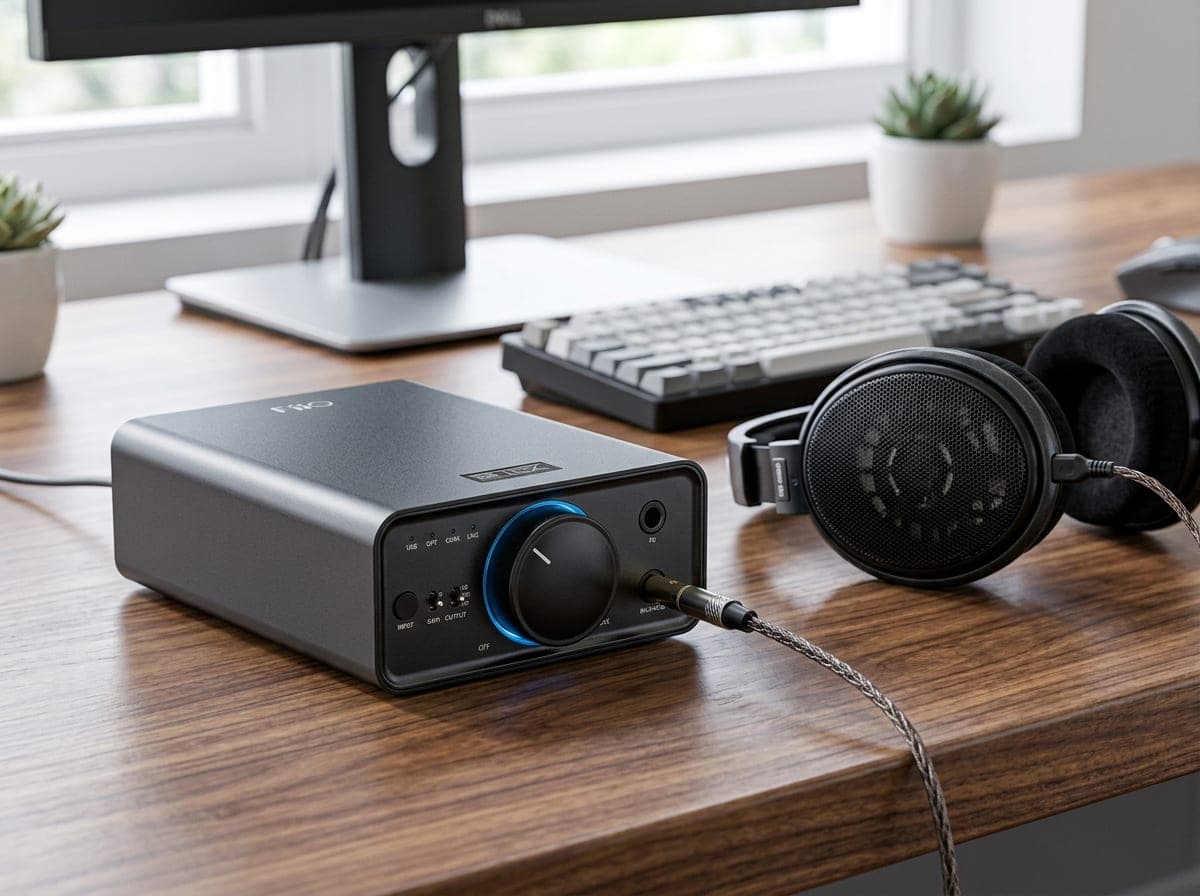
The K7 is the 'buy this unless you have a specific reason not to' pick, and it has held that position because the engineering is genuinely a tier above the budget class. Two AKM AK4493SEQ DAC chips — one per channel — feed dual THX AAA 788+ amplifier modules, a combination that delivers up to 2,000 mW per channel into 32Ω balanced and a strong 560 mW into 300Ω. In plain terms: it drives essentially any desk headphone, including hard-to-power planars and high-impedance studio cans, to clean volume with real dynamic headroom, and it measures excellently while doing it — very low distortion, high SNR, and output impedance under 1Ω so it never colors sensitive headphones.
Connectivity is the other reason it's the all-rounder. USB, optical, coaxial, and RCA line-in on the back mean it slots into a PC, a console, and a turntable's phono stage at once, and a two-level gain switch covers everything from IEMs to power-hungry cans. The plain K7 is wired-only; if you want Bluetooth with LDAC for a phone or tablet, buy the K7 BT variant — otherwise the boxes are identical. What you give up versus the budget K11 is a front display, and the unit is fairly deep and heavy for a small desk. Those are small prices for what is, dollar for dollar, the most complete desktop DAC/amp most people will ever need.
What we like
- Dual THX AAA 788+ amps and dual AK4493S DACs — clean, powerful, neutral
- ~2,000 mW into 32Ω balanced drives nearly any desk headphone
- Excellent measured performance for the price
- USB, optical, coaxial, and RCA line-in for multiple sources
Worth knowing
- No display and only basic front controls
- Plain K7 has no Bluetooth — you must choose the K7 BT variant
- Fairly deep and heavy for a small desk
- DAC
- 2× AKM AK4493SEQ
- Amplifier
- 2× THX AAA 788+
- Power (balanced)
- ~2,000 mW @ 32Ω; ~560 mW @ 300Ω
- Inputs
- USB, optical, coaxial, RCA line-in
- Outputs
- 4.4mm balanced, 6.35mm SE
3. Best for Gaming
Creative Sound Blaster GC7
Typically around $150
- Competitive and immersive gaming
- Setups that need a mic input and chat/game mix control
- Console players who want virtual surround
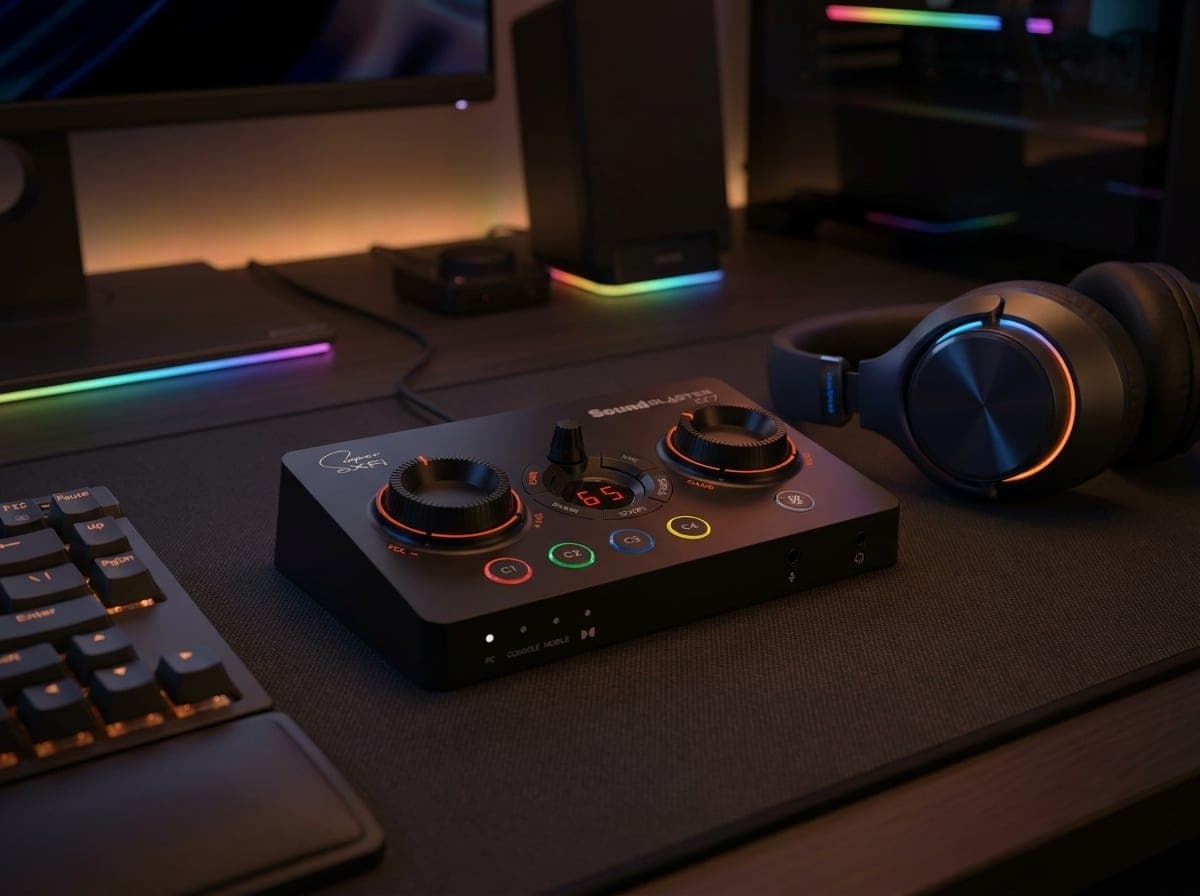
The GC7 is the only pick here built around gaming rather than critical listening, and that focus is the whole point. It is the single unit in this guide with a real microphone input and a hardware GameVoice Mix dial, so you can balance game audio against voice chat without diving into software — a genuinely useful control that pure audiophile DAC/amps simply don't offer. On top of that sit Creative's Super X-Fi head-and-ear-mapped holography, Scout Mode for exaggerating directional cues like footsteps, and virtual 7.1 surround with Dolby decoding over the optical input. For an FPS player, those processing features translate into a positional advantage that a flat, neutral amp will not give you.
The desk experience is tactile in a way the other picks aren't: a volume dial, four programmable RGB buttons, and quick mode toggles all live on the angled top face, and USB-C connectivity works with PCs, Macs, and consoles. Two honest limits keep it in the gaming lane rather than the audiophile one. Creative doesn't publish a milliwatt power figure, and the output impedance is a relatively high 10Ω — fine for gaming headsets and most full-size headphones, but not ideal for sensitive low-impedance IEMs, which it can color or underpower. And the single 3.5mm headphone output means it isn't the unit for a demanding 300Ω audiophile can. As a gaming command center, though, nothing else here competes.
What we like
- Real mic input plus a hardware GameVoice Mix dial for chat/game balance
- Super X-Fi and Scout Mode give genuine positional cues for FPS
- Console-friendly over USB-C, with optical in for surround decode
- Tactile desk controls: volume dial and four programmable buttons
Worth knowing
- No published power figure and only a 3.5mm output
- 10Ω output impedance is high — not ideal for sensitive IEMs
- Feature stack is tuned for gaming, not neutral critical listening
- DAC
- AKM AK4377
- Rated load
- 32–300Ω (power not published)
- Inputs
- USB-C, 3.5mm mic, line-in, optical
- Outputs
- 3.5mm headphone, line-out, optical
- Gaming features
- Super X-Fi, Scout Mode, GameVoice Mix
4. Best Modular Stack
Topping E30 II + L30 II Stack
Typically around $300 (pair)
- Spec-driven buyers who prioritize measured transparency
- Anyone who wants to upgrade the DAC and amp separately
- Sensitive IEMs and demanding cans alike (three gain modes)
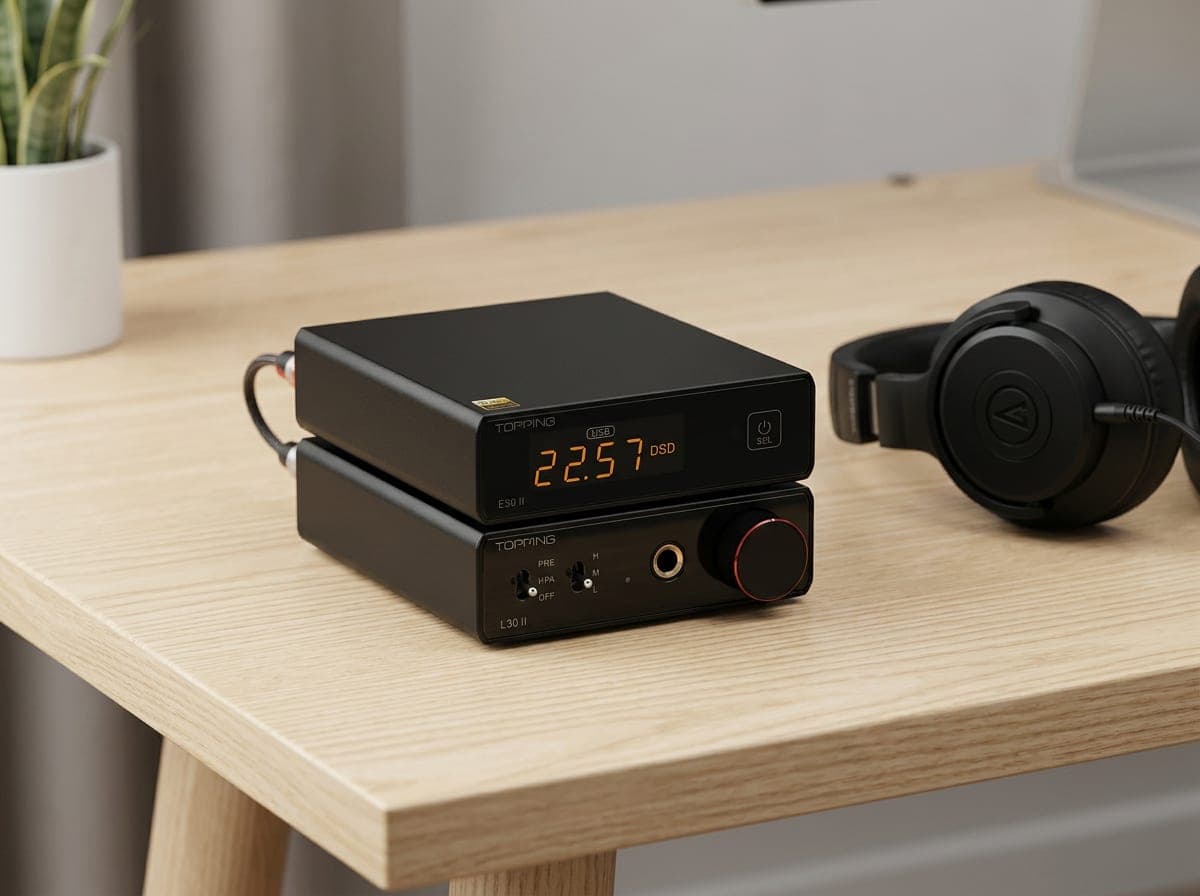
For buyers who care about measured transparency above all, the Topping E30 II DAC paired with the L30 II amplifier is the classic answer. Both units are perennial favorites in the measurement community for a reason: the E30 II (dual AKM AK4493S) posts near-reference distortion and noise figures, and the L30 II's NFCA amplifier module has a noise floor and distortion so low it is effectively inaudible, while pushing up to around 3.5 W into 16Ω. Three switchable gain modes make the stack equally at home with hiss-prone sensitive IEMs and power-hungry full-size headphones — a flexibility single-gain units can't match.
The modular format is the strategic appeal. Because the DAC and amp are separate boxes joined by an interconnect, you can upgrade one without replacing the other as your headphones or standards change — buy the amp now, add a better DAC later, or vice versa. The compact matching enclosures stack neatly and the E30 II ships with a remote. Be clear on one limitation before you buy: this stack is single-ended only. There is no 4.4mm or XLR balanced output anywhere, so if balanced connectivity is a requirement, look at Topping's E50 + L50 or the FiiO options instead. Two boxes also mean an extra interconnect cable and more desk clutter than a one-box combo. For pure measured performance per dollar, though, it's hard to beat.
What we like
- Reference-grade measured transparency — audibly clean DAC and amp
- Modular: upgrade the DAC or amp independently over time
- Three gain modes suit both sensitive IEMs and demanding cans
- Compact matching boxes, remote included with the DAC
Worth knowing
- Single-ended only — no 4.4mm or XLR balanced output
- Two boxes plus an interconnect add cable clutter
- No Bluetooth, and utilitarian styling
- DAC
- 2× AKM AK4493S (E30 II)
- Amplifier
- NFCA, ~2,700 mW @ 32Ω (L30 II)
- Inputs
- USB, optical, coaxial
- Outputs
- 6.35mm SE + RCA (no balanced)
- Gain
- Three switchable modes
5. Premium Pick
FiiO K9
Typically around $499
- Hard-to-drive or high-impedance flagship headphones
- Desks with multiple sources and powered speakers
- One hub to run headphones and speakers for years
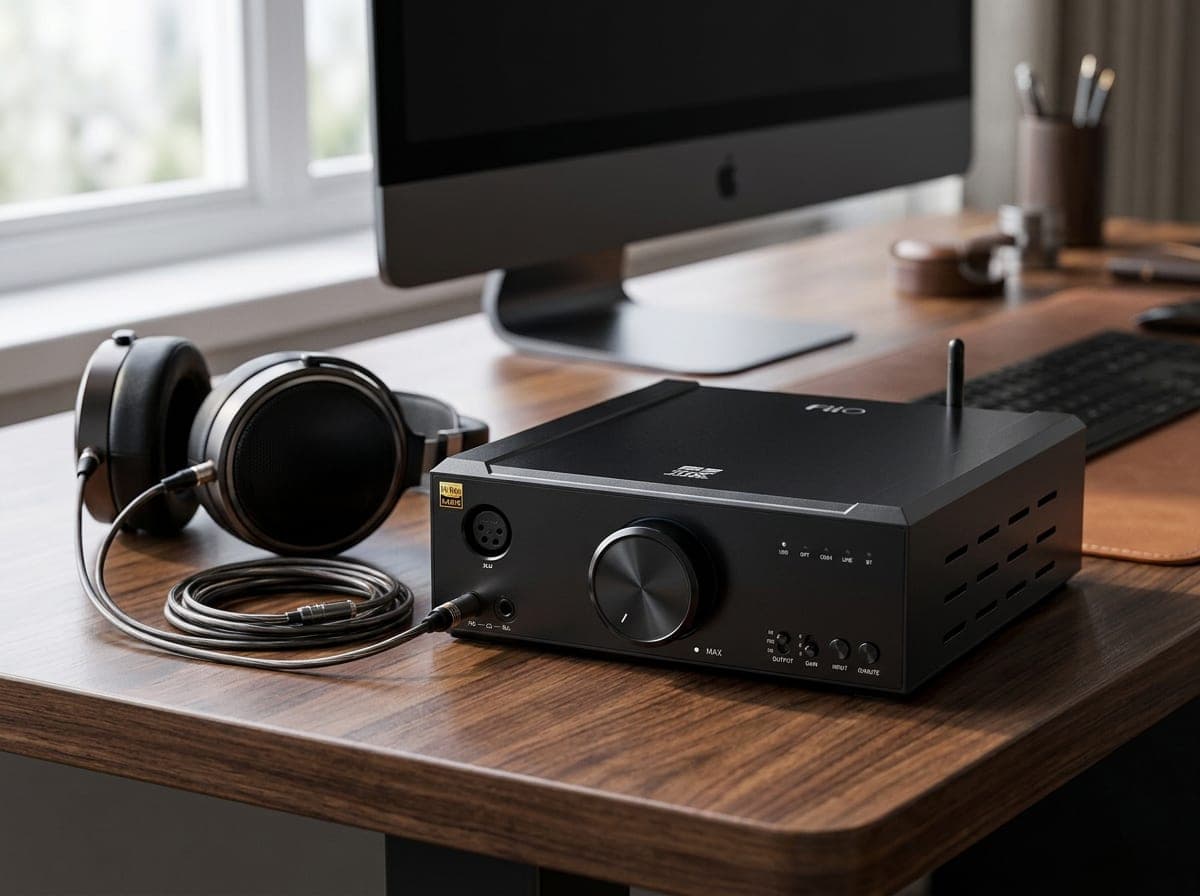
The K9 is endgame-on-a-budget: a fully balanced desktop hub that will out-last several rounds of headphone upgrades. Dual ESS ES9068AS DACs feed a balanced THX AAA 788+ amplifier that delivers up to 2,000 mW into 32Ω and a serious 780 mW into 300Ω, with the transient headroom (a quoted 42 Vpp into high-impedance loads) to control demanding flagship headphones the smaller units strain to reach. If you own — or plan to own — hard-to-drive planars or 300Ω-plus studio cans, this is the pick that has power to spare.
Where the K9 really separates itself is I/O. The front panel carries a 4-pin XLR balanced output alongside 4.4mm balanced and 6.35mm single-ended, so any headphone termination plugs straight in. The back adds USB, optical, coaxial, RCA and 4.4mm line-in, plus XLR and RCA line-outs — meaning the K9 doubles as a preamp to drive active speakers, and Bluetooth 5.1 with LDAC handles wireless sources. It is, effectively, the center of a desk audio system rather than a single-purpose amp. The trade-offs are exactly what you'd expect at this size: it's large and heavy, it uses an external power brick, and it is overkill for easy-to-drive headphones. For a setup you want to stop upgrading, that's the point.
What we like
- XLR-4, 4.4mm, and 6.35mm headphone outputs — every termination fits
- Balanced THX AAA 788+ with 780 mW into 300Ω for flagships
- XLR and RCA line-outs let it double as a speaker preamp
- Bluetooth 5.1 with LDAC — rare at this power class
Worth knowing
- Large, heavy, and uses an external power brick
- Overkill for easy-to-drive headphones
- The wealth of I/O adds complexity versus a one-knob unit
- DAC
- 2× ESS ES9068AS
- Amplifier
- THX AAA 788+ (balanced)
- Power (balanced)
- ~2,000 mW @ 32Ω; ~780 mW @ 300Ω
- Inputs
- USB, optical, coaxial, RCA, 4.4mm, Bluetooth (LDAC)
- Outputs
- XLR-4, 4.4mm, 6.35mm + XLR/RCA line-out
The verdict
For most people, the FiiO K7 is the right answer and the one to buy unless something specific points elsewhere: dual THX amplification, ~2,000 mW into 32Ω balanced, and enough clean input options to run a PC, a console, and a turntable at once, all for around $199. If your budget is tighter, the FiiO K11 delivers a genuinely startling amount of balanced power for $129 — just plan on 4.4mm-terminated headphones to use it fully. Gamers should look past the audiophile boxes to the Creative Sound Blaster GC7, the only pick with a real mic input, a hardware chat/game mix dial, and positional processing built for FPS. Measurement-focused buyers who want a modular upgrade path will be happiest with the Topping E30 II + L30 II stack, provided single-ended output is no obstacle. And if you own hard-to-drive flagships or want one hub to run headphones and speakers for years, the FiiO K9 has the power, the connectors, and the headroom to stop the upgrade cycle for good.
Frequently asked questions
Not always. If you use easy-to-drive headphones — most gaming headsets and consumer cans under about 50Ω — and you're happy with the volume and clarity from your motherboard or laptop, you may not need one. A dedicated DAC/amp helps most when your headphones are high-impedance or low-sensitivity (they sound quiet or lifeless), when your onboard audio hisses or picks up interference, or when you want features like balanced output, optical in, or a preamp output to drive powered speakers.
As a rough guide, headphones at 32Ω or below with decent sensitivity usually run fine from a phone or PC, though a good amp still tightens dynamics. The ~80–250Ω range benefits clearly, and 300Ω-plus models — many Sennheiser and Beyerdynamic studio cans — genuinely need an amp to reach proper volume and control. Sensitivity (dB/mW) matters as much as impedance: low-sensitivity planar headphones can be demanding even at low impedance, which is why we list power at both 32Ω and 300Ω.
Balanced outputs (4.4mm or 4-pin XLR) use separate signal paths per channel, which on many devices unlocks noticeably more power and can lower crosstalk and noise. On the FiiO K11, for example, the balanced port delivers around 1,400 mW into 32Ω versus roughly 520 mW single-ended. That extra headroom is the main practical benefit — but balanced isn't automatically 'better sounding,' and it only helps if your headphones have (or can be re-cabled to) a balanced connector. For easy-to-drive headphones, a strong single-ended output like the Topping L30 II's is completely sufficient.
A DAC (digital-to-analog converter) turns the digital audio from your PC into an analog signal. An amp takes that analog signal and boosts it to drive headphones. A combo unit — like the FiiO K7 or K9 — puts both in one box, which is simpler, cheaper, and tidier, and it's the right call for most desks. A separate stack, like the Topping E30 II + L30 II, lets you upgrade each piece independently and can push measured performance a little higher, at the cost of an extra box and interconnect cable.
It can, in two ways. First, cleaner amplification and a low noise floor make quiet cues — footsteps, reloads — easier to pick out. Second, features like Creative's Super X-Fi, Scout Mode, and virtual 7.1 surround process the audio to exaggerate directional cues, which many players find helps them locate opponents. These effects are processing, not extra hardware power, but combined with a mic input and a chat/game mix dial, a gaming-focused unit like the Sound Blaster GC7 offers real convenience and positional advantages a pure audiophile DAC/amp doesn't.
Keep building your setup
Audio
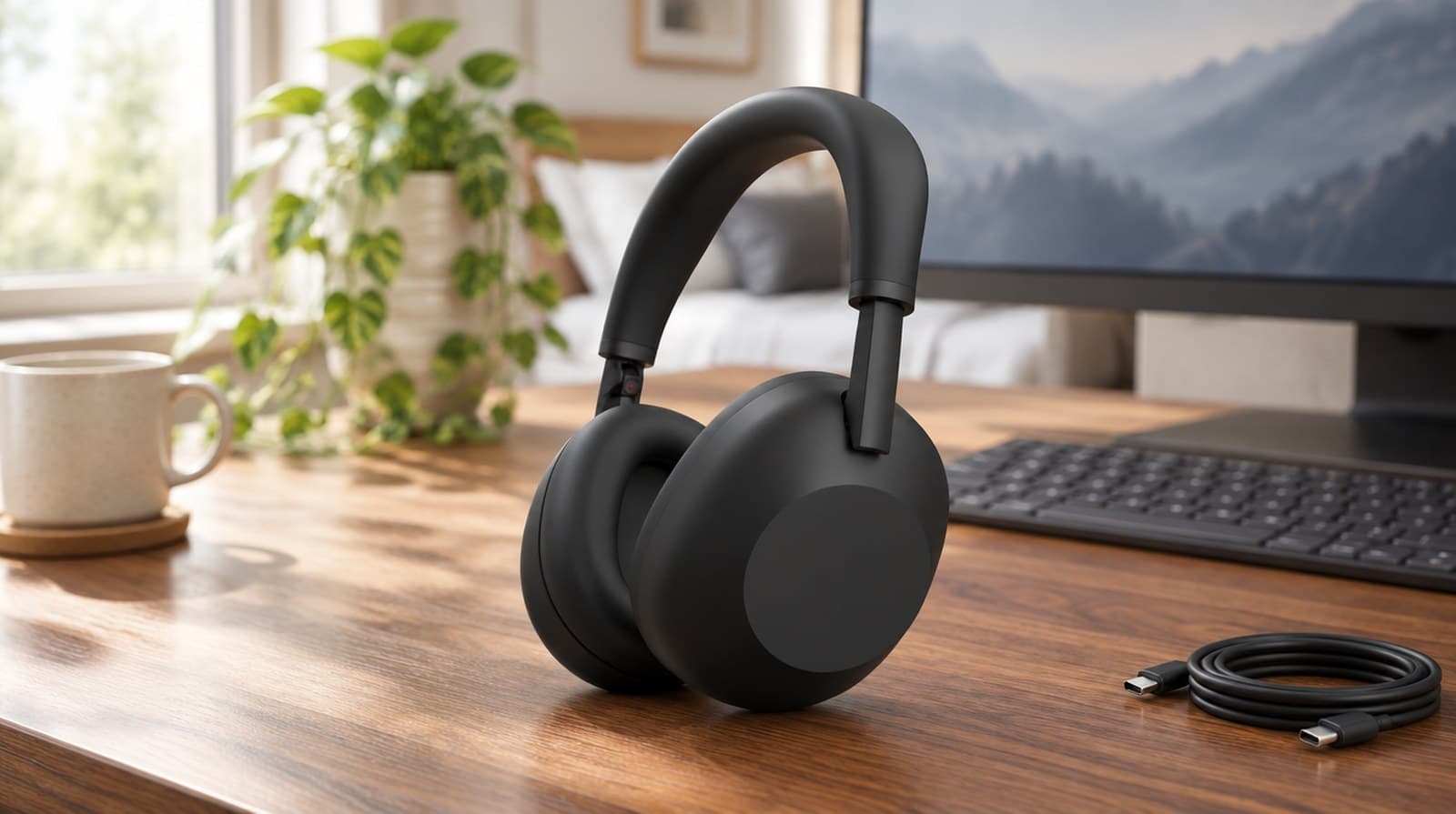
The Best Noise-Cancelling Headphones for a Home Office in 2026
Every round-up ranks these for a flight. A desk is a different job: the cable, the second Bluetooth device, and what they weigh at hour eight. On those three, the $449.99 flagship is not the winner — and the cheapest Bose beats the expensive one.
Updated September 26, 2026
Audio
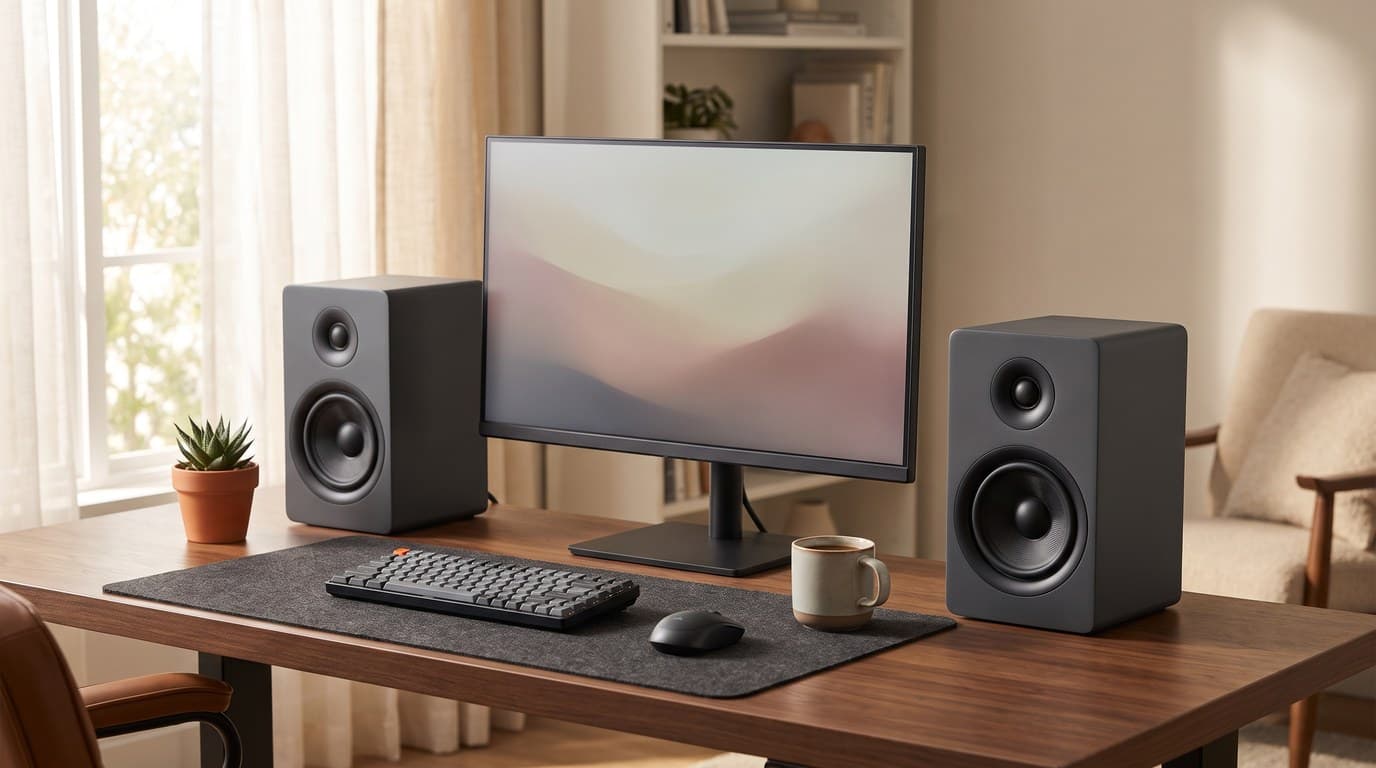
The Best Computer Speakers for Small Desks in 2026
Great desktop audio in a small footprint. Five compact speaker picks from $40 to $350, ranked with the one spec the category never puts in a table — how much desk each pair actually occupies.
Updated September 19, 2026
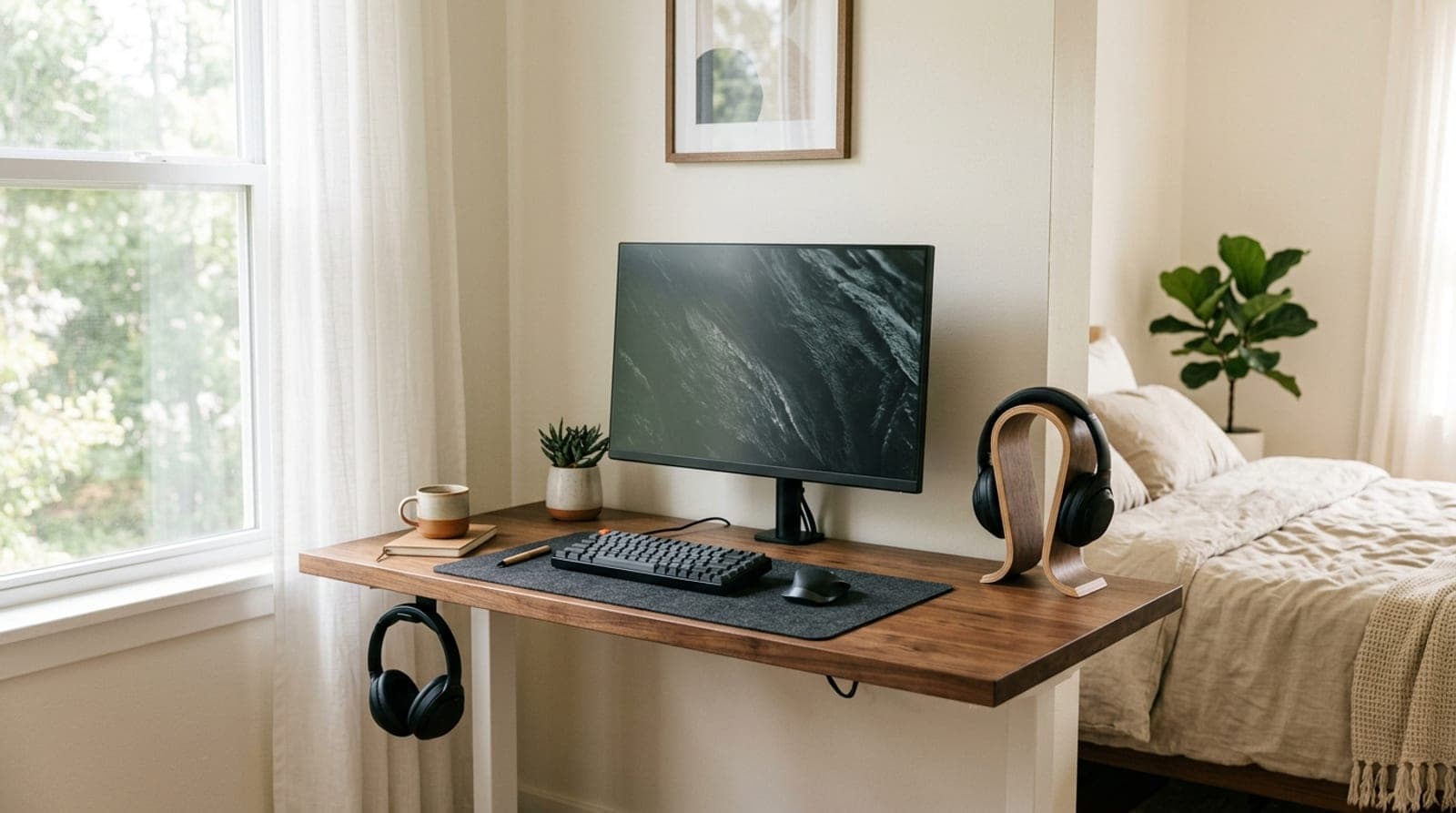
Stands
The Best Headphone Stands and Under-Desk Hooks in 2026
A headphone stand fixes clutter by spending the one thing you're short of: desk space. Six stands and hooks — under-desk adhesive, desk-edge clamp, budget aluminum, RGB hub, wireless-charging wood, and premium — sorted by where they mount.
Updated August 5, 2026
Get the next guide in your inbox
One short email when we publish or meaningfully update a buying guide. No spam, no daily deals firehose.