 Rigworthy
The Best Noise-Cancelling Headphones for a Home Office in 2026
By Rigworthy Editorial Team · Updated September 26, 2026
Rigworthy is reader-supported: we may earn a commission if you buy through our links, at no cost to you. How we make money
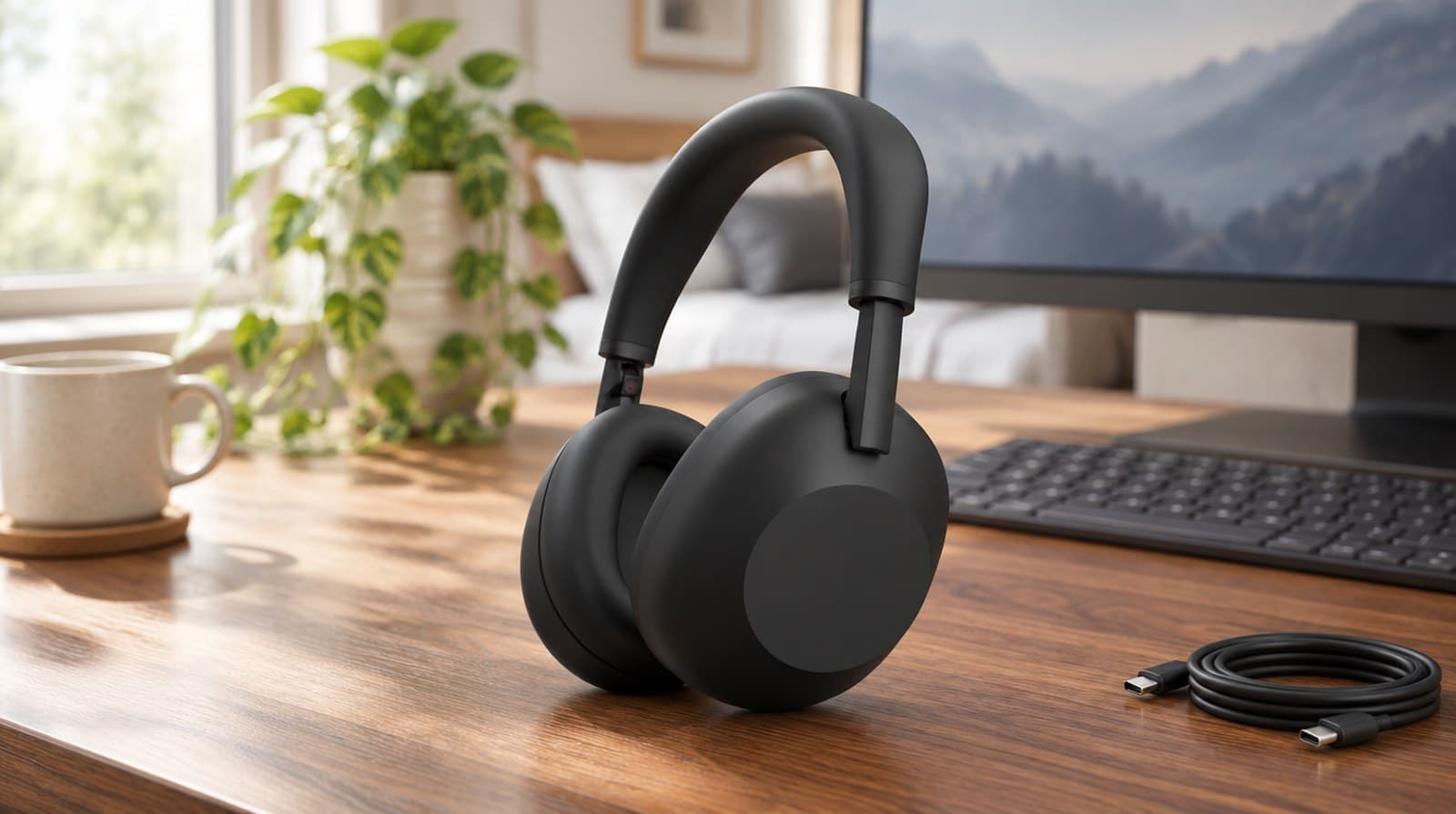
Almost every round-up of noise-cancelling headphones is written for a flight. It ranks them on how deep the cancellation goes, how small they fold, and how many hours they last between airports — all reasonable things to care about at 35,000 feet, and mostly the wrong things to care about at a desk you sit at every day.
A home office asks three different questions. Can they run off a cable, so the battery and the Bluetooth link stop being something you think about? Will they hold the work laptop and the phone at the same time? And what do they weigh at hour eight, which is a long way from what they weigh in a shop? Sort this category on those three and the order changes: the $449.99 flagship turns out to have no USB-C audio at all, the cheapest Bose has a better wired spec than the expensive one, and a $129.99 pair from Anker lands within three percentage points of the best-measured Bose here. This guide covers six picks from $129.99 to $549, with every figure taken from the maker's own specification page — and it is clear about the one job none of them is the right tool for. Prices were checked at each manufacturer's store as of late September 2026 and street prices move with sales.
Our top picks at a glance
- 1
- 2
- 3
- 4
- 5
- 6
How we chose
- How it connects by wire — the spec this category buries and a desk lives on. Four of these six run as a USB-C audio device; the exact bit depth differs by maker and is in the table, not in the prose
- Weight, because a home office is a shift and not a flight. The spread here is 230 g to 386 g — the heaviest pick is 68% heavier than the lightest, and no review mentions that at hour eight
- Multipoint — two hosts at once, which for most remote workers means the work laptop and the phone. One pick here does not have it in the standard sense, and we say exactly who that breaks for
- Battery with active noise cancelling switched on, using each maker's own published figure rather than a measured one, so the numbers are comparable to each other
- Price against the tier above and below, checked at the maker's own store on the day of writing rather than against a remembered street price
- What we don't claim: we have no anechoic chamber and we don't score ANC or microphones ourselves. Every figure below is from the manufacturer's own specification page; where we cite an independent measurement we name the lab that took it
Our picks come from spec research, long-term owner feedback, and category expertise — not sponsorships. Read the full methodology.
Compared side by side
| Product | Award | Wired audio | Weight | Multipoint | Battery (ANC on) | Typical price |
|---|---|---|---|---|---|---|
| Sony WH-1000XM6 | Best Overall | 3.5 mm only | 254 g | 2 devices | 30 h | $449.99 |
| Bose QuietComfort Headphones (2nd Gen) | Best Value | USB-C 24-bit/48 kHz | 230 g | 2 devices | 24 h | $359 |
| Bose QuietComfort Ultra Headphones (2nd Gen) | Best for a Loud House | USB-C 16-bit/48 kHz + 3.5 mm | 264 g | 2 devices | 30 h | $449 |
| Sennheiser Momentum 5 Wireless | Best Battery Life | USB-C 24-bit/96 kHz + 3.5 mm | 290 g | 2 devices | 57 h | $399.95 |
| Apple AirPods Max 2 | Best for Mac and iPhone | USB-C 24-bit/48 kHz | 386 g | Apple devices only | 20 h | $549 |
| Soundcore Space 2 | Best Budget | 3.5 mm only | 264 g | 2 devices | 50 h | $129.99 |
1. Best Overall
Sony WH-1000XM6
Typically $449.99
- Noise cancelling at the top of this field
- Calls, if you won't wear a boom mic
- Anyone who also travels with them
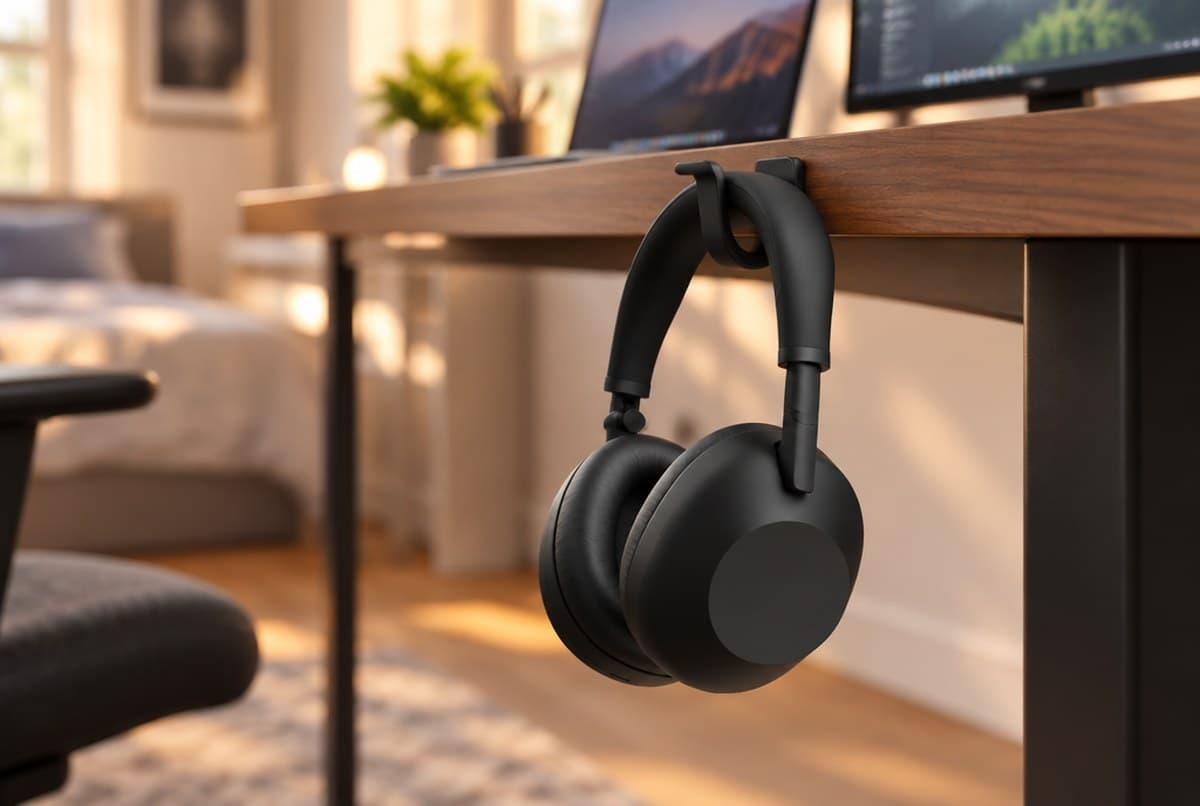
The XM6 is the one to buy if you want the noise cancelling itself to be the reason. Sony's QN3 processor reads twelve microphones — six per side — against a 30 mm carbon-fibre-composite driver, and the result sits at the top of this field: SoundGuys score its ANC 8.7 out of 10, which they describe as beating 87% of the over-ear headphones they've measured. That is a ranking against their catalogue and not an attenuation figure, so don't read it against the 85.1% and 87% loudness reductions quoted for the Bose picks below; SoundGuys' own verdict is that the flagship tier cancels at similar levels, with the Sony and the AirPods Max ahead on passive isolation. Sony also quietly fixed the XM5's most-complained-about regression, so these fold flat again at a new metal hinge, which matters more in a bag than on a desk but costs you nothing either way.
For a home office the rest of the sheet is strong without being remarkable. Thirty hours with ANC on, 254 g (the second-lightest here), Bluetooth 5.3 with multipoint across two devices, and LDAC and LC3 for anyone on Android or LE Audio — but no aptX and no Snapdragon Sound. The twelve-mic array with AI noise reduction is the largest here by some distance — three to eight mics elsewhere — so it should be the strongest of these on calls, though microphones are one of the things we don't score ourselves. That's a real thing to want if your video calls are occasional and you'd rather not own a headset.
The catch is the one nobody leads with, and at a desk it is the catch that counts: there is no USB-C audio. Plug the XM6 into a laptop and it charges, nothing more. Wired listening is the bundled 3.5 mm cable and analogue only — so the top-cancelling pick here is also the only expensive one that can't become a wired USB headphone when the battery dies mid-afternoon. Note also that Sony's more expensive 2026 model is not an upgrade for this job: the $649.99 WH-1000XX ColleXion is 320 g and rated for 24 hours, heavier and shorter-lived than the XM6, and there is no XM7 — industry reporting in January 2026 put the next generation no earlier than 2027.
What we like
- SoundGuys score its ANC 8.7/10 — ahead of 87% of the over-ears they've measured
- Twelve mics with AI noise reduction, the largest array here by some distance
- 254 g, and folds flat again after the XM5 dropped it
- LDAC and LC3, plus multipoint across two devices
Worth knowing
- No USB-C audio at all — wired means the 3.5 mm cable, and nothing else
- No aptX or Snapdragon Sound
- At $449.99 it costs Ultra money without the Ultra's wired flexibility
- Wired audio
- 3.5 mm analogue only (cable included); no USB audio
- Weight
- 254 g
- Battery
- 30 h with ANC on (Sony's figure)
- Bluetooth
- 5.3, multipoint across 2 devices
- Codecs
- SBC, AAC, LDAC, LC3
- Drivers / mics
- 30 mm carbon-fibre composite; 12 microphones (six per side)
2. Best Value
Bose QuietComfort Headphones (2nd Gen)
Typically $359
- Eight-hour days — the lightest pick here at 230 g
- Living plugged into the laptop over USB-C
- Spending $90 less than the Ultra for most of the Ultra
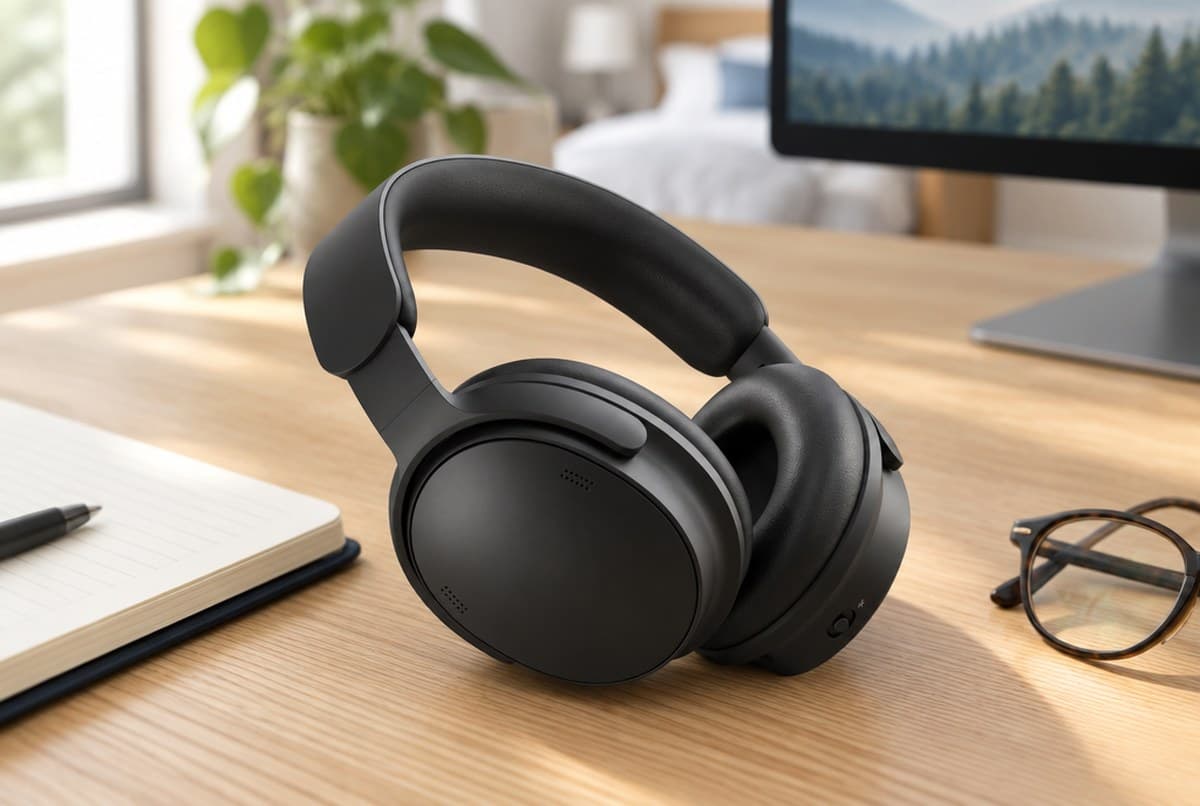
This is the pick that made the guide worth writing. Bose's 2026 base model is 230 g — the lightest thing here by 24 g and 156 g under the AirPods Max 2 — and it inherited Immersive Audio with head tracking from the Ultra line, which used to be the reason to pay up. Battery is the weakest number in the guide at 24 hours with ANC on, 18 with Immersive running, and if you are actually at a desk that is the number that matters least, for the reason in the next paragraph.
Its USB-C implementation is better than its own flagship's. Bose publishes lossless input up to 24-bit/48 kHz and — the part almost nobody prints — voice output up to 24-bit/16 kHz, meaning the cable carries the microphone too. Plugged in, these are a wired USB headset: the battery stops being a consideration, the connection stops dropping, and your voice reaches the far end on a digital path instead of a Bluetooth voice codec. The Ultra, ninety dollars dearer, tops out at 16-bit over the same port.
Two honest limits. There is no 3.5 mm jack at all — Bose includes a USB-C-to-3.5 mm cable, so if you own a desk DAC or headphone amp you are going through an adapter to reach it. And the codec list is SBC and AAC only: no aptX, no LDAC, so Android users give up hi-res over Bluetooth. Neither costs you anything if the plan is to sit at a desk with a cable in. SoundGuys measured its cancellation at 85.1% against the Ultra's 87% — a gap you can see on a chart and would struggle to name in a room.
What we like
- Lightest in the guide at 230 g, which is the spec that decides hour eight
- USB-C lossless in at 24-bit/48 kHz and voice out at 24-bit/16 kHz — better than the Ultra's
- Immersive Audio with head tracking, inherited from the more expensive line
- Multipoint across two devices; $90 under the Ultra
Worth knowing
- Shortest battery here — 24 hours with ANC on, 18 with Immersive
- No 3.5 mm jack; analogue means the bundled USB-C adapter cable
- SBC and AAC only — no aptX or LDAC
- Wired audio
- USB-C: lossless in up to 24-bit/48 kHz, voice out up to 24-bit/16 kHz. No 3.5 mm jack (adapter cable included)
- Weight
- 230 g (0.507 lb, Bose's figure)
- Battery
- 24 h with ANC on; 18 h with Immersive Audio
- Bluetooth
- 5.4, multipoint across 2 devices
- Codecs
- SBC, AAC
- Modes
- Quiet, Aware, Immersive (Still / Motion), Cinema
3. Best for a Loud House
Bose QuietComfort Ultra Headphones (2nd Gen)
Typically $449
- Shared houses, building work, a partner on calls in the next room
- Android users who want aptX Adaptive
- Keeping a 3.5 mm jack as well as USB-C
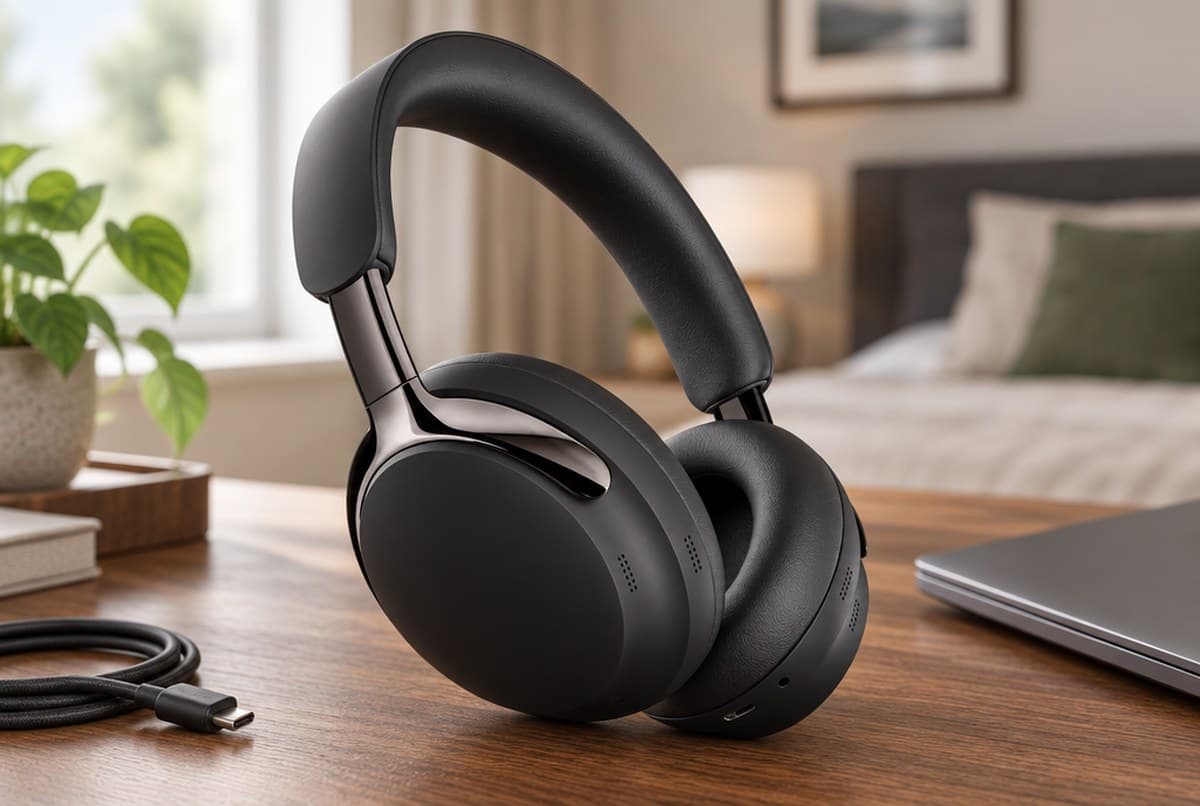
The Ultra is the comfort-and-cancellation pick, and the case for it over the $359 model is narrower than the price gap suggests. It is 264 g, runs 30 hours with ANC on and 23 with Immersive Audio, and adds what the base model gives up: aptX Adaptive with a Snapdragon Sound gaming mode, a 35 mm driver, and — the one a lot of people will care about — an actual analogue output, via the bundled 3.5 mm-to-2.5 mm cable. SoundGuys put the QuietComfort Ultra at 87% perceived-loudness reduction, the highest Bose figure they've published — though that measurement is of the Ultra line rather than this 2nd-Gen unit, for which no separate number exists yet.
The inversion is in the port. Bose rates the Ultra's USB-C audio at 16-bit, 44.1 or 48 kHz — the base QuietComfort does 24-bit over the same connector, and the Sennheiser below does 24-bit/96 kHz. So the most expensive Bose has the weakest digital wired spec of the three headphones here that offer one. That is a strange place to land, and it is the single clearest argument for buying down rather than up within this brand unless the analogue jack or aptX is what you're after.
Who should still pay the $90: anyone whose problem is genuinely a loud house rather than a hum. The Ultra is the deeper canceller of the two Bose, it holds two devices on Bluetooth 5.4, and the plush oval pads and suspended leather strap carry its extra 34 g better than the number suggests. If your noise is HVAC and a fan, the base model does the same job for less.
What we like
- The deeper canceller of the two Bose — 87% for the Ultra line at SoundGuys against 85.1% for the $359 model
- Keeps an analogue output (3.5 mm-to-2.5 mm cable included) as well as USB-C
- aptX Adaptive and a Snapdragon Sound gaming mode
- 30 hours with ANC on, multipoint across two devices
Worth knowing
- USB-C audio caps at 16-bit — worse than the $359 model over the same port
- 34 g heavier and $90 dearer than the base QuietComfort for a gap SoundGuys' own comparison puts at under two points
- Immersive Audio costs seven hours of battery
- Wired audio
- USB-C at 16-bit/44.1 or 48 kHz, plus 3.5 mm-to-2.5 mm analogue cable
- Weight
- 264 g (0.583 lb, Bose's figure)
- Battery
- 30 h with ANC on; 23 h with Immersive Audio
- Bluetooth
- 5.4, multipoint across 2 devices
- Codecs
- SBC, AAC, aptX Adaptive (Snapdragon Sound in gaming mode)
- Driver
- 35 mm, 32 Ω wired
4. Best Battery Life
Sennheiser Momentum 5 Wireless
Typically $399.95
- Charging roughly once a week
- The best USB-C audio spec in the guide
- Keeping the same headphones for five years
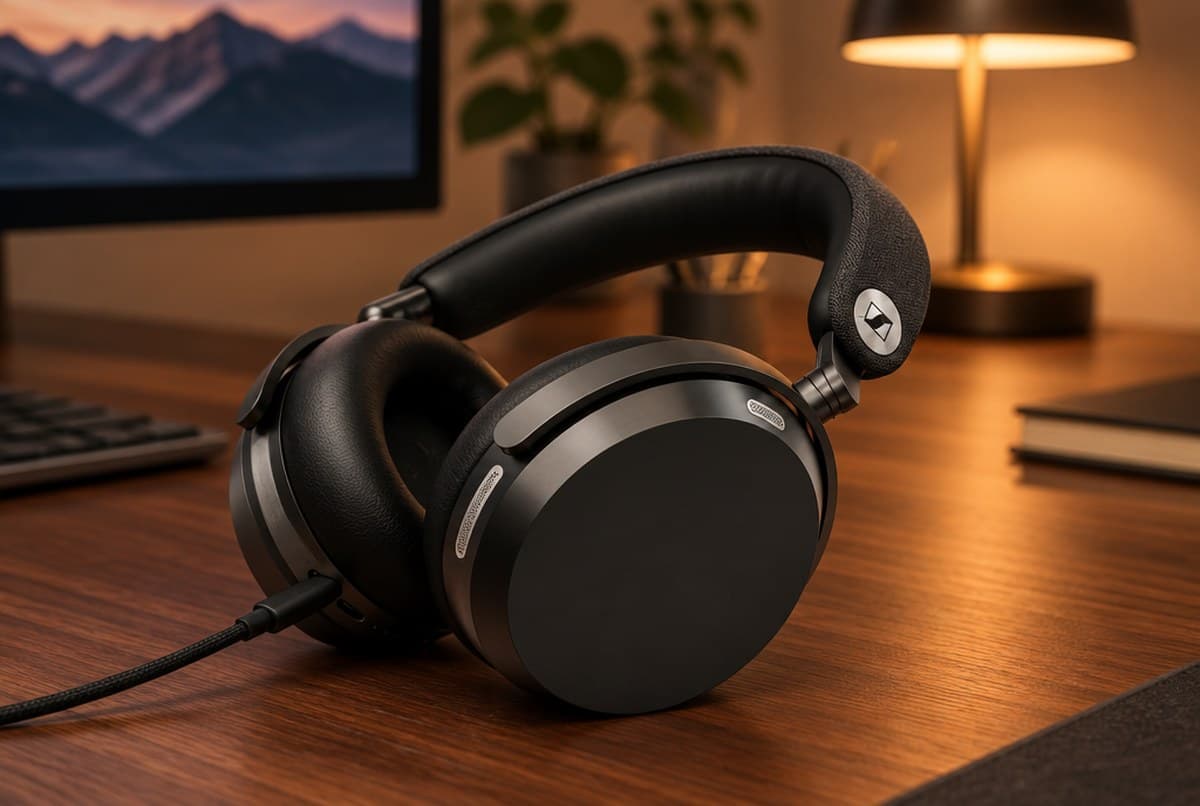
Fifty-seven hours with ANC on is not a rounding-up of the field; it is more than double the base Bose and nearly twice the Sony. In practice a normal working week ends with charge left over, which changes the relationship you have with the things — you stop thinking about it. Sennheiser gets there with a 700 mAh cell behind 42 mm drivers, the largest here, and a ten-minute top-up buys seven hours.
The genuinely unusual feature is that the battery is user-replaceable with a small Phillips screwdriver. Every other pick in this guide is disposable the day its cell stops holding charge, which for wireless headphones is typically the failure that ends them. If you intend to keep a $400 purchase for five or six years rather than three, that single screw is the most valuable line on this page — and it is the reason this entry's award is about life rather than hours.
The connectivity is the best of the lot too, and it is easy to miss under the battery headline. USB-C audio runs to 24-bit/96 kHz, the highest digital wired spec here, driver-free and effectively latency-free; there's a 3.5 mm cable in the box as well; and the codec list is the full Qualcomm set — aptX, aptX HD, aptX Adaptive and aptX Lossless under Snapdragon Sound, plus SBC and AAC — with Bluetooth 5.4 multipoint across two devices and a promised 6.0 firmware update. The costs are weight and cancellation: at 290 g it is the heaviest of the five non-Apple picks, and its eight-mic adaptive ANC is very good rather than class-leading. If quiet is the whole point, the Sony or the Ultra cancel harder.
What we like
- 57 hours with ANC on — roughly a week between charges
- User-replaceable battery, so the headphones outlive the cell
- Best USB-C audio spec here at 24-bit/96 kHz, plus a 3.5 mm cable
- Full aptX set including aptX Lossless, and 42 mm drivers
Worth knowing
- 290 g — the heaviest pick that isn't the AirPods Max 2
- ANC is strong but trails the Sony and the Bose Ultra
- Ships on Bluetooth 5.4; the promised 6.0 is a future firmware update
- Wired audio
- USB-C up to 24-bit/96 kHz, plus 3.5 mm cable
- Weight
- approx. 290 g (10 oz)
- Battery
- 57 h with ANC on; 700 mAh, user-replaceable
- Bluetooth
- 5.4 Class 1, multipoint across 2 devices
- Codecs
- SBC, AAC, aptX, aptX HD, aptX Adaptive, aptX Lossless (Snapdragon Sound)
- Drivers / mics
- 42 mm dynamic; 8 microphones (four per side)
5. Best for Mac and iPhone
Apple AirPods Max 2
Typically $549
- Desks where the laptop and the phone are both Apple
- Lossless USB-C listening and recording in Logic Pro
- Anyone who wants the hardware to feel like the price
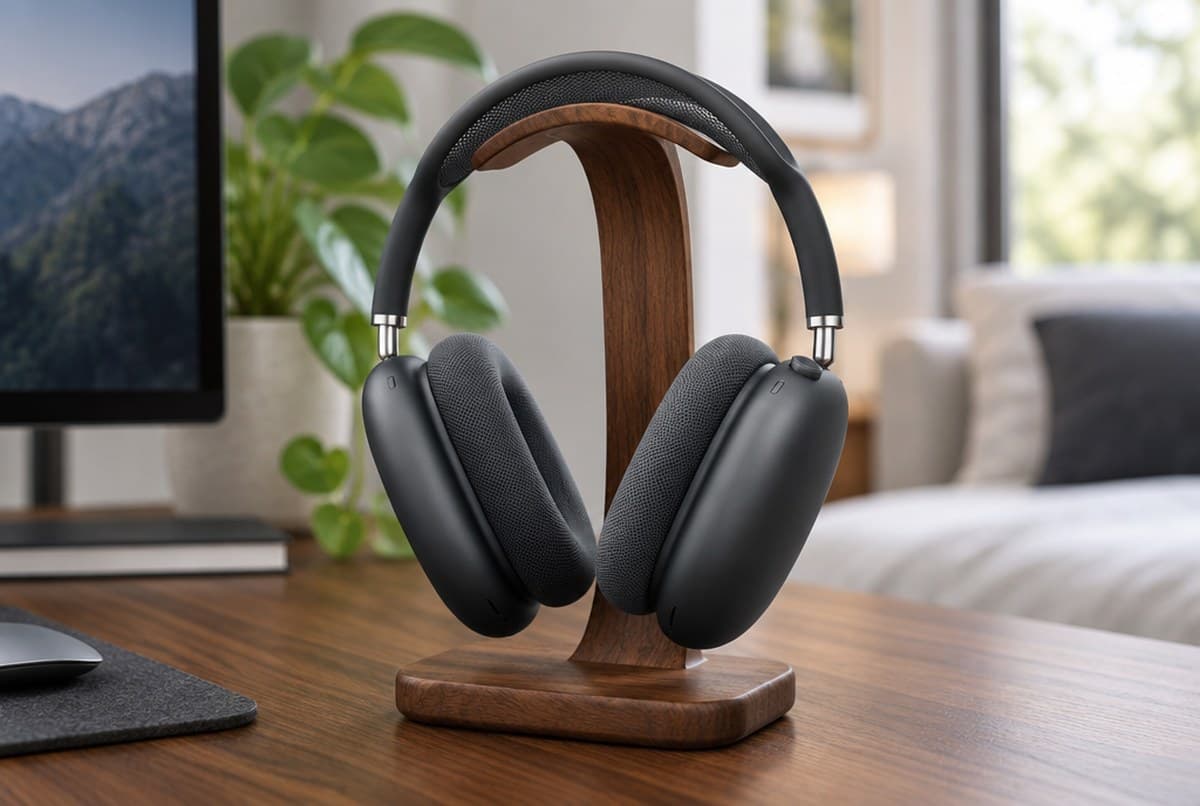
The March 2026 refresh finally put an H2 chip in each cup, and the gains are real: Apple claims cancellation up to 1.5× more effective than the first generation, plus Voice Isolation for calls, Adaptive Audio, Conversation Awareness and Live Translation. Over USB-C it does 24-bit/48 kHz lossless with ultra-low latency, and it is the only pick here you can both mix and monitor Personalized Spatial Audio on. The anodised aluminium cups and stainless stems are the nicest objects in this guide by a distance.
Two things disqualify it for a lot of home offices, and both are structural rather than fixable. The first is 386 g — 156 g more than the base Bose, which is to say 68% heavier. That is a different experience at hour eight, and no amount of mesh canopy engineering makes a third of a kilogram disappear. The second is that Apple does not implement standard Bluetooth multipoint. Within the Apple ecosystem it gives you something better: devices signed into the same Apple ID hand the headphones back and forth automatically. Outside it, you get one connection at a time. If your work laptop is a Windows machine and your phone is an iPhone — an extremely common remote-work pairing — this is the one pick in the guide that will not hold both.
Battery is the other soft spot at 20 hours with ANC on, the shortest here, though five minutes of charge returns about 90 minutes. Buy it if your desk is all-Apple and you want the best-built thing on the page. If either of those isn't true, one of the picks above does this job better for $150 to $190 less.
What we like
- H2 in each cup — Apple rates ANC up to 1.5× the first generation
- USB-C lossless at 24-bit/48 kHz with ultra-low latency
- Automatic handoff between devices on the same Apple ID, and Live Translation
- By far the best-built hardware in this guide
Worth knowing
- 386 g — 68% heavier than the lightest pick here
- No standard Bluetooth multipoint: a Windows laptop and an iPhone won't both stay connected
- Shortest battery in the guide at 20 hours, and the highest price
- Wired audio
- USB-C lossless at 24-bit/48 kHz (cable included); no 3.5 mm jack
- Weight
- 386.2 g (13.6 oz)
- Battery
- 20 h with ANC on; 5 min charge ≈ 1.5 h
- Chip
- Apple H2 in each ear cup
- Bluetooth
- 5.3; Apple automatic switching, not standard multipoint
- Released
- Announced March 2026; five colours
6. Best Budget
Soundcore Space 2
Typically $129.99
- A second pair, or a first pair under $150
- Fifty hours of ANC for a third of the flagship price
- Android users who want LDAC cheaply
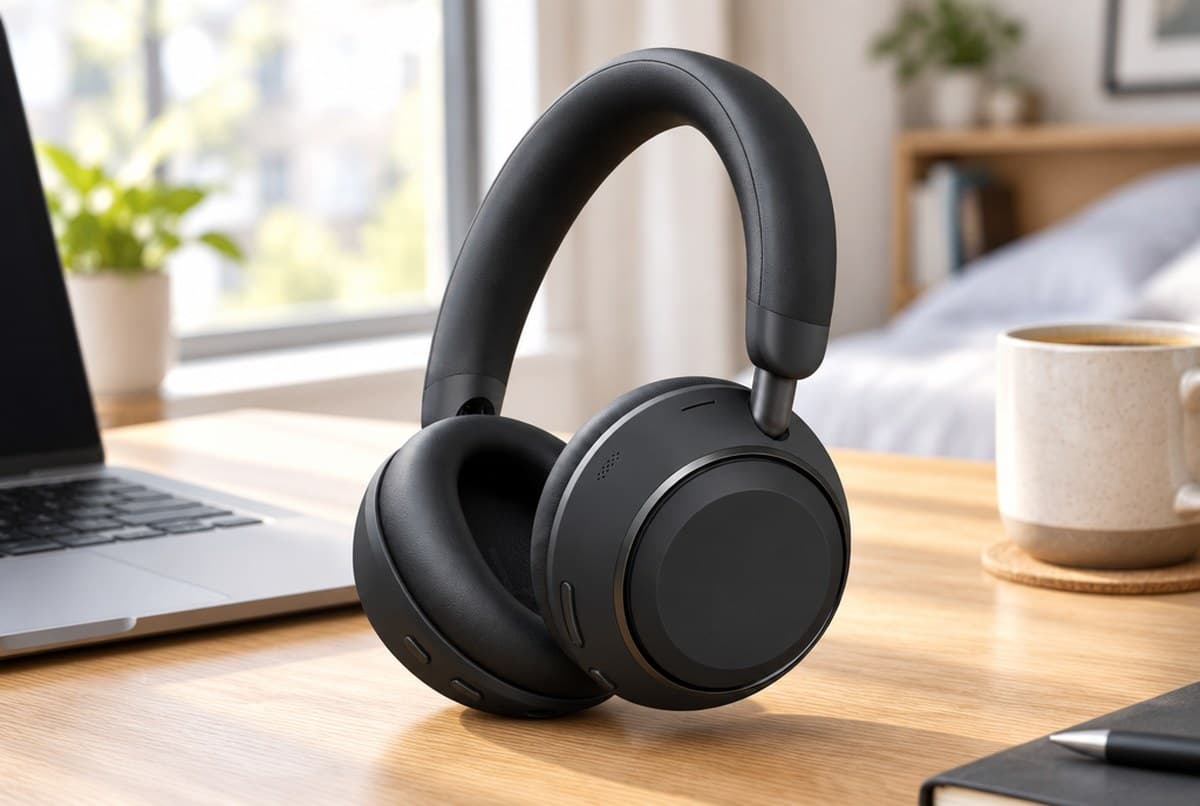
The Space 2 is the answer to the question this guide's price ladder invites: how much of a $449 pair of headphones is actually the noise cancelling, and can you get that part for $130? Mostly, yes. Anker's D1402 runs 40 mm double-layer drivers with an adaptive four-stage ANC system, 50 hours with cancellation on and 70 without, LDAC for hi-res over Bluetooth, multipoint, and Bluetooth 6.1 — the newest radio in the guide, in the cheapest product in the guide. A five-minute charge returns four hours.
SoundGuys measured 84% attenuation, which puts it within about a point of the $359 Bose and three of the $449 Ultra. That is the headline: the cancellation gap across a $320 price gap is small, and most of what the flagships are selling above it is comfort, call microphones, materials and wired flexibility. Their own comparison argues the Space 2 is the better buy than Anker's $199.99 Space One Pro, which measures the same 84% but runs fewer hours and carries a bass tuning they found fatiguing. In fairness to the Pro, they aren't kind about the Space 2's tuning either — boxy and dull out of the box — but they note that restrained bass is far easier to correct with EQ than over-emphasis is.
What $130 doesn't buy is the desk half of this guide. Wired means 3.5 mm only — there is no USB-C audio, so it can't become a wired USB headset the way four picks above can. The microphone array is three mics rather than eight or twelve, so expect it to be the weakest of these on calls. And at 264 g it is no lighter than the Bose Ultra. Buy it as the sensible pick, or as the pair you leave at a second desk; just don't buy it expecting the cable to do anything but play analogue.
What we like
- 50 hours with ANC on, 70 without — second only to the Sennheiser
- 84% attenuation as measured by SoundGuys, within a point of a $359 pick
- LDAC, multipoint and Bluetooth 6.1 at $129.99
- Matches Anker's $199.99 Space One Pro on attenuation with more hours
Worth knowing
- No USB-C audio — wired is 3.5 mm analogue only
- Three-mic array, the smallest here — expect the weakest calls
- 264 g, no lighter than picks costing three times as much
- Wired audio
- 3.5 mm aux only; no USB audio
- Weight
- 264 g (9.31 oz)
- Battery
- 50 h with ANC on, 70 h off; 5 min charge ≈ 4 h
- Bluetooth
- 6.1, multipoint
- Codecs
- SBC, AAC, LDAC
- Drivers / mics
- 40 mm double-layer diaphragm; 3 microphones with AI
The verdict
For most people working from home, the Bose QuietComfort Headphones (2nd Gen) at $359 is the smartest buy on this page, and it wins on the two specs a desk actually exposes: it is the lightest pair here at 230 g, and its USB-C audio — 24-bit/48 kHz in, with voice out at 24-bit/16 kHz — is better than the $449 Ultra's over the same connector. Its 24-hour battery is the shortest in the guide and matters least, because plugged in it doesn't run on battery at all.
Buy around that for specific reasons. If you want a top-tier canceller and the biggest microphone array short of a boom, the Sony WH-1000XM6 is still the strongest headphone here — just know that wired means the 3.5 mm cable and nothing else. If your house is genuinely loud, the Bose QuietComfort Ultra (2nd Gen) cancels hardest of the Bose pair and keeps an analogue jack. If you'd rather charge once a week and keep the same headphones for six years, the Sennheiser Momentum 5 Wireless has 57 hours, the best USB-C spec in the guide at 24-bit/96 kHz, and a battery you can replace with a screwdriver. On an all-Apple desk the AirPods Max 2 is the nicest object here, though 386 g and the lack of standard multipoint rule it out for a lot of setups. And on a budget the Soundcore Space 2 gets you to within a few points of flagship quiet for $129.99.
One honest caveat before you spend. If your working day is mostly video calls, none of these is the right purchase — a mic six inches away inside an earcup cannot beat a boom two inches from your mouth, and a call headset costs less while sounding better to everyone else on the meeting. And if the noise breaking your concentration is people talking rather than a fan humming, temper your expectations: active cancellation is at its weakest exactly where speech lives. Whichever you land on, give them somewhere to live — a stand or an under-desk hook keeps the desk clear — and if you want to hear the room again between meetings, a pair of desk speakers is the other half of a well-sorted audio setup.
Frequently asked questions
Not nearly as well as they block a fan, and this is the single most common disappointment in the category. Active cancellation works by generating an inverted copy of incoming sound, and that only stays accurate for long, slow, predictable waves — which means it is strongest at low frequencies and falls away as pitch rises. Steady drone is exactly that: HVAC, a fridge compressor, traffic, a PC fan, a plane cabin. Speech is the opposite — higher in pitch, broadband, and constantly changing — so it is the hardest thing for ANC to predict and cancel. What actually reduces voices is the passive seal of the earcup plus something to mask what gets through. If your problem is a partner on calls or children in the house, budget for a good seal and plan to play something, and treat the ANC figure as the smaller half of the fix.
If calls are most of your working day, buy the headset. Every pick here hides its microphones in the earcups, which puts them roughly six inches from your mouth at best, and the physics is unforgiving: your voice gains about 6 dB every time you halve the distance to the capsule, so a boom arm sitting two inches away starts with a large and permanent advantage that no amount of AI processing closes. We go through the numbers in how far a microphone should be from your mouth, and the shortlist is in the best wireless headsets for video calls. The headphones on this page are the right buy when your day is mostly focused work with calls in it — and if you want the biggest mic array among them anyway, that's the Sony's twelve.
It means the headphones can work as a wired USB audio device rather than just charging from the port. Three things follow, and all three are desk things. The battery stops mattering, because the cable powers them while they play — a flat charge at 3pm becomes a non-event instead of the end of your afternoon. The wireless link stops being a variable, so no dropouts and no codec compromise. And on some models the cable carries the microphone too: Bose publishes voice output up to 24-bit/16 kHz over USB-C on the QuietComfort (2nd Gen), which means your call audio takes a digital path instead of a Bluetooth voice codec. On a flight none of this is worth much. At a fixed desk it is arguably the most useful feature in the category, which is why it is the first column of our table — and why it is worth knowing that the $449.99 Sony doesn't have it.
If you have a work laptop and a personal phone, yes, and you'll notice its absence daily. Multipoint keeps both hosts connected at once, so a call landing on your phone interrupts the music from your laptop and then hands it back, with no menu-diving and no re-pairing. Five of the six picks here do it across two devices. The exception is the AirPods Max 2: Apple doesn't implement standard Bluetooth multipoint, and instead switches automatically between devices signed into the same Apple ID. Inside an all-Apple setup that is better than multipoint. If your work machine runs Windows and your phone is an iPhone, it is meaningfully worse, and it's the main reason that pick carries an ecosystem-specific award rather than a general one.
Less than the flagships suggest, if cancellation is what you're buying. SoundGuys' measurements put the $129.99 Soundcore Space 2 at 84% attenuation, the $359 Bose at 85.1% and the QuietComfort Ultra at 87% — roughly three points across a $320 spread. What the extra money genuinely buys is comfort over long days, call microphones, build materials, and the wired flexibility described above. So: if your budget is tight, the Space 2 is not a compromise on quiet. If you sit at a desk eight hours a day, the $359 Bose is the best value on this page because it is the lightest and has the better USB-C spec of the two Bose models. Spend past that only for a specific reason — top-tier ANC and the biggest mic array (Sony), a week of battery and a replaceable cell (Sennheiser), or an all-Apple desk (AirPods Max 2).
Only some of them, and it's worth checking before you buy if you already own one. A desk DAC or amp generally expects an analogue 3.5 mm or 6.35 mm plug. The Sony, the Bose QuietComfort Ultra, the Sennheiser and the Soundcore all have an analogue input and will connect directly. The Bose QuietComfort (2nd Gen) and the AirPods Max 2 have no 3.5 mm jack at all — Bose includes a USB-C-to-3.5 mm cable, but you are then running the headphones' own converter, not the one on your desk. Be aware too that active headphones plugged in analogue behave differently from passive ones: some keep ANC running, some pass audio with the power off, and the benefit of a good external amp is smaller than it would be with a pair of open-back wired cans.
Keep building your setup
Audio
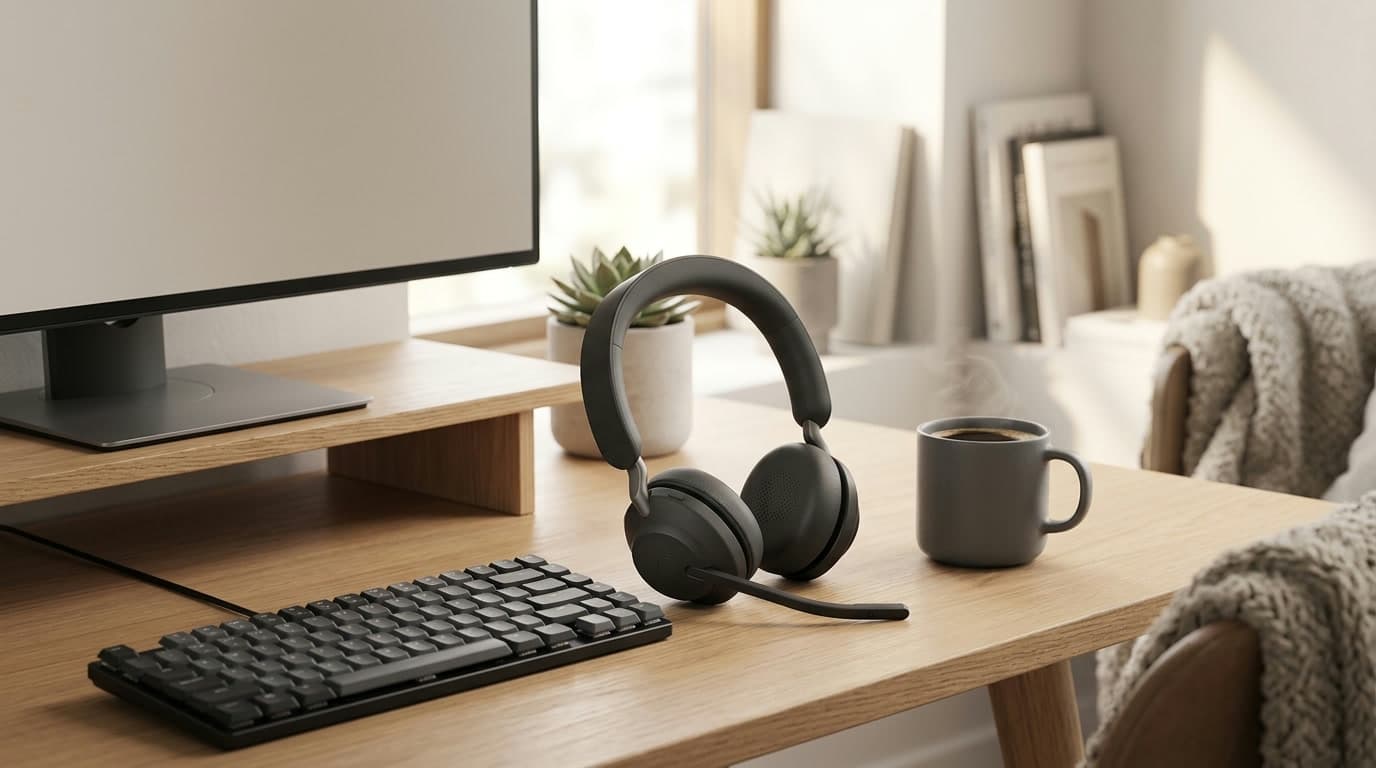
The Best Wireless Headsets for Video Calls in 2026
A headset with a mic near your mouth makes you sound clearer on calls than any laptop or webcam mic can — and lets you hear the room, or block it out. Six wireless headsets for back-to-back meetings, from a $99 budget pick to a $300 pair of enterprise earbuds, sorted by mic type and noise cancelling.
Updated July 31, 2026
Audio
The Best Headphone DACs and Amps for Your Desk in 2026
A dedicated DAC/amp is the fix for weak, hissy onboard audio and headphones that never get loud enough. Five desktop picks from $129 to $499, sorted by power, connectivity, and who each one is actually for.
Updated July 28, 2026
Stands
The Best Headphone Stands and Under-Desk Hooks in 2026
A headphone stand fixes clutter by spending the one thing you're short of: desk space. Six stands and hooks — under-desk adhesive, desk-edge clamp, budget aluminum, RGB hub, wireless-charging wood, and premium — sorted by where they mount.
Updated August 5, 2026
Get the next guide in your inbox
One short email when we publish or meaningfully update a buying guide. No spam, no daily deals firehose.