 Rigworthy
The Best Lumbar Support Cushions for Office Chairs in 2026
By Rigworthy Editorial Team · Updated July 28, 2026
Rigworthy is reader-supported: we may earn a commission if you buy through our links, at no cost to you. How we make money
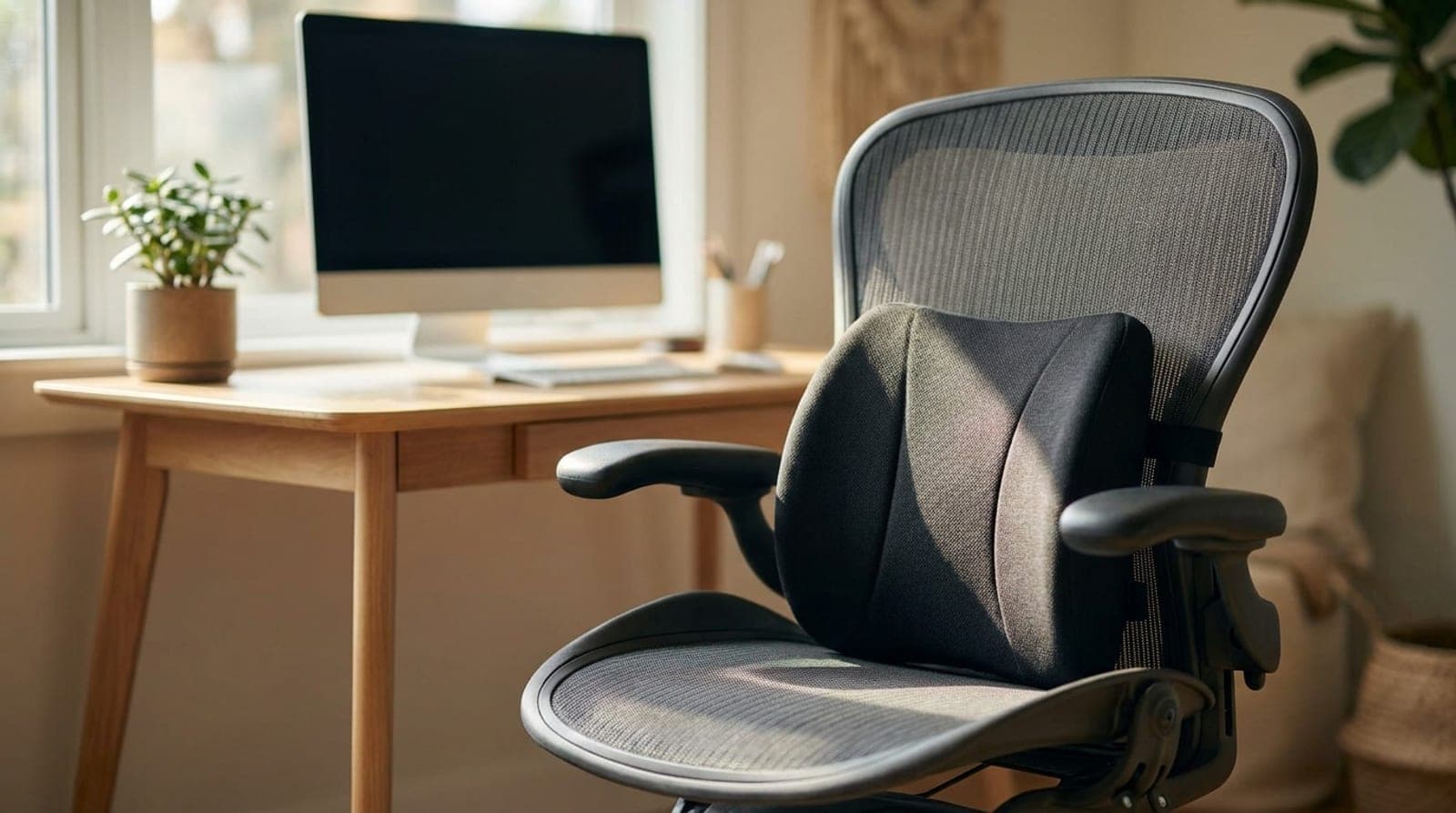
A lumbar cushion is the cheapest fix for the most common desk-chair complaint: a lower back that feels fine at 9am and aches by 3pm. Most office chairs — and nearly every dining, folding, and gaming chair pressed into desk duty — have a flat or gently curved back that leaves a gap behind your lumbar spine. Without something filling that gap, you slowly slump, your lower back flattens out of its natural inward curve, and the muscles that hold you upright fatigue over a long day.
A good cushion closes that gap and puts your spine back into its neutral curve. The catch is that "good" depends on your chair and your body more than on the cushion's marketing. Three things separate the ones that get quietly abandoned in a closet from the ones that stay on the chair: mounting that actually holds position (especially on slippery mesh backs), firmness that supports without either bottoming out or shoving you off the seat, and — the complaint that sinks more cushions than any other — how much heat it traps against your back. One honest note up front: a cushion helps posture-driven, sitting-related aches. It is not a treatment for a structural back problem, and sharp or radiating pain is a reason to see a clinician, not to buy foam. Here are six worth considering.
Our top picks at a glance
- 1
- 2
- 3
- 4
- 5
- 6
How we chose
- Support shape that sits at your actual lumbar curve — the belt line, not the mid-back
- Mounting that stays put, including on flat mesh chair backs and while reclining
- Firmness that holds its shape instead of pancaking within a month
- Breathability — heat build-up is the single most common real-world complaint
- Depth that supports without shoving you off a shallow seat
Our picks come from spec research, long-term owner feedback, and category expertise — not sponsorships. Read the full methodology.
Compared side by side
| Product | Award | Material | Mounting | Typical price |
|---|---|---|---|---|
| Everlasting Comfort Lumbar Support Cushion | Best Overall | Memory foam | Two straps | ~$40 |
| LoveHome Memory Foam Lumbar Support Back Cushion | Best Value | Memory foam | Two straps | ~$28 |
| Purple Back Cushion | Best Cooling | Gel grid | Single strap | ~$79 |
| Cushion Lab Ergonomic Lumbar Pillow | Best Premium | Dense foam | Non-slip strap | ~$69 |
| Original McKenzie Lumbar Roll | Best Clinical Pick | Foam roll | Elastic strap | ~$38 |
| Core Products Deluxe Inflatable Lumbar Cushion | Best Adjustable | Inflatable | Webbing strap | ~$55 |
1. Best Overall
Everlasting Comfort Lumbar Support Cushion
Typically around $40
- Most office chairs
- All-day sitting
- First-time buyers
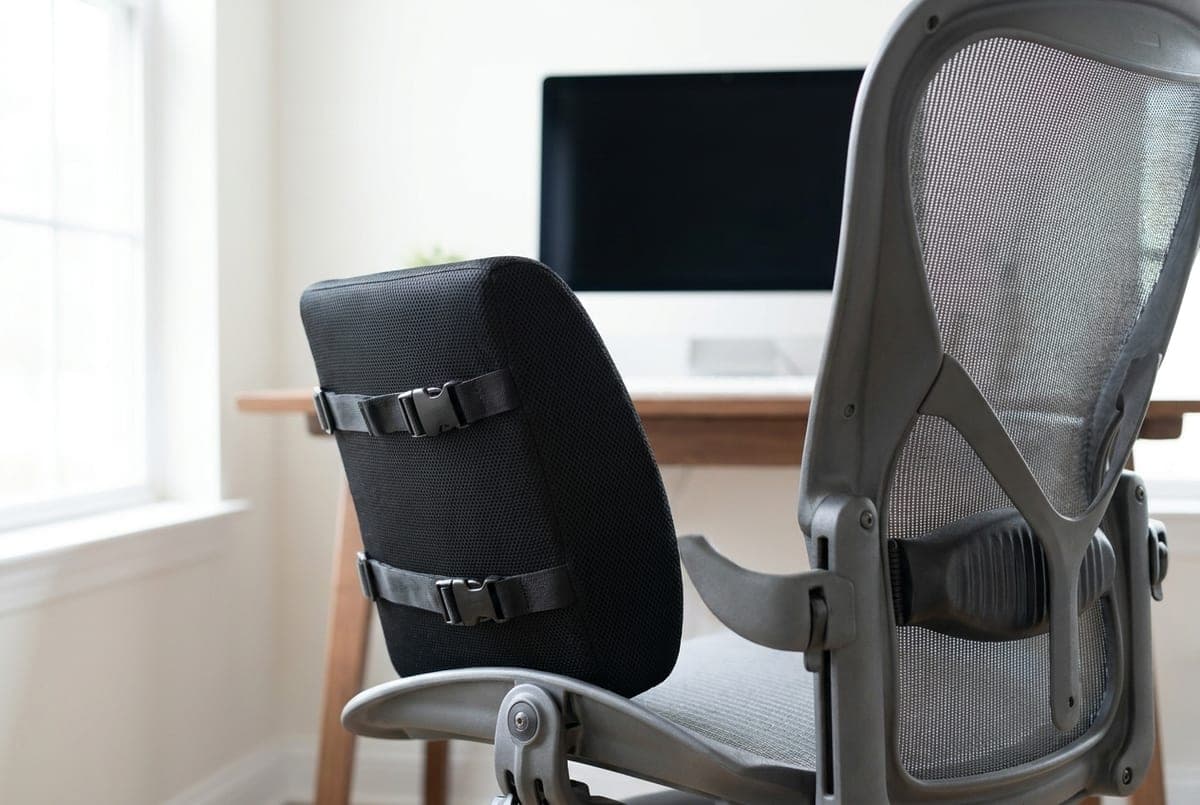
Everlasting Comfort's cushion is the one most people should buy first, and the numbers behind it — tens of thousands of reviews sitting near 4.5 stars — reflect that it gets the fundamentals right. It's a contoured slab of heat-responsive memory foam that softens slightly to your back over a few minutes, held on with two adjustable straps and extensions that reach chairs up to about 32 inches wide.
That two-strap system is the quiet reason it works where cheaper cushions slide down: it anchors top and bottom so the support stays parked at your lumbar curve instead of migrating to your seat by lunchtime. The removable 3D-mesh cover helps with airflow, though like any dense foam it still runs a little warm on a long, hot afternoon. Everlasting doesn't publish exact cushion dimensions — only packaged size — but the shape suits a wide range of builds, and a lifetime replacement guarantee removes the risk from a sub-$50 experiment.
What we like
- Two-strap mounting keeps it anchored at the lumbar curve
- Heat-responsive foam contours without going flat
- Fits chairs up to ~32 in wide; lifetime replacement guarantee
Worth knowing
- Still retains some heat despite the mesh cover
- Exact cushion dimensions aren't published (packaged size only)
- Material
- Contoured memory foam, 3D-mesh cover
- Mounting
- Two adjustable straps + extensions
- Chair fit
- Up to ~32 in wide
- Guarantee
- Lifetime replacement
2. Best Value
LoveHome Memory Foam Lumbar Support Back Cushion
Typically around $28
- Tight budgets
- Second chair or car
- Simple needs
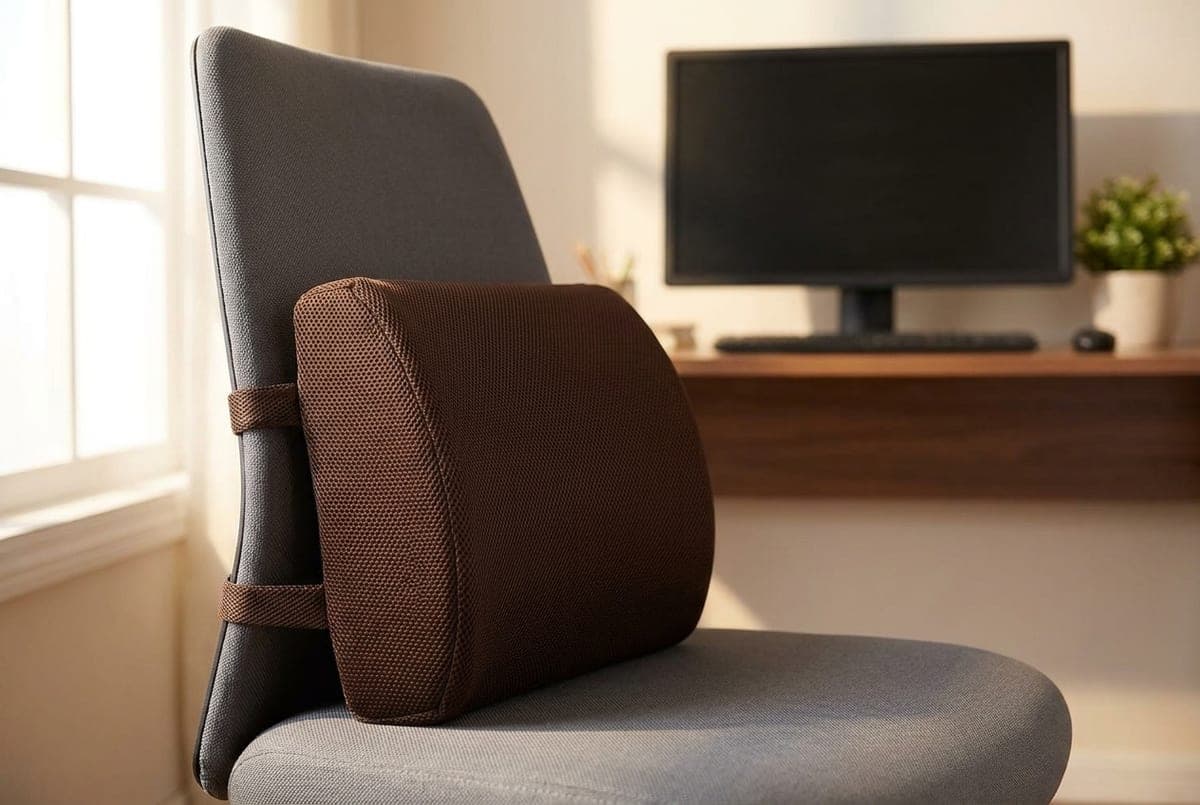
If the Everlasting is the safe default, LoveHome's cushion is the one that does 90% of the job for two-thirds of the price. It's a high-resilience memory foam block in a breathable 3D-mesh cover, with adjustable straps and extensions that LoveHome markets as a '3-way fixation' system — functionally two straps plus reach extenders, not three separate anchors. With well over 25,000 reviews at a 4.6-star average, it's one of the most trusted cheap picks in the category.
Expect a one-to-two-week break-in while the foam settles into its final firmness, and don't count on a perfect fit in every car seat — the shape favors chairs. But it holds its form for years rather than flattening, the cover pops off for washing, and at this price it's the obvious cushion to put on a second chair or hand to a skeptical family member. Listed dimensions hover around 14 × 11 × 4 inches, though LoveHome doesn't spell them out on every listing, so treat that as approximate.
What we like
- Holds its shape for years at a genuine budget price
- Breathable mesh cover, removable and washable
- Straps stay put better than single-strap rivals
Worth knowing
- One-to-two-week break-in before it settles
- Shape favors office chairs over car seats
- Material
- High-resilience memory foam, mesh cover
- Mounting
- Two adjustable straps + extensions
- Dimensions
- ~14 × 11 × 4 in (approx.)
- Reviews
- 25,000+ at ~4.6 stars
3. Best Cooling
Purple Back Cushion
Typically around $79
- Hot sitters
- Mesh chairs
- Warm rooms
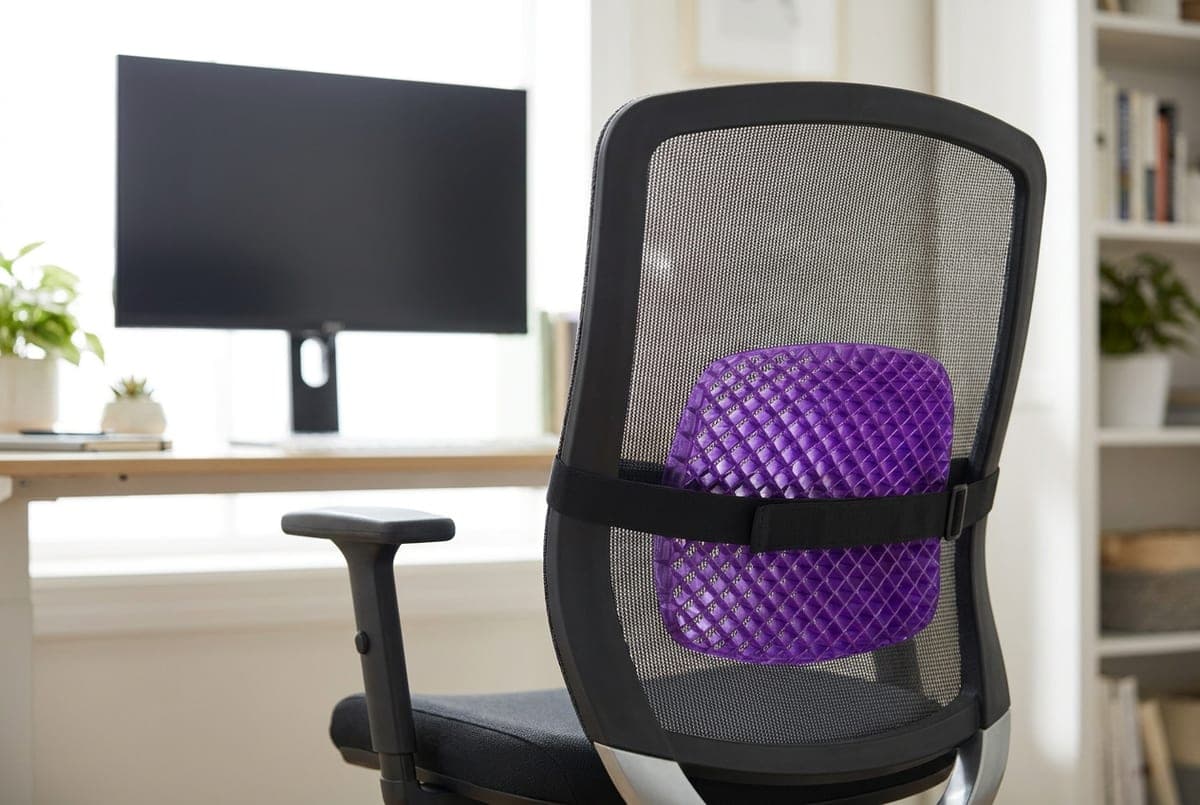
Heat is the number-one reason people abandon a lumbar cushion, and Purple's is the direct answer. Instead of foam, it's built from the same hyper-elastic GelFlex polymer grid Purple uses in its cushions and mattresses — an open lattice of air channels that simply doesn't trap body heat the way a solid foam block does. If you run hot, sit in a warm room, or chose a mesh chair specifically for airflow, this is the cushion that won't undo that decision.
The grid also springs back instead of compressing flat, so it won't develop a permanent dent, and the whole cover is washable. The trade-offs are real: at 15.75 × 9.25 × 2.5 inches it's a flatter, gentler pad than a sculpted foam wedge, so people who want aggressive, deep lumbar push may find it too subtle — and the springy grid feel is polarizing. One clarification worth making before you buy: Purple sells this Back Cushion separately from its Seat Cushions, and buyers constantly confuse the two.
What we like
- Open GelFlex grid stays cool where foam traps heat
- Springs back — won't compress into a permanent dent
- Fully washable cover; made in the USA
Worth knowing
- Flatter, gentler support than a sculpted foam wedge
- Grid feel is polarizing; premium price for the size
- Material
- GelFlex hyper-elastic polymer grid
- Mounting
- Adjustable strap + buckle
- Dimensions
- 15.75 × 9.25 × 2.5 in
- Care
- Washable cover
4. Best Premium
Cushion Lab Ergonomic Lumbar Pillow
Typically around $69
- Full-back support
- Deep-seat chairs
- Serious posture work
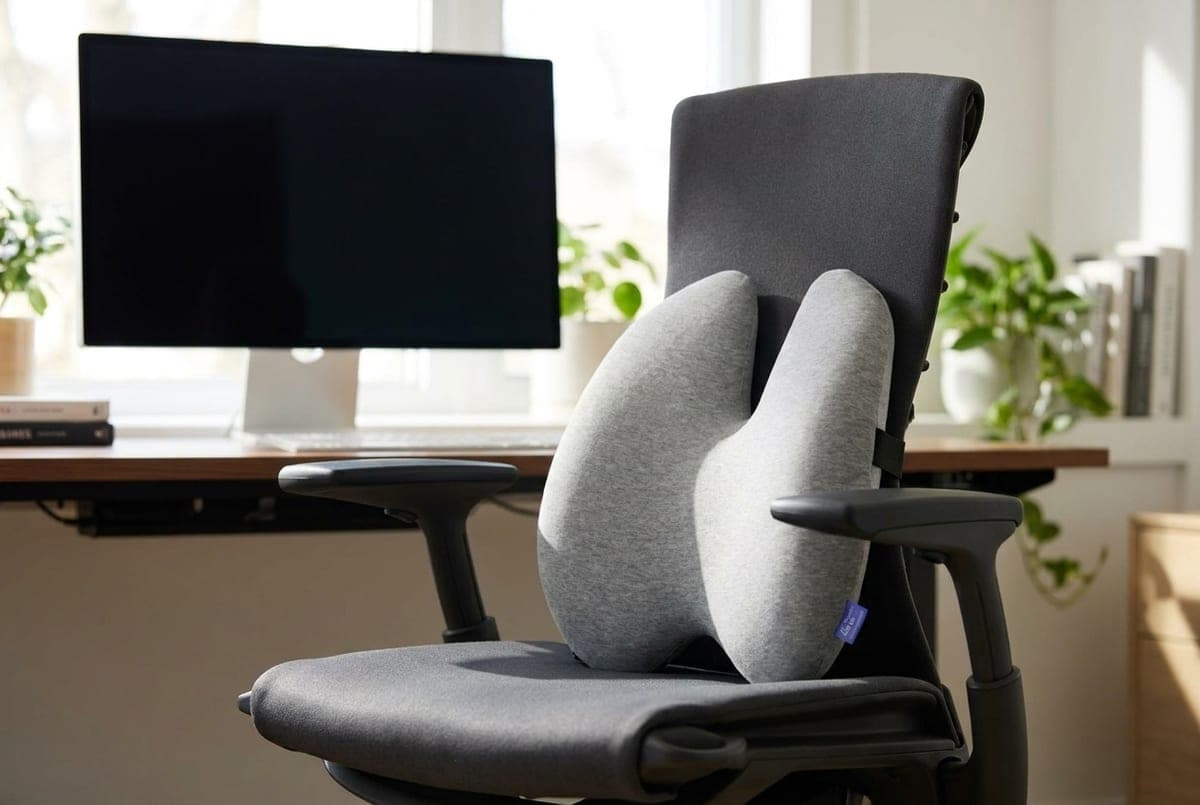
Cushion Lab's pillow is the most sophisticated shape here. Rather than a simple curve, it's a physical-therapist-designed multi-zone contour — a full 16 × 16 inches of extra-dense HYPERFOAM sculpted with a central channel for your spine and raised regions that cradle the muscles on either side. Where cheaper cushions support a single point, this one supports the whole lower back, which is why it's the pick for people whose problem is genuine, all-day discomfort rather than mild stiffness.
The foam is deliberately firm and dense — supportive, not plush — and a gel-lined non-slip strap keeps it from wandering. That firmness is also the main complaint you'll read: a minority of buyers find it too rigid or say it doesn't contour softly enough. And because it's a large, deep pad, it pushes you noticeably forward on a shallow-seat chair, so it's happiest on a deeper office seat where you have room to spare. Note Cushion Lab sells three easily-confused lumbar products — this is the full-back Ergonomic Lumbar Pillow, not the smaller Extra-Dense roll or the seat cushion.
What we like
- PT-designed multi-zone shape supports the entire lower back
- Extra-dense foam that resists bottoming out
- Gel-lined non-slip strap; washable cover
Worth knowing
- Firm enough that some find it too rigid
- Large, deep pad crowds shallow-seat chairs
- Material
- Extra-dense HYPERFOAM (CertiPUR-US)
- Mounting
- Gel-lined non-slip strap
- Dimensions
- 16 × 16 × 4 in
- Warranty
- 1 year
5. Best Clinical Pick
Original McKenzie Lumbar Roll
Typically around $38
- PT-recommended support
- Targeted lower-back relief
- Travel between chairs
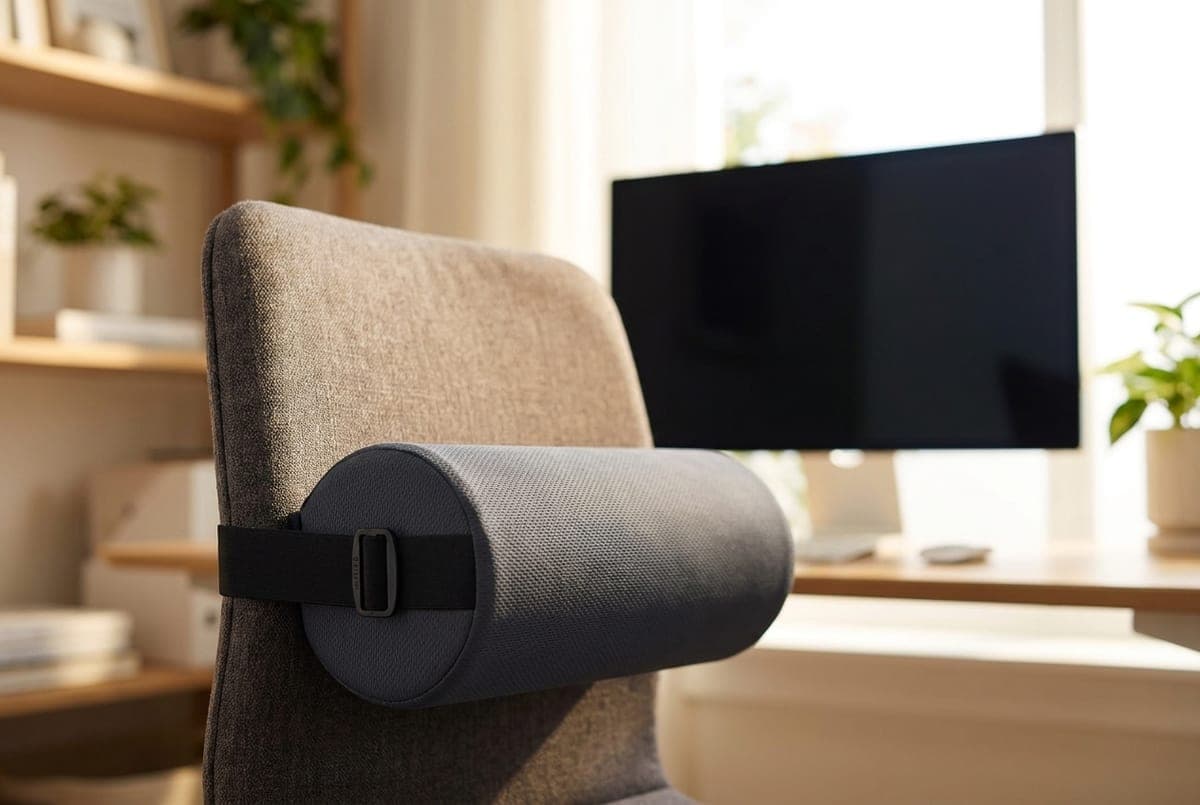
The McKenzie Roll is the cushion your physical therapist has probably actually handed you. Made by OPTP, it's the reference standard for the McKenzie Method — a firm, pre-compressed cylindrical foam roll, about 11 inches long and 4.75 inches in diameter, held on by a single 1.5-inch elastic strap. It doesn't try to cradle your whole back; it does one thing, which is push your lumbar spine into its natural inward curve, exactly where a clinician would place it.
That targeted approach is its strength and its limit. If you know your issue is lumbar position — you slump, you flatten your lower back, a PT told you to sit up into a curve — nothing here is more purpose-built, and you can move it between your office chair, dining chairs, and the car. If you want broad, plush, full-back comfort, this isn't it: the firmness is deliberate and polarizing, and it looks like the clinical tool it is. A firm version is offered for those who want more, and note the Roll is distinct from OPTP's flatter, low-profile SuperRoll.
What we like
- The clinical McKenzie-Method reference standard
- Firmly targets the lumbar curve where a PT would place it
- Compact and portable between chairs and the car
Worth knowing
- Targeted roll, not broad full-back comfort
- Deliberately firm; utilitarian, clinical look
- Material
- High-resiliency pre-compressed foam
- Shape
- Cylindrical roll, ~11 in × 4.75 in dia.
- Mounting
- 1.5 in adjustable elastic strap
- Options
- Standard or firm density
6. Best Adjustable
Core Products Deluxe Inflatable Lumbar Cushion
Typically around $55
- Dialing in exact firmness
- Tall users and travel
- Changing chairs often
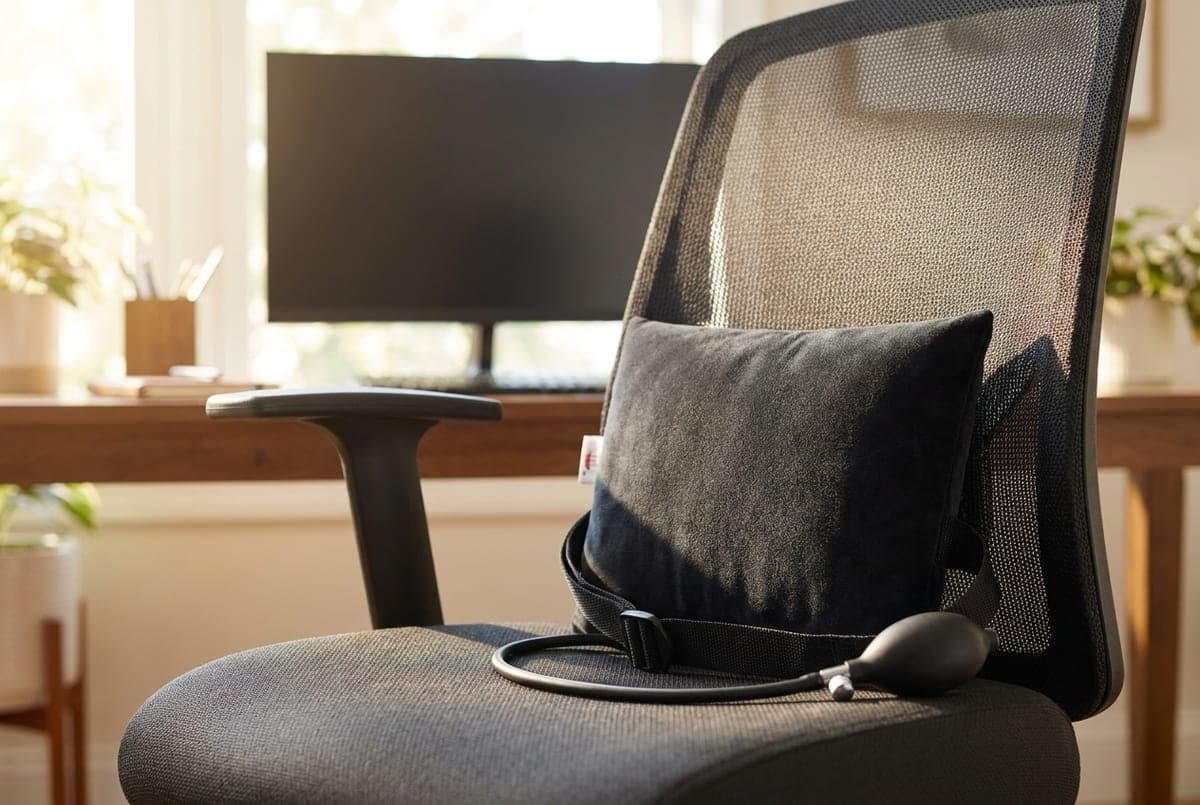
Every other cushion here is a fixed shape you either fit or you don't. Core Products' inflatable is the one you tune. An attached hand pump inflates it from about 1.5 inches up to 4 inches deep — 35 pumps or fewer — and a twist knob lets the air back out, so you control both firmness and how far it pushes into your back on the fly. That makes it the standout pick for tall users trying to raise the support point, for anyone who hasn't nailed down how much curve they want, and for travel, since it packs flat and weighs under half a pound.
It comes from a clinical-supply brand, mounts with a webbing strap and buckle, and at 15 × 7 × 4 inches (fully inflated) it's a compact, targeted pad rather than a full-back wedge. The honest caveat with any air bladder is longevity — inflatables can develop slow leaks over years in a way solid foam never will, and the feel is firmer and less plush than memory foam. Buy it for the adjustability, which nothing else here matches, and go in clear-eyed about the trade.
What we like
- True on-the-fly firmness and depth control (1.5–4 in)
- Ultralight and packs flat — ideal for travel and tall users
- From an established clinical-supply brand
Worth knowing
- Air bladders can develop slow leaks over years
- Firmer, less plush than memory foam
- Material
- Inflatable air bladder, fabric cover
- Adjustment
- Hand pump, 1.5–4 in depth
- Mounting
- Webbing strap + buckle
- Weight
- ~0.45 lb
The verdict
For most people, the Everlasting Comfort cushion is the right first buy — a proven contoured-foam shape, two straps that keep it parked at your lumbar curve, and a lifetime guarantee that makes it a no-risk experiment. If money is tight or you need a second one, the LoveHome does nearly the same job for around $28.
From there, buy to your specific problem. If heat is what kills lumbar cushions for you — or you bought a mesh chair for airflow — Purple's GelFlex grid is the one that won't trap warmth. For serious, all-day discomfort that needs broad support, Cushion Lab's PT-designed multi-zone pillow cradles the whole lower back, provided your seat is deep enough for it. If a physical therapist has you working on lumbar position specifically, the McKenzie Roll is the clinical reference standard. And if you can't settle on the right firmness — or you're tall and need to raise the support point — Core Products' inflatable is the only one here you can tune to the exact curve you want.
Whichever you choose, remember the placement rule that matters more than the brand: the thickest part belongs in the hollow of your lower back, around your belt line — not up between your shoulder blades. And remember what the cushion's depth does, because it's the part nobody mentions: a 2.5-to-4-inch pillow pushes you forward by its own thickness, subtracting that from your effective seat depth. A chair like the Steelcase Series 1 only adjusts 2.25 inches there, so start from its deepest setting and adjust around the cushion rather than adding one to a chair you've already dialled in. Pair it with a footrest that gets your feet flat and a monitor raised to eye level, and you've fixed the three things that wreck a sitting posture — for less than the cost of one new chair.
Frequently asked questions
For the right problem, yes. A cushion fills the gap between a chair's flat back and your spine's natural inward curve, which reduces the slumping and static muscle load that cause end-of-day lower-back ache. The clinical evidence is genuinely mixed and a cushion won't cure a structural issue like a herniated disc — but for posture-driven, sitting-related discomfort, it's one of the cheapest interventions that reliably helps. If your pain is sharp, radiating, or new, see a clinician first.
At the small of your back — roughly your belt line, around the L3–L5 vertebrae — not up between your shoulder blades. The most common reason a cushion 'doesn't work' is that it's mounted too low and pushes on your seat rather than your spine. Sit back fully, then adjust the strap so the thickest part of the cushion lands in the hollow of your lower back. Tall users especially often need to raise it higher than the default strap position allows.
Yes, but mounting matters more than on a solid chair. Mesh backs are flat and slippery, so a two-strap cushion that anchors top and bottom stays put far better than a single strap that can slide down a taut mesh panel. If breathability was your reason for buying a mesh chair, favor a cooling design — a gel grid like Purple's — so you don't cancel out the airflow with a heat-trapping foam block.
Gel grids run coolest by a wide margin: the open lattice lets air move through instead of trapping it. Memory foam is the warmest, even with a mesh cover, because it's a solid block against your back — this is the single most common complaint about foam cushions. Inflatable and roll-style cushions sit in between. If heat is your deciding factor, a grid cushion is the clear choice; if plush contouring matters more, foam wins.
Often, but check two things. Depth: a thick full-back cushion can crowd a compact car's seating position — a slimmer roll or pad travels better. Mounting: car seats have different headrest and strap geometry, so a two-strap or hook-and-loop design holds more securely through cornering than a single loose strap. Compact, targeted options like the McKenzie Roll or the inflatable cushion cross over to a car far more gracefully than a large sculpted wedge.
A well-designed chair with adjustable built-in lumbar support is ideal, but a good cushion gets most of the way there for a fraction of the price — and it lets you place the support exactly where your back wants it, which many fixed built-in systems don't. If you already own a decent chair whose only flaw is a flat lower back, a cushion is the smart, cheap fix. If your chair is failing in several ways at once, put the money toward the chair.
Keep building your setup
Ergonomics
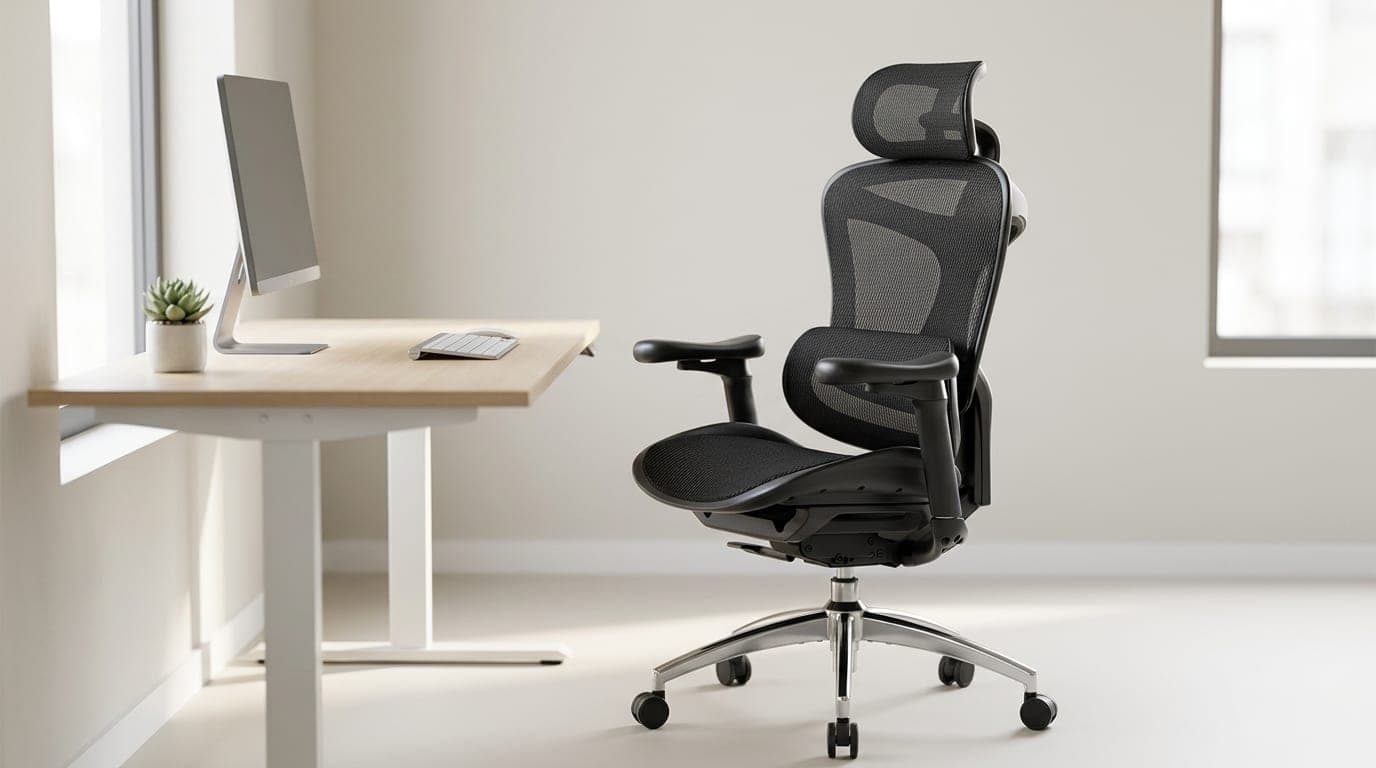
The Best Ergonomic Office Chairs Under $300 in 2026
You don't need a $1,500 Herman Miller to fix your back. Six ergonomic office chairs under $300 compared on the things that actually matter — real lumbar adjustment, armrest range, weight capacity, and who each one fits.
Updated September 15, 2026
Ergonomics
The Best Ergonomic Office Chairs Under $600 in 2026
The gap between a $250 chair and a $500 one isn't comfort — it's how long the thing survives and who pays when it doesn't. Six ergonomic office chairs from $330 to $600, compared on warranty terms read line by line, the adjustments that genuinely change your posture, and what each maker will still ship you a part for in year eight.
Updated August 13, 2026
Ergonomics
The Best Seat Cushions for Office Chairs in 2026
The cheapest fix for a hard seat that leaves your tailbone aching by 3pm. Six seat cushions compared by cutout shape, height, firmness, and how hot they run.
Updated July 29, 2026
Get the next guide in your inbox
One short email when we publish or meaningfully update a buying guide. No spam, no daily deals firehose.