 Rigworthy
What Actually Fits Under Your Desk
By Rigworthy Editorial Team · Updated September 18, 2026
Rigworthy is reader-supported: we may earn a commission if you buy through our links, at no cost to you. How we make money
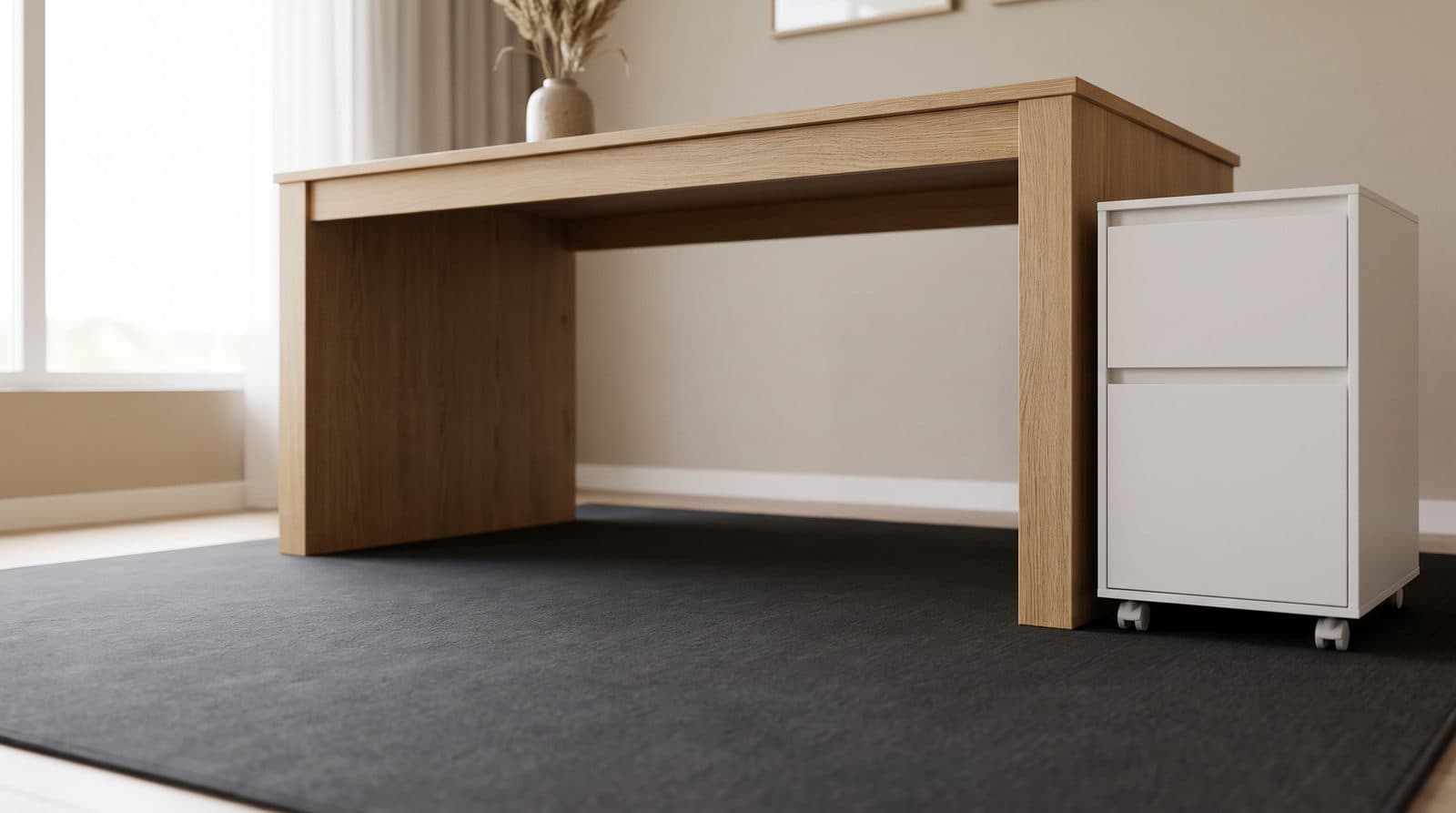
Desk storage is sold on a simple premise: there is a large empty volume under your desktop, and the right product turns it into drawers. Every guide on this site's storage hub is written on that assumption, and this one is about the fact that it is not true. The space under a desk has published minimum dimensions, specified independently by OSHA and by the office furniture industry's own standards body, and the two agree to within half an inch. It is a clearance envelope, and it was allocated before you started shopping.
That would be a technicality if the numbers were generous. They are not. Work through the arithmetic — and it is one subtraction, because the terms that vary most between a small adult and a large one cancel exactly — and the vertical space you can genuinely spend below a correctly set desktop is one to three inches. The VIVO drawer we rate Best Overall is 5.5 to 6.3 inches tall. The FlexiSpot S01 is 3.9. OSHA's own text names the products this category sells, in one sentence: the space "should remain free of items such as files, CPUs, books, and storage."
The useful part is why so many people get away with it, and what to do instead. The budget is generous exactly when your desk is too tall, which most desks are — so the drawer usually fits, and it is being paid for out of an ergonomic error you would otherwise want to fix. Meanwhile the dimension nobody competes on is enormous: the protected corridor is under 20 inches wide, and a 55-inch desk has 35 inches that your legs have no claim on at all. This piece has the standards, the arithmetic, the measured drop of every product we recommend, and three corrections to our own guides — including one where we published a drawer's external dimensions in the interior-dimensions field.
The short version
- The space under a desk is a published clearance envelope, not free volume. OSHA and BIFMA specify it independently and agree closely: roughly 20 inches wide, 17 inches deep at knee level, 24 inches deep at foot level, and at least 26.8 inches of height for the thighs.
- OSHA's own wording names the products this category sells. The clearance space "should remain free of items such as files, CPUs, books, and storage." Our three storage guides sell drawers, a PC mount and a file cabinet into exactly that volume.
- The vertical budget is a difference, and the difference cancels almost everything out. Spendable drop below the desktop = your elbow rest height minus your thigh clearance, minus the keyboard, minus the desktop. Across the whole design population that is 1.0 to 2.7 inches.
- Every under-desk drawer we recommend overruns the budget. The FlexiSpot S01 is 3.9 inches tall; the VIVO clamp-on, our Best Overall pick, is 5.5 or 6.3 depending on the clamp setting. That is double to triple what a correctly set desk can spare.
- The budget is large exactly when the desk is wrong. On a 29-inch fixed desk, a median woman has around six inches of clearance to spare — because the desk is four inches too tall for her. The drawer fits, and it is being paid for out of an ergonomic error.
- Width is the budget you actually have. The protected zone is 19.8 inches out of a 48-to-60-inch desk, so there is 28 to 40 inches of unprotected width. Put storage beside your knees, not below them.
- "Fits under a 29-inch desk" is measured against a desk our own height guide says is one to three inches too tall for most people. Set your desk correctly and two of the six cabinets we recommend stop fitting, and a third becomes a dead heat.
Measurements here come from manufacturers' own published mounting specifications, not from our estimates. Read the full methodology.
The space under your desk already belongs to something
Every guide on this hub, ours included, treats the underside of a desk as found space — a volume that was going to waste until somebody sold you a drawer to put in it. That framing is so natural it is almost invisible, and it is wrong in a specific and checkable way. The space under a desk is a clearance envelope with published minimum dimensions, and it is spoken for before you buy anything.
Two organisations specify it independently. OSHA's Computer Workstations eTool gives minimum clearance areas for a seated user, sized to accommodate everyone from a 5th-percentile woman to a 95th-percentile man. BIFMA — the office furniture industry's own standards body — publishes its version in the G1 ergonomics guidelines, reproduced with the derivations intact in Allsteel's Ergonomics and Design reference guide. Neither is obscure. Neither is quoted in a single desk-storage article we have been able to find, including our own three.
The striking thing is how closely they agree. These are different documents from different bodies using different anthropometric derivations, and they land within half an inch of each other on every dimension. That is unusual enough to be worth trusting: when a furniture trade association and a federal safety agency independently arrive at the same envelope, the envelope is real.
And then there is the sentence that made this article necessary. Under "Possible Solutions," OSHA writes that you should provide adequate clearance for users to change posture, and that "this space should remain free of items such as files, CPUs, books, and storage." It goes on: "Limit the number of items that are stored under the work surface. There should be no items stored that will limit the space needed for workers' legs and feet."
Read our three storage guides side by side and you will find, in order: a file cabinet, a PC mount, and a range of storage. OSHA named all three in one sentence. That is not a coincidence — it is the standard describing the failure mode that the products cause. This is the sharpest version of a problem this site keeps finding: each of our guides is correct on its own, and a reader who follows all of them ends up somewhere none of them intended.
The rest of this piece is not an argument that you should buy nothing. It is the arithmetic that tells you how much you can put under there, which turns out to be a surprisingly small and surprisingly computable number — and, more usefully, where the space you actually have is hiding. It is not below your knees. It is beside them.
| Dimension | OSHA eTool | BIFMA G1 | What the BIFMA figure is built from |
|---|---|---|---|
| Height for thighs (floor to underside) | 20–28 in at the hip, adjustable | At least 26.8 in | Thigh clearance + popliteal height + shoe allowance |
| Depth for knees | 17 in at knee level | No less than 17 in | Buttock-to-knee length − abdominal extension depth |
| Width for thighs | 20 in wide | No less than 19.8 in | Sitting hip breadth + movement + clothing allowance |
| Depth at foot level | 24 in | No less than 23.5 in | Buttock-to-popliteal + foot length − abdominal depth |
| Height at foot level | 4 in | 4.2 in | Lateral malleolus height + shoe allowance |
| Height of the work surface itself | Not specified | 22.2–28.5 in adjustable; 28.5 in fixed | Popliteal + elbow rest + shoe − input device thickness |
The vertical budget is about two inches, and it barely depends on who you are
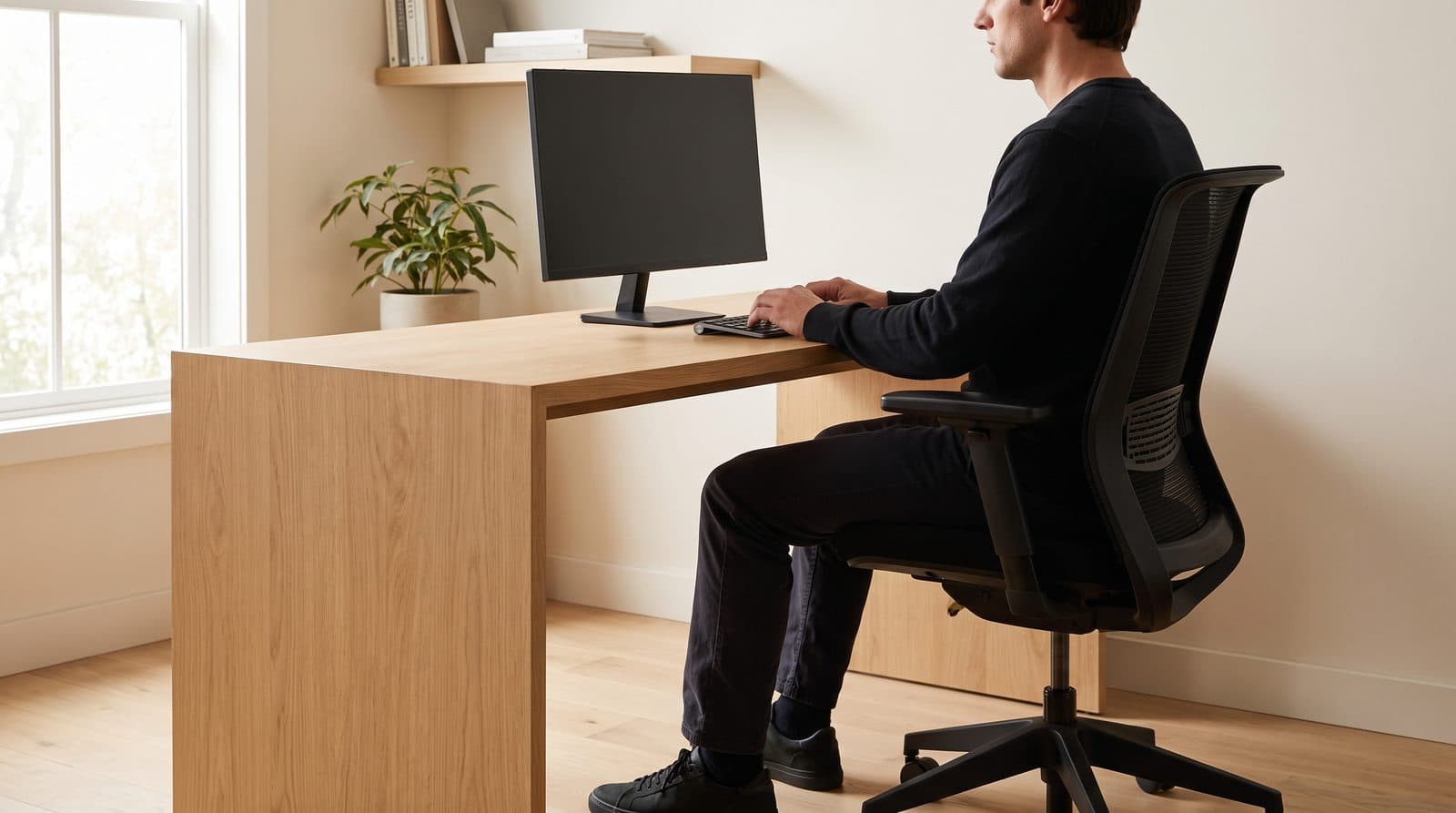
The number a shopper actually needs is not in either standard, because both are written for people specifying furniture rather than people buying a drawer. What you want to know is: how far below my desktop can something hang before it hits my legs? That is a subtraction, and — as this site has now found five runs running — the subtraction is far better behaved than either of the numbers going into it.
Start from BIFMA's own two formulas, both of which are in the table above. The height of the work surface is your popliteal height (floor to the underside of your knee, seated) plus a shoe allowance plus your elbow rest height, minus the thickness of the keyboard your hands are actually resting on. The clearance your thighs require is your popliteal height plus a shoe allowance plus your thigh clearance. Subtract the second from the first and take off the thickness of the desktop itself:
Spendable drop = elbow rest height − thigh clearance − keyboard thickness − desktop thickness.
Popliteal height and the shoe allowance cancel exactly, which is the whole trick. They are the two terms that carry most of the variation between a small adult and a large one, and they appear identically on both sides. What survives are two measurements taken from the surface of the seat — how far your elbow sits above it, and how far the top of your thigh does — and those vary together, because both are governed by the same body.
Run it across the Natick figures that BIFMA references and the answer is a narrow band. A 5th-percentile woman gets 1.0 inch. A 95th-percentile man gets 2.7. Elbow rest height across those same rows spans 7.1 to 11.6 inches — four and a half inches of variation in the input, collapsed to under two in the output. Nobody in the design population gets three inches.
That is worth cross-checking against the standards directly, because a derivation this convenient deserves suspicion. BIFMA's own published guideline numbers give the same answer by a completely different route: a fixed work surface is specified at 28.5 inches and the required thigh clearance at 26.8, a gap of 1.7 inches once you subtract a one-inch desktop. At the small end, the adjustable minimum of 22.2 inches against a 5th-percentile thigh clearance of 21.0 gives 1.2. Two derivations, one to three inches, no overlap with the four inches the category sells.
One honest caveat on the method, the same one that applies to any percentile table. The 95th-percentile row for elbow rest height and the 95th-percentile row for thigh clearance do not describe the same person, so the true spread between real individuals is wider than the table shows. It is not wider by much — both are torso-and-limb measurements that move together — and the conclusion survives a generous error bar, because the gap between two inches and four inches is not a rounding problem.
| Person | Elbow rest height | Thigh clearance | Spendable drop |
|---|---|---|---|
| 5th-percentile woman | 7.1 in | 4.1 in | 1.0 in |
| 50th-percentile woman | 9.2 in | 5.4 in | 1.8 in |
| 95th-percentile woman | 11.0 in | 6.9 in | 2.1 in |
| 5th-percentile man | 7.4 in | 4.3 in | 1.1 in |
| 50th-percentile man | 9.5 in | 5.7 in | 1.8 in |
| 95th-percentile man | 11.6 in | 6.9 in | 2.7 in |
Measured against that, almost nothing in the category fits
Here is where the arithmetic becomes uncomfortable, because the products in question are ones we recommend. Under-desk drawers are almost never published with a "drop" figure — the distance they hang below the desktop — so we went and got what the manufacturers do publish from their own specification pages. "Almost" is doing real work in that sentence, and the exception is instructive: VIVO gives a true drop for exactly one drawer in its line (the lockable DESK-AC03L, "3.3 inches below desk surface") and overall height for the other two. One maker, one product family, two incompatible conventions.
The VIVO clamp-on drawer, our Best Overall pick, is 5.5 or 6.3 inches tall depending on which of its two clamp settings you use. VIVO publishes the DESK-AC03C at 15.7 inches long (21.4 including the clamps) by 9.1 deep, with an interior of 14.3 by 8.7 by 3.8. The FlexiSpot S01 is 3.9 inches, published by FlexiSpot as 14.6 by 11.3 by 3.9 overall. Both exceed the spendable drop of a correctly set desk — the S01 by roughly double, the VIVO by three times — and note which way round that runs: the cheaper clamp-on, not the heavy lockable one, is the bigger intrusion into your knee room. As the correction near the end of this piece records, this paragraph previously carried the figures for a different VIVO drawer.
The PC mount is not close to the same conversation. Our HumanCentric pick takes cases 12 to 21 inches tall, which is six to ten times the budget — and "CPUs" is one of the three things OSHA names by hand. That does not make it a bad product, but it does mean it belongs beside your legs rather than in front of them, which is a placement decision our guide does not currently make explicit.
Two of the five under-desk products come out fine, and the reasons are instructive. The VIVO corner clamp-on drawer (DESK-DR3C) hangs off the desk's side or corner, outside the knee envelope rather than under it — on any desk wide enough to have a clear strip, which is most of them, its geometry was never in conflict. Our guide files it under "Best Multi-Level" and flags side-hung units as a risk on small desks; neither line recognises that on a normal desk it is the one product that solves the clearance problem by construction. And the HUANUO keyboard tray is an honest exception in a more interesting way, which the next paragraph is about.
A keyboard tray looks like the worst offender — it deliberately hangs a platform below the desktop. But it is the only product here that spends the budget on the thing the budget is for. BIFMA's work-surface formula subtracts input device thickness precisely because the keyboard is what your hands rest on; a tray simply moves that surface down and lets the desktop sit above elbow height. It is not competing with your thighs for the space, it is converting the space into the thing your arms needed. Whether it fits still depends on the same arithmetic — a tray hanging more than a couple of inches down on a correctly set desk will hit your thighs — but it is spending the money on the right thing.
The generalisable point, and it is the one worth carrying off this hub: when a product category does not publish a spec, it is often because the spec is the one that would disqualify it. Drawer makers publish width, interior volume and load rating. Drop is the number that has to be checked against your legs, and checking it against your legs is how you decide not to buy one — so it is published rarely, inconsistently, and, as VIVO's own line shows, on two different conventions within a single catalogue. A shopper comparing "4 inches" against "3.3 inches below desk surface" is not comparing like with like, and nothing on either page says so.
| Product | Where it mounts | Drop below the desktop | Against a ~2 in budget |
|---|---|---|---|
| VIVO clamp-on drawer (DESK-AC03C) | Desk underside, front | 5.5 or 6.3 in (two clamp settings) | Nearly triple |
| FlexiSpot S01 | Desk underside, screw-mount | 3.9 in | About double |
| HUANUO keyboard tray | Desk underside, on rails | Varies by mount; slides back out of the way | Spends it on the keyboard — by design |
| VIVO corner clamp-on drawer (DESK-DR3C) | Desk side or corner | Hangs outside the knee envelope | No conflict |
| HumanCentric PC mount | Desk underside, screw-mount (or wall) | 12–21 in (the case height) | Six to ten times over |
The budget is generous exactly when your desk is wrong
At this point a reasonable objection arrives: plenty of people have an under-desk drawer and their knees are fine. That is true, and the explanation is the most useful finding in this article, because it is not "the standards are too cautious."
Almost nobody has a correctly set desk. Our own standing desk height guide puts it bluntly: most desks in the world are a fixed 29 to 30 inches, that convention is inherited from writing furniture rather than typing, and "for most people a fixed desk is not slightly too tall, it is one to three inches too tall." Every one of those surplus inches lands in the space under the desk. If anything that range is conservative at the short end: a 5th-percentile woman's correct surface is BIFMA's 22.2-inch adjustable minimum, which makes a standard desk close to seven inches too tall for her — and hands her close to seven extra inches of storage space she is paying for with her shoulders.
Do the arithmetic for a median woman. Her correct work surface is around 24.9 inches, which leaves the roughly 1.8-inch budget from the table above. Sit her at a standard 29-inch desk instead and the underside jumps to 28 inches while her thighs still only need 22.1 — a budget of 5.9 inches, enough for the four-inch drawer with room to spare. A 95th-percentile man at the same desk has 3.2 inches, because a 29-inch desk is very nearly correct for him. A 5th-percentile woman has nearly eight, because it is nearly seven inches too tall for her.
So the drawer fits. It fits because the desk is too tall, and the same four surplus inches that make room for it are the reason her shoulders creep up by four in the afternoon. The storage is being paid for out of an ergonomic error, and if you ever fix the error the storage stops fitting. That is a genuinely awkward thing for a site that sells both, and it is the single most important sentence in this piece.
It also explains the whole history of the keyboard tray, which stops looking like an accessory and starts looking like a workaround. Office furniture spent decades bolting trays under desks that were built too tall, spending the surplus clearance on lowering the hands. That is the correct use of the space. A drawer spends the same surplus on stationery.
None of which means you should refuse to own a drawer until you own an adjustable desk. It means the order of operations matters, and it is the reverse of how the category is sold: set the desk height first, measure what is left, and then buy storage to fit the leftover — not the other way round. If you are on a fixed 29-inch desk and you intend to stay there, you have somewhere between three and eight inches to play with depending on your size, and the four-inch drawer is a perfectly sensible purchase. If you are on a sit-stand desk that you actually set to your elbow, you have about two, and it is not.
| Person | Correct work surface | Budget when the desk is right | Budget at a 29 in desk |
|---|---|---|---|
| 5th-percentile woman | ~22.1 in | 1.0 in | 7.9 in |
| 50th-percentile woman | ~24.9 in | 1.8 in | 5.9 in |
| 50th-percentile man | ~26.8 in | 1.8 in | 4.0 in |
| 95th-percentile man | ~28.5 in | 2.7 in | 3.2 in |
Width is the budget you actually have
Everything above is about the vertical dimension, which is the one the category competes in and the one you barely own. Turn the envelope on its side and the picture inverts completely.
The protected zone is 19.8 inches wide. A desk is 48, 55 or 60. So a 48-inch desk has 28 inches of width that your legs have no claim on, and a 60-inch desk has 40. That is the real storage space under a desk, it is enormous, and not one product in our three guides is positioned by it — because "mount it to one side" is not a feature you can put on a box.
It changes which cabinet you should buy, too, and it promotes a spec our own guide treats as a nice-to-have. Assume the envelope sits centred on where you sit: a 48-inch desk leaves roughly 14 inches of clear width on each side. The DEVAISE slim at 11.8 inches wide fits in that strip. The Branch pedestal at 12 fits. The HELMER at 11 fits. The Vari and the Poppin Stow, both 15.75 inches wide, do not — on a 48-inch desk they intrude into your leg space by about an inch and a half, and they only stop doing so at around 55 inches of desk width.
Our rolling-cabinet guide describes the DEVAISE's narrow body as useful "in the tight gap between a desk leg and a wall." That undersells it by a category. The slim width is not for the gap beside the desk; it is what lets the cabinet live under the desk without taking your knees with it, and on the most common desk width sold it is the difference between compatible and not.
The same logic reorganises the drawers. The VIVO clamp-on is 15.7 inches wide and 21.4 across its clamps; mounted where the instructions show it — centred, under the front edge — it occupies almost the whole 19.8-inch protected corridor. Slide the same drawer to the far left or right of a 55-inch desk and its six-inch drop stops mattering, because there are no thighs under it. The product did not change. Its position did, and position is free.
There is a depth axis too, and it is the one that catches PC mounts. The envelope is 17 inches deep at knee level but 23.5 to 24 inches at foot level, which means the volume you can use is the wedge behind your feet and above the floor at the back of the desk — the deepest, most annoying-to-reach part of the desk, which is exactly why a tower ends up there and exactly why it works. On a 30-inch-deep desk there are about six inches of depth at the back that no part of you occupies.
So the resolution to the whole problem is not "put nothing under your desk." It is much more specific and much easier to follow: keep a corridor about 20 inches wide, 17 inches deep and 27 inches high clear in front of your chair, and use everything else. Most desks have far more "everything else" than they have clutter.
| Desk width | Clear strip each side | Cabinets narrow enough for the strip | Cabinets too wide for it |
|---|---|---|---|
| 48 in | ~14.1 in | HELMER (11.0), DEVAISE (11.8), Branch (12.0), ALEX (14.1) | Vari, Poppin Stow (15.75) |
| 55 in | ~17.6 in | All six | — |
| 60 in | ~20.1 in | All six, with room to open a drawer | — |
"Fits under a 29-inch desk" is measured against the wrong desk
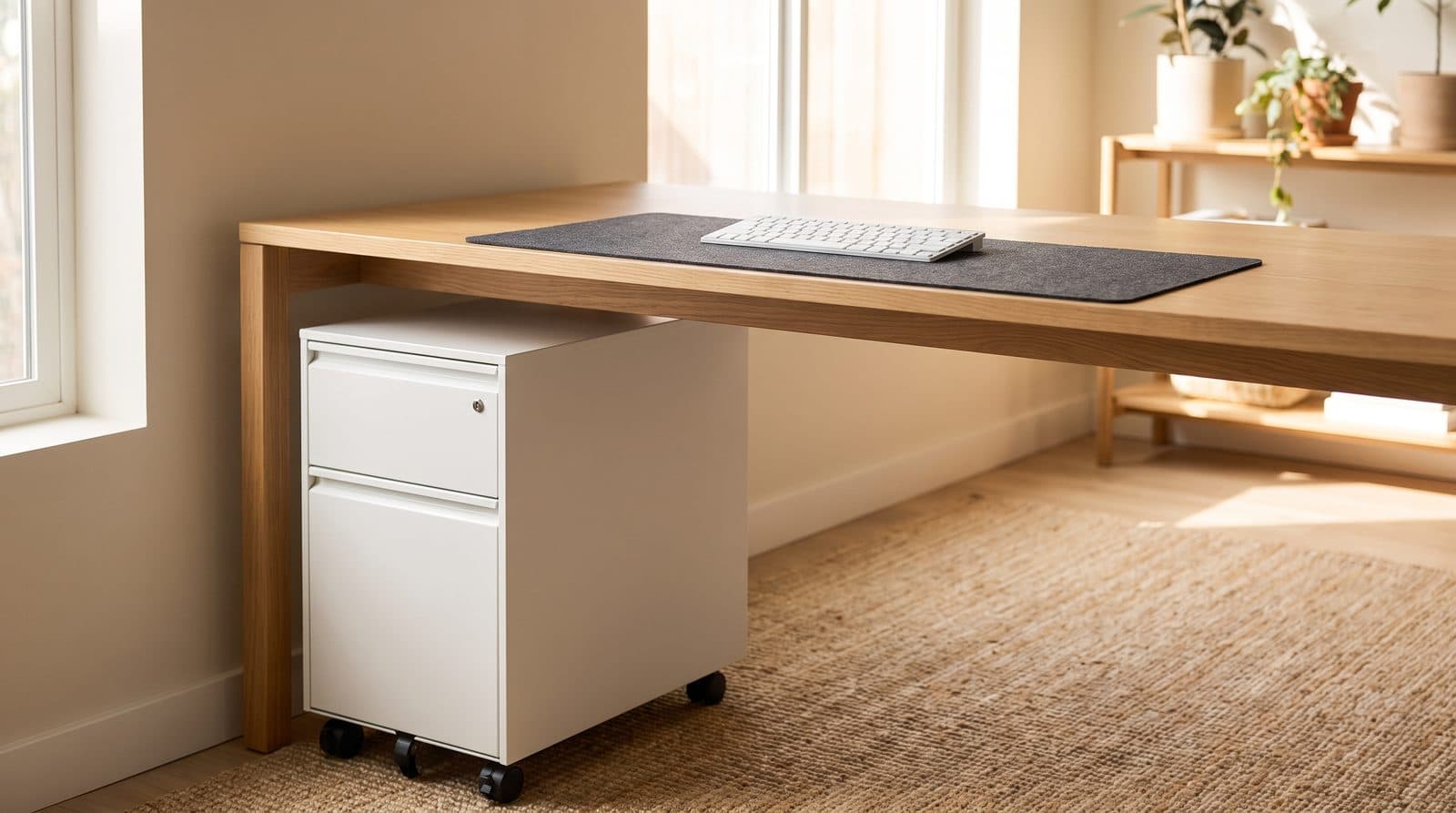
Our rolling-storage guide leads on one spec above all others, and it says so explicitly: "the single spec that trips people up isn't drawers or price — it's height." That is correct. The problem is the number it is measured against.
The guide's criterion reads "a standard desk is ~29 in tall," and its comparison table's third column is literally titled Fits under 29" desk. Meanwhile, four guides away, our height guide is arguing that a 29-inch desk is one to three inches too tall for most adults and that you should set yours to your elbow. Both statements are correct in isolation. Follow both and you buy a cabinet sized to a desk you have just been told to stop using.
Set the desk correctly and the ranking changes. For a median woman at a 24.9-inch surface with a one-inch top, the clearance underneath is 23.9 inches — and the Vari File Cabinet, our Best Overall pick at 25.8 inches tall, no longer goes under the desk at all. The HELMER at 27.1 needs a 28.1-inch work surface to roll under, which is a standard desk or taller: on a correctly set one it clears only for the tallest users. The Poppin Stow at 24.0 becomes a dead heat, a tenth of an inch on the wrong side and well inside the noise of where you park the casters. So the ALEX, which we already flag as a beside-the-desk unit at 29.9 inches, is joined by two cabinets we currently present as under-desk picks, with a third too close to call.
This does not overturn the guide's recommendations, and we are not going to pretend it does — the Vari is still the best-built pedestal in that lineup, and standing beside a desk is a perfectly good place for a file cabinet. What changes is the claim attached to it. "Rolls under a standard 29-inch desk" is true of a standard desk and false of a correct one, and a reader who is doing the ergonomics properly is exactly the reader most likely to be misled by it.
The fix is one substitution, and it is the same move as measuring your own viewing distance before buying a laptop stand rather than trusting the category's default. Do not ask whether a cabinet fits under a 29-inch desk. Measure from the floor to the underside of your own desktop, at the height you actually sit at, and subtract an inch for the casters to roll over a rug. It takes ten seconds and it is the only number that decides the purchase.
One further wrinkle for sit-stand owners, which our guide raises and then under-states. A desk that moves has a lowest setting, and the cabinet has to clear that, not the setting you happen to use. Our height guide tabulates frame travel at 25 to 26 inches on the popular frames, so a desk that reaches 48 inches standing typically bottoms out around 22 to 23 — below every cabinet in the lineup except the Branch. If you ever lower the desk all the way with a pedestal parked under it, the desk wins.
| Cabinet | Height | Under a 29 in desk (28 in clear) | Under a correct 24.9 in desk (23.9 in clear) |
|---|---|---|---|
| Branch Mobile Pedestal | 20.0 in | Yes | Yes |
| DEVAISE 3-drawer slim | 23.4 in | Yes | Yes, by 0.5 in |
| Poppin Stow | 24.0 in | Yes | Dead heat — 0.1 in over |
| Vari File Cabinet | 25.8 in | Yes | No |
| IKEA HELMER | 27.1 in | Yes, by 0.9 in | No |
| IKEA ALEX on casters | 29.9 in | No — stands beside | No |
Three corrections: the dimensions we published, the drawer we ranked on them, and the drawer that turned out to be two drawers
This hub's own buying criteria open with "real interior dimensions — will a notebook, charger, or A4 paper actually fit," and the category page repeats it: "check inside measurements against what you'll actually store... not just the outer footprint." It is the right instruction. Checking our own guides against it produced three findings, and the last two are straightforward errors.
First, the coverage. Across the seventeen products in our three storage guides, exactly two carried interior dimensions before this run: the FlexiSpot S01 and the VIVO corner organiser. Everything else was quoted on its outer footprint, which is the specific thing the criterion tells readers not to shop on. That is the third time in four runs that this site has found a hub naming a governing spec in its criteria and then publishing it for almost nothing — it is becoming the cheapest check we run, because it needs no external research to spot, only to fix.
Second, and worse: one of those two is mislabelled. Our guide lists the FlexiSpot S01's "interior dimensions (approx.)" as 14.6 by 11.3 by 3.9 inches. FlexiSpot publishes exactly those figures as the drawer's external dimensions. The real interior, from FlexiSpot's own European listing, is 32 by 24 by 6 centimetres — 12.6 by 9.5 by 2.4 inches. We had credited the drawer with two extra inches in each direction and an extra inch and a half of depth, in the one field the hub tells readers to shop on.
The same entry carried a second error of the type run 52 warned about. We listed the S01's overall width as "~17.7 inches." FlexiSpot does sell a 17.7-inch under-desk drawer — it is a different product with a different model listing. The S01 is 14.6 inches overall. As with the laptop stand that turned out not to be adjustable, every individual claim was plausible for the category, and the entry read like a competent description of something else.
The practical consequence is smaller than the error, which is worth saying plainly rather than dramatising. US Letter is 11 by 8.5 inches and A4 is 11.7 by 8.3, so both still lie flat inside a 12.6-by-9.5-inch drawer — the guide's claim that it takes letter and A4 paper survives. What does not survive is the margin. We implied about three inches of slack in each direction; there is closer to one, and a ring binder or a padded laptop sleeve that would have fitted the published figures will not fit the real ones.
And once both interiors are on the page, the guide's own ranking reads differently. What the S01 buys you is the lock and the 22-pound rating, both of which are real and neither of which is volume — so the sentence our guide used to open it with, that it is "the drawer for people who need more than a cubby," was describing the wrong axis. That claim has been rewritten.
All of those corrections are now in the guide, along with the drop figures and load ratings that were missing. While we were there: VIVO rates its drawers at 11 pounds, not the 5-to-15 the guide's FAQ generalised, and IKEA rates the HELMER at 2 pounds per drawer and 11 pounds total — a figure our guide had for the drawer but not for the unit.
Correction, 18 September 2026 — a third finding, and it invalidates some of the arithmetic above as originally published. Everything in the two paragraphs before this one about the VIVO drawer was measured against the wrong VIVO drawer. Our guide's Best Overall pick carried the product slug vivo-desk-ac03c and the name "18-inch clamp-on," but every published number — 18 by 12.2 by 4.0 overall, 15.9 by 11.3 by 2.8 inside, a 5/8-inch minimum desktop thickness — belongs to DESK-AC03B, the bracket-mounted pull-out drawer, a different $59.99 product. The clamp-on VIVO actually sells, DESK-AC03C, is $39.99 and measures 15.7 by 9.1 by 5.5 or 6.3 inches, with a 14.3 by 8.7 by 3.8-inch interior and a 2-inch maximum desktop thickness. The entry was a blend of two real products: the mounting story from one, every number from the other. This piece then wrote the blend into a single label — "VIVO 18" clamp-on drawer (DESK-AC03B)" — and built a drop calculation on it.
Three things change. The drop is 5.5 or 6.3 inches, not 4.0, which makes this article's central claim stronger rather than weaker: the cheapest, most-recommended drawer in the category overruns a correctly set desk's clearance by three times, not two. The interior comparison flips on one axis — the S01 is deeper in plan than the clamp-on (9.4 inches against 8.7) while the clamp-on is wider and an inch and a half taller inside, so the old line that the S01 is smaller "in all three dimensions" was false and is gone. And the paper margin shrinks: A4's short side is 8.27 inches against 8.7 inches of drawer depth, so it lies flat with under half an inch to spare, not the inch we claimed.
The lesson is the cheapest one this site has found, because it needed no external research to spot. Our own slug said AC03C while our own specs said AC03B, in the same file, eleven lines apart. A product entry that disagrees with its own identifier is a defect visible to a text search, and nobody ran it.
The whole thing, in five minutes and one tape measure
None of this needs the standards documents. It needs three measurements you can take before you spend anything, and they will settle the purchase faster than any comparison table.
1. Set the chair and the desk first. Feet supported, elbows level with the work surface. Our chair adjustment guide is the order of operations and our height guide is the desk half. Everything below is measured against a correctly set desk, and if yours is three inches too tall you have three extra inches of storage space that you are paying for elsewhere.
2. Measure the clearance you have. Floor to the underside of the desktop, at the height you actually sit at — and on a sit-stand desk, at its lowest setting if there is any chance you will use it. That is the number every cabinet has to clear.
3. Measure the clearance you need. Sit normally and measure from the floor to the top of your thigh where it passes under the desk. Add an inch so you can cross your legs and shift position. The difference between this and step two is your entire vertical budget, and for most people at a correct desk it will be somewhere between one and three inches.
4. Mark the corridor. Sit down, and put a strip of tape on the floor 10 inches to either side of your centreline and another 24 inches out in front of your chair. That rectangle is the envelope. Nothing goes in it — not a tower, not a pedestal, not a box of files. Everything outside it is fair game, and on a 55- or 60-inch desk that is most of the desk.
5. Then buy for the leftover. If the vertical budget is under two inches, nothing mounts under the front edge; put a corner or side-hung organiser on the desk's edge instead, or move the storage up the wall onto a pegboard where the constraint does not exist. If you have four or more inches — which usually means a too-tall fixed desk — a drawer will fit, mounted to one side rather than centred. And if what you need is real volume, a rolling pedestal narrow enough to sit in the clear strip beside your knees does more than anything you can bolt to the underside.
The one-sentence version, and it is the opposite of how this category is sold: the space under a desk is mostly not yours, but the space to the sides of it is almost entirely unclaimed — so stop shopping for things that hang below your desktop and start shopping for things that stand beside your knees.
The bottom line
Measure two things before you buy anything, and neither of them is on a product page. Floor to the underside of your own desktop, at the height you actually sit at — and on a sit-stand desk, at its lowest setting. Then floor to the top of your thigh where it passes under the desk, plus an inch so you can shift and cross your legs. The gap between those numbers is your entire vertical budget. If it comes out around two inches, which it will on a correctly set desk, then nothing in the under-desk drawer category mounts under your front edge, and you should stop shopping in it.
That is not the same as having no room. It is the wrong axis. The protected zone is roughly 20 inches wide, 17 deep at the knee and 24 at the foot, and a normal desk is 48 to 60 inches across — so the storage space under your desk is real, large, and located to the sides and the back rather than under your shins. Mark that corridor on the floor with two strips of tape once, keep it clear, and everything outside it is yours. In practice that means a slim pedestal in the 11-to-12-inch class parked in the strip beside your knees does more for a desk than anything you can bolt underneath it, and a drawer mounted eight inches off-centre stops being a problem for free.
And if the honest answer is that you have no vertical budget and no clear strip either — a 48-inch desk in a small room is a genuinely tight case — then the space you want is not under the desk at all. It is the wall behind it, where the clearance envelope has no jurisdiction, and our pegboard guide is the one to read instead. The best under-desk storage decision a lot of people can make is to put the storage somewhere else.
Frequently asked questions
OSHA and BIFMA specify it independently and agree closely: roughly 20 inches of width, 17 inches of depth at knee level, 23.5 to 24 inches of depth at foot level, and at least 26.8 inches of height from the floor to the underside of the desktop for a large adult. Your own requirement is lower if you are shorter — it is your seated popliteal height plus your thigh clearance plus an inch for shoes. The fastest way to get it is to sit down and measure from the floor to the top of your thigh where it passes under the desk, then add an inch so you can shift position and cross your legs.
It depends almost entirely on whether your desk is the right height. On a correctly set desk the spendable drop below the desktop is only about one to three inches, and every under-desk drawer we recommend overruns it — the FlexiSpot S01 is 3.9 inches tall and the VIVO clamp-on is 5.5 or 6.3 depending on its clamp setting. On a standard 29-inch fixed desk, which is one to three inches too tall for most adults, that surplus lands under the desk and gives a median woman closer to six inches of room, so the drawer fits comfortably. The other fix is free: mount it to one side rather than centred under the front edge, since the protected zone is only about 20 inches wide and a 55-inch desk has 35 inches that your legs have no claim on.
It is bad to put it in front of your legs. OSHA's guidance names CPUs specifically among the items the under-desk clearance space "should remain free of," and a mid-tower case is 12 to 21 inches tall against a vertical budget of a couple of inches. But the objection is about position, not principle. The protected envelope is roughly 20 inches wide and 24 inches deep at foot level, so on a 55- or 60-inch desk there is a large volume at the back and to the sides that no part of you occupies — which is where a floor-standing or under-mounted tower belongs. Mounted there, an under-desk PC mount genuinely does clear your floor without costing you anything you were using.
Measure from the floor to the underside of your own desktop rather than trusting the standard 29-inch figure, because that figure describes a desk most people should not be using. At a correctly set 24.9-inch desk the clearance is about 23.9 inches, which the Branch pedestal (20 in) and the DEVAISE slim (23.4) clear, the Poppin Stow (24.0) meets to within a tenth of an inch, and the Vari File Cabinet (25.8) and IKEA HELMER (27.1) do not. Width matters as much as height and gets less attention: the clear strip beside your legs on a 48-inch desk is only about 14 inches, so the 11-to-12-inch slim pedestals fit under it and the 15.75-inch ones intrude. And if you have a sit-stand desk, check the cabinet against its lowest setting, which is typically 22 to 23 inches — below everything in the lineup except the Branch.
Because a keyboard tray is the one product that spends the clearance on the thing the clearance is for. BIFMA's own formula for work surface height subtracts the thickness of the input device, since what your hands rest on is the keyboard rather than the desktop, and a tray simply moves that surface down so the desktop can sit above elbow height. That is why the office furniture industry bolted trays under desks for decades: fixed desks were built too tall, and the tray spent the surplus on lowering the hands instead of on stationery. The arithmetic still applies — a tray hanging more than a couple of inches below a correctly set desk will meet your thighs — but on a too-tall desk it is the best possible use of the space.
All of it except a corridor about 20 inches wide in front of your chair. BIFMA puts the width required for thighs at no less than 19.8 inches and OSHA rounds it to 20, which on a 48-inch desk leaves roughly 14 inches clear on each side and on a 60-inch desk leaves about 20. That is the single most underused measurement in desk storage, because there is no product feature to attach to it — moving a drawer eight inches to the left costs nothing and is not something anyone can sell you. Mark the corridor on the floor with tape once, keep it empty, and treat everything outside it as storage.
It comes straight off the budget, and on a thin one it is a meaningful share of it. A basic laminate top is about 0.75 inches, a standard Uplift or FlexiSpot top around 1 inch, solid bamboo or hardwood 1 to 1.25, and a butcher-block slab 1.5 or more. Since the spendable drop is only one to three inches to begin with, swapping a laminate top for a butcher block can remove close to half of it. It cuts the other way too: a thick top raises both ends of a sit-stand desk's range, which helps a tall standing user and hurts a short seated one — the same trade our height guide covers in detail.
Keep building your setup
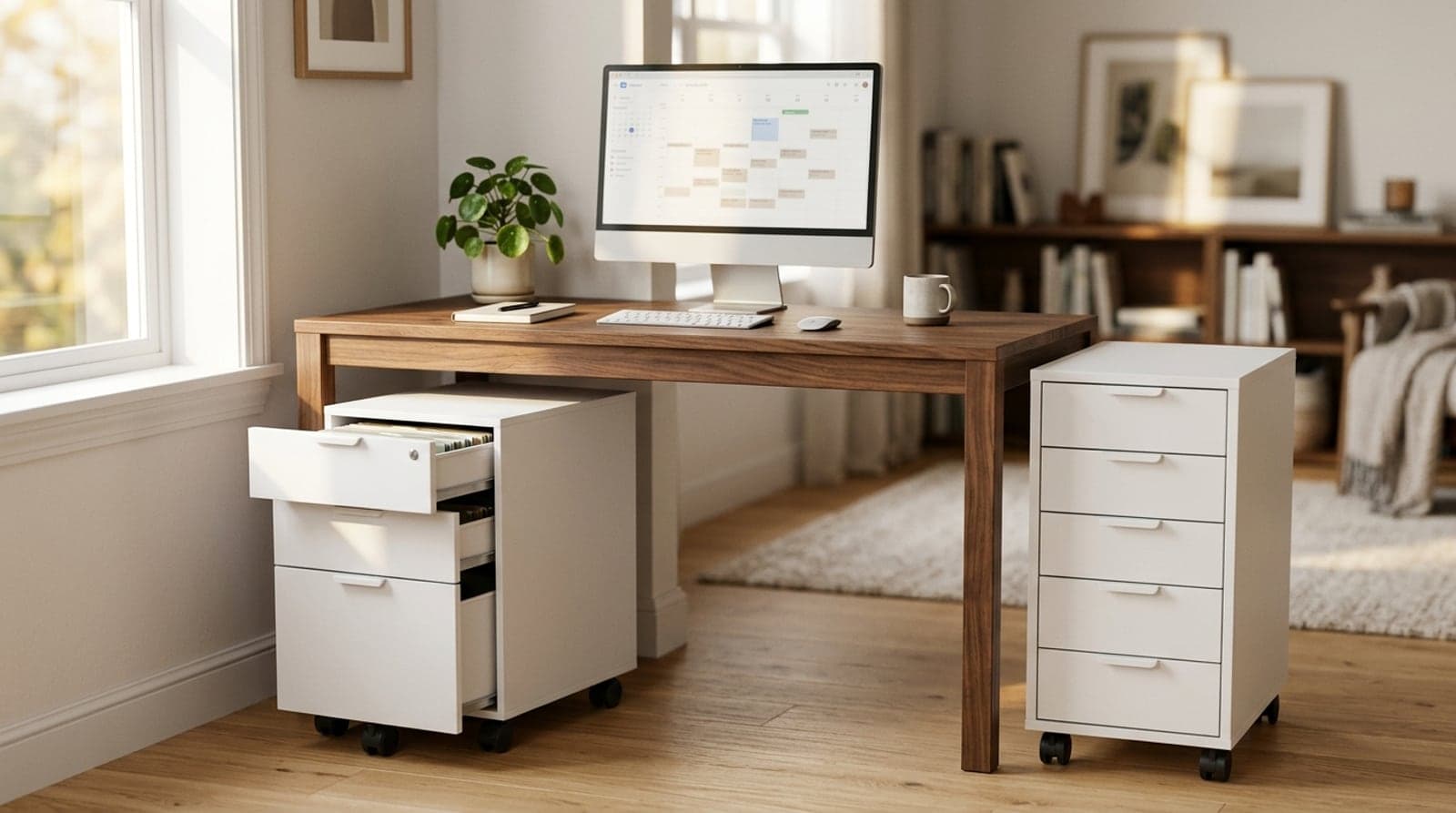
Storage
The Best Mobile File Cabinets and Rolling Storage Carts in 2026
The storage that rolls, not the storage that bolts on. Six mobile file cabinets and drawer carts — locking steel pedestals, laminate drawers, and budget metal — sorted by whether they lock, hold files, and fit under your desk.
Updated August 4, 2026
Storage
The Best Under-Desk Drawers and Mounts in 2026
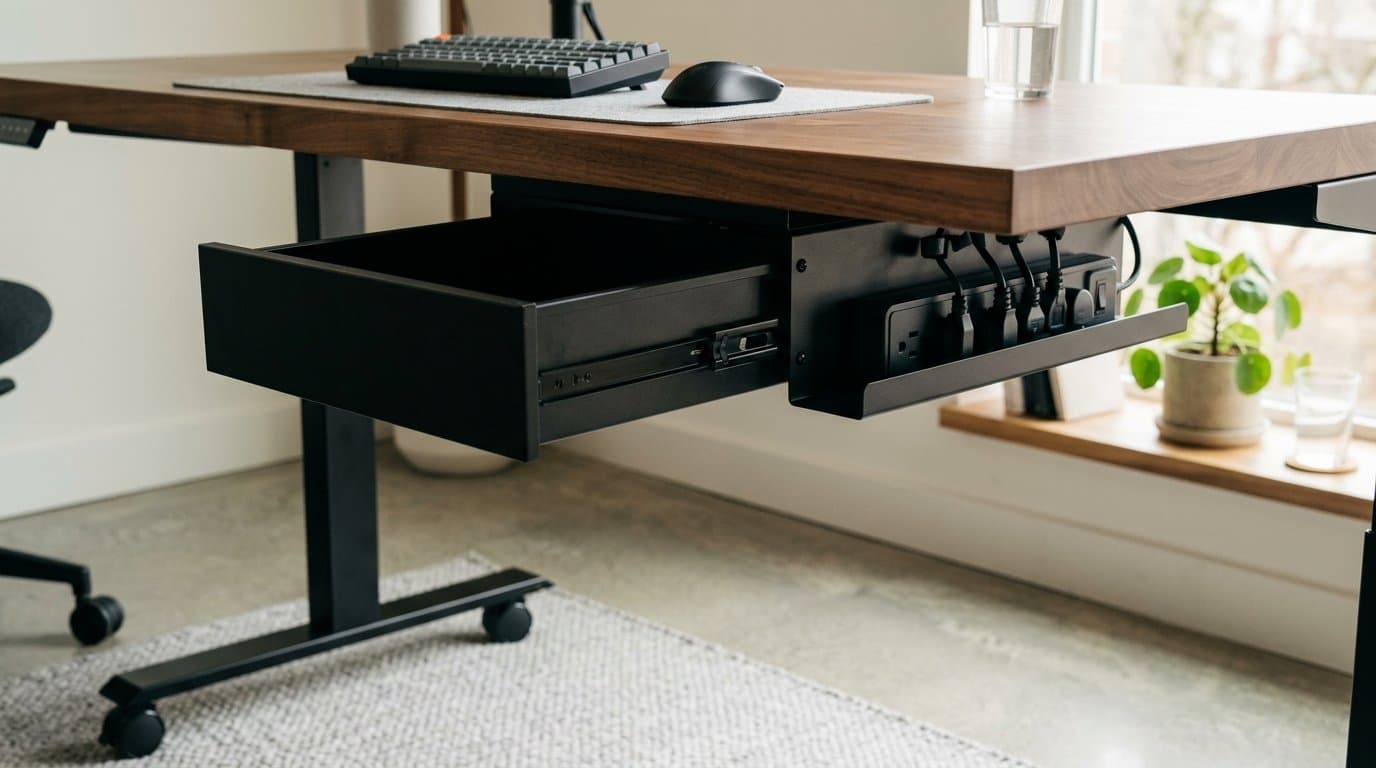
Free your desktop without filling your knee room. Five under-desk storage picks — clamp-on drawers, lockable steel, a keyboard tray with a cubby, and a PC mount — with the install method and the drop below the desktop verified for each.
Updated September 18, 2026
Desks
The Best Under-Desk Keyboard Trays in 2026
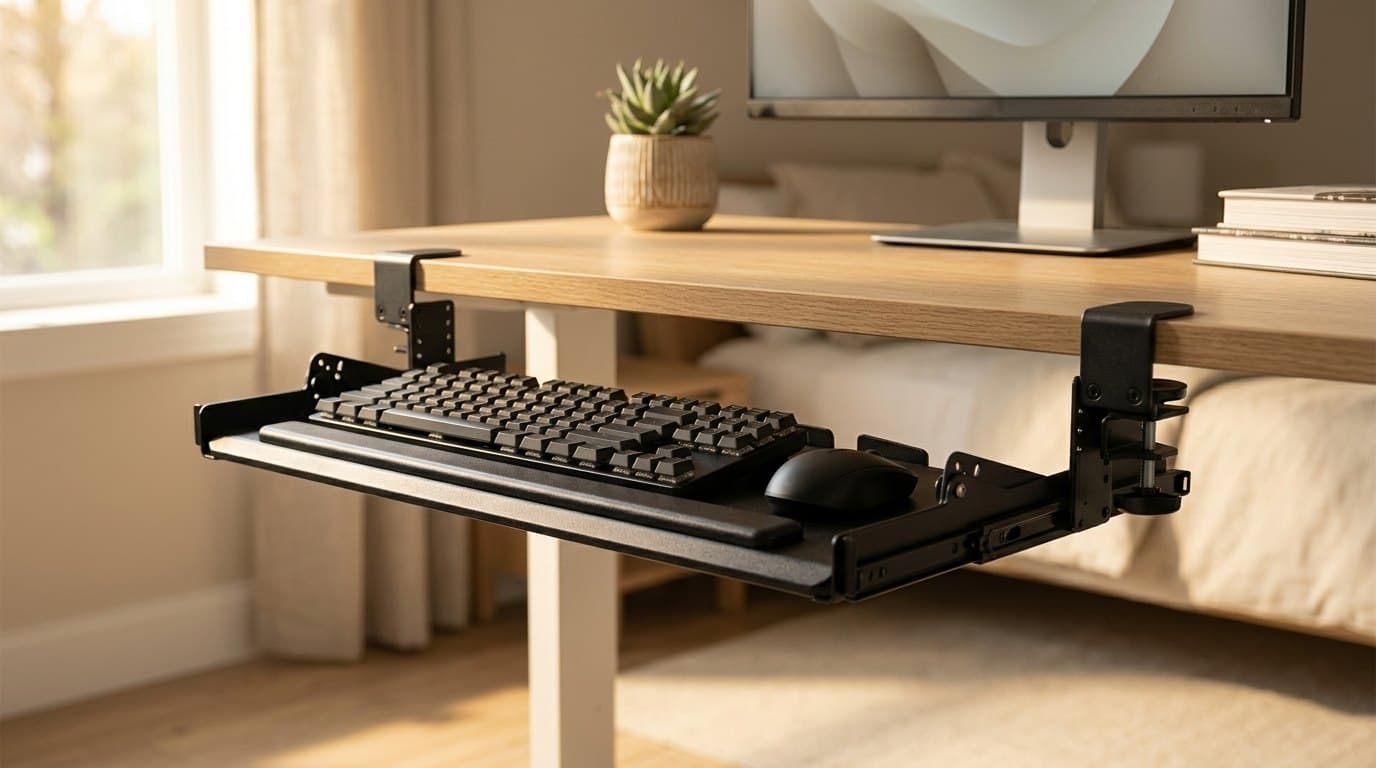
A keyboard tray is a desk-height correction, not an accessory. Six picks compared on the two specs that decide whether one works: how far it drops your hands, and how much clear depth its track needs.
Updated September 13, 2026
Get the next guide in your inbox
One short email when we publish or meaningfully update a buying guide. No spam, no daily deals firehose.